AI is dramatically accelerating AI research
Posted by yurivish 4 hours ago
Comments
Comment by chr15m 1 minute ago
Benchmarks are by definition a curated set of things that can be measured and evaluated.
Things that can be measured and evaluated can be (expensively) trained on.
The progress we are observing comes from figuring out how to measure and evaluate particular aspects of intelligence, and then expensively training on feedback loops made of those exact measurements (literally benchmaxing).
What is not shown in these graphs are the set of things that intelligence can do, which are difficult, expensive or impossible to measure and evaluate.
That set of things is much larger than the set of benchmarks represented in the graph.
Therefore the graph is misleading in the sense that the "superintelligence" being targeted is "jagged" to use Karpathy's term, and we infact already have jagged superintelligence (calculators, compilers, Bayesian spam classifiers, etc.)
We are witnessing a profound explosion of much more jagged superintelligence, restricted to the exact domains that can be (expensively) RL'ed on.
Comment by nsilvestri 2 hours ago
If I had to do my individual tasks without AI, I would be slower. But if I take a step back, I'm really not changing the world any faster than I was before.
Comment by jack_pp 1 hour ago
Comment by LeFantome 1 hour ago
The other place they are amazing is in working with legacy code bases. I mean, the kind the dev team always wants to throw away. First, even if you do want to throw it away, you can first find out what it does and realize it does more than you think it does. You can also create integrations to more modern components which can be used to extend it. You can also create a pretty decent test suite if you do not have one. And, once the behaviour has good test coverage, you can re-write it into something more modern. You can even completely change the architecture while ensuring compatible external behaviour. Remember, this is all in place of “throw it away and start over from scratch, only to discover that the scope is much larger than expected”.
Comment by simonask 16 minutes ago
It’ll still take weeks with AI in the picture, but for some reason management is more willing to plan it when they also have the additional token bills to pay.
Comment by 1123581321 11 minutes ago
Now, you can make enough progress with one developer’s quiet afternoon to be confident and finishing the work also takes less time.
The technical grasp of the legacy codebase was a factor, but often not the largest.
Comment by sick_of_slop 25 minutes ago
Comment by llama_drama 58 minutes ago
Comment by jack_pp 50 minutes ago
Comment by sodapopcan 46 minutes ago
Comment by furyofantares 46 minutes ago
I mean, I have finished more side projects than before. So they do change it. Just not as dramatically.
Comment by anonymous908213 45 minutes ago
Comment by erikus 42 minutes ago
Comment by krapp 37 minutes ago
Comment by jopsen 1 hour ago
At work, they mostly let me increase quality, because it's easy to say find all parsers in my code base and fuzz them.
Comment by rajay99 1 hour ago
Comment by switchbak 1 hour ago
Of course, you can make a giant pile of doggy-doo-doo, but that was always true, just you can now make an epic Giza-sized pile.
Comment by bhelkey 1 hour ago
Could you elaborate? What work are you doing which only exists because of AI?
Comment by soared 1 hour ago
I’m also required to explain how I use AI in my work. I must plan all of my future work, with an AI tool. Another AI assesses whether my work is aligning with planned work.
Before I work and after I work, there is a million circular references that exist solely because of AI. These have scaled because it’s so easy to do with AI, but the we’re wasting so much time doing a ton of extra things very efficiently.
Let me do my job. My manager should know how I’m doing. Maybe highlight key wins. CSATs/etc go out every year.
Comment by ctkhn 57 minutes ago
Comment by switchbak 1 hour ago
This sounds truly Kafkaesque. And thank you for finally allowing me to use that word in earnest.
Comment by LeFantome 1 hour ago
Comment by gerardvschie 34 minutes ago
Imagine developers move faster because of AI programming! No lets create more slop for other slopmachines
Comment by deadbabe 44 minutes ago
Comment by jasondigitized 32 minutes ago
Comment by N7lo4nl34akaoSN 2 hours ago
Comment by gavmor 1 hour ago
It's not that deep—there were many more verticals outside of control plans, and there are now many more verticals outside of machine learning.
Or am I missing the point?
Comment by sejje 2 hours ago
Comment by unrented7977 2 hours ago
Comment by e584 1 hour ago
Comment by cronin101 3 hours ago
Anecdotally it seems like the majority of continued uplift comes from models doing more and exploring more of the search space, and we are getting better at giving them embarrassingly parallel problems to Hoover up with infinite token spend.
Comment by atleastoptimal 2 hours ago
1. Intelligence per dollar spent/token output seems to be increasing rapidly. Opus 4 was $15/75 per million input/output tokens when released. Opus 5.5, which is significantly better, is $4/15. Sure it cost more money upfront to train Opus 5.5, or the bigger model (Fable 5.5) which tuned it, but once it is reached, there are massive diffusive effects.
2. The capital equation is still favoring more spend. Anthropic's revenue is growing rapidly and they are profitable on inference. Huge upfront spend for realized gains later on is standard for R&D. As long as serving the models is profitable and generates more value than the energy/compute consumed
3. The search space is too large to assume that improvement in AI assisted research is just models dumbly trying every combination until something works. For every additional bit searched, the space doubles, so even a trivially small combinatorial exploration incurs prohibitively large costs. Intelligent searching which continuously prunes that space along dimensions of effectiveness is not a trivial skill and is among the emergent accoutrements of these smarter models.
Comment by InsidiousWombat 2 hours ago
But they are essentially fighting for smaller and smaller part of the pie. The better open models are the less you need frontier models, so the frontier AI companies are essentially fighting for market that will shrink the better AI is.
Sure there is inertia and the usual corporate enterprise nonsense of "we only buy stuff from other big companies regardless the cost" that keeps the licenses going but we're quickly getting into point where you don't need any of the frontier models to do majority of the tasks
Comment by calebkaiser 1 hour ago
I mainly think this because frontier labs already try to compete at this tier. For example, 6.1 Sol has identical pricing to Kimi K3.1, but with a lower price per task due to Kimi's verbosity. It seems to score roughly the same on most benchmarks, with some (like Artificial Analysis) putting 6.1 Sol significantly higher. If you need to step down, 6.1 Terra is also cheaper than K3.1 or K3 and performs well relative to their benchmarks. Opus 5.5 and much of Anthropic's recent push seems to confirm this as a major area of focus as well.
I still use a lot of open models and harnesses, but I don't know if cost competitiveness (at least not with the current crop of open models) will ultimately drive a huge chunk of average users away.
Things could change, but fundamentally, large labs aren't precluded from training more cost effective models if there is significant demand for them, which is what we're seeing now.
Comment by LeFantome 1 hour ago
6.1 Sol is not a “frontier model” and does not command the pricing of one. The reason it exists is because of competition from non-frontier models that are “good enough”.
In fact, you kind of made the same argument. As “good enough” models commoditized, the use cases requiring frontier models and frontier model pricing will shrink.
And, even if performance is not as good, many will prefer open models.
Comment by calebkaiser 41 minutes ago
"The better open models are the less you need frontier models, so the frontier AI companies are essentially fighting for market that will shrink the better AI is."
The implication in this is that frontier labs' market is exclusively people who need the absolute frontier, i.e. Astra or Fable. And the point I made was that frontier labs are clearly prioritizing the broader market of people who want more cost effective models, and that if OpenAI/Anthropic offers models that are price competitive with the top open models (before factoring in subscription discounts and corporate lock-in), then I don't see how that leads to the average user walking away from the labs in favor of self-hosting or relying OpenRouter/Together/etc.
I also went out of my way to clarify that I personally prefer and use open models wherever possible. I'm not saying that there isn't a real group of people who prefer them. I'm specifically saying that frontier labs also sell "good enough" models and that there's nothing preventing them from training models to fit the demands of users. It's not as if training a frontier model boxes them in such that they can't release an Opus 5.5 or a 6.1 Terra.
Comment by aleqs 1 hour ago
Comment by calebkaiser 35 minutes ago
I'm just talking about the idea that frontier labs will lose market share to providers that sell open model inference at sub-Fable prices. And I'm not convinced that this specifically is a threat to frontier labs, because they also train and sell models that fit that demand.
Comment by root_axis 2 hours ago
True in theory, but in practice hardware availability and cost will keep open source impractical for years to come.
Comment by dontlikeyoueith 1 hour ago
Comment by aleqs 1 hour ago
Comment by asdfologist 2 hours ago
Comment by atleastoptimal 2 hours ago
Comment by bunderbunder 2 hours ago
I would also like to point out that “profitable on inference” is similarly meaningless, because it’s based on a figure that arbitrarily discards whatever bits of their operating costs they need to to get to the claim that they’re profitable on inference. Potentially including ones that can’t be ignored because they’re every bit as much a part of COGS as the actual inference is.
Comment by rcxdude 1 hour ago
It's going to depend on the task (and this is prone to cheating), but you can get a decent idea by looking at task benchmarks and the cost of completing them.
I was inclined to agree but Anthropic's latest S-1 statement only includes a paper loss due to their value going up. They're objectively making money now, the only question is can they keep it up and can they grow enough to be able to pay the bills they've signed up for in future?
Comment by bunderbunder 1 hour ago
Which is a really important distinction. One measures specific points on the jagged boundary. The other is a word that blithely paints it all with a single brush, and sweeps the jagged boundary problem under the rug in the process.
It really is important to keep track of that. Whenever we talk about “intelligence” as if it were a well-defined (let alone quantifiable) thing, we fall into the kind of wooly thinking that lets anyone say pretty much anything. We abandon the realm of grounded statements in favor of pure vibes.
Comment by rcxdude 38 minutes ago
Comment by pizza234 48 minutes ago
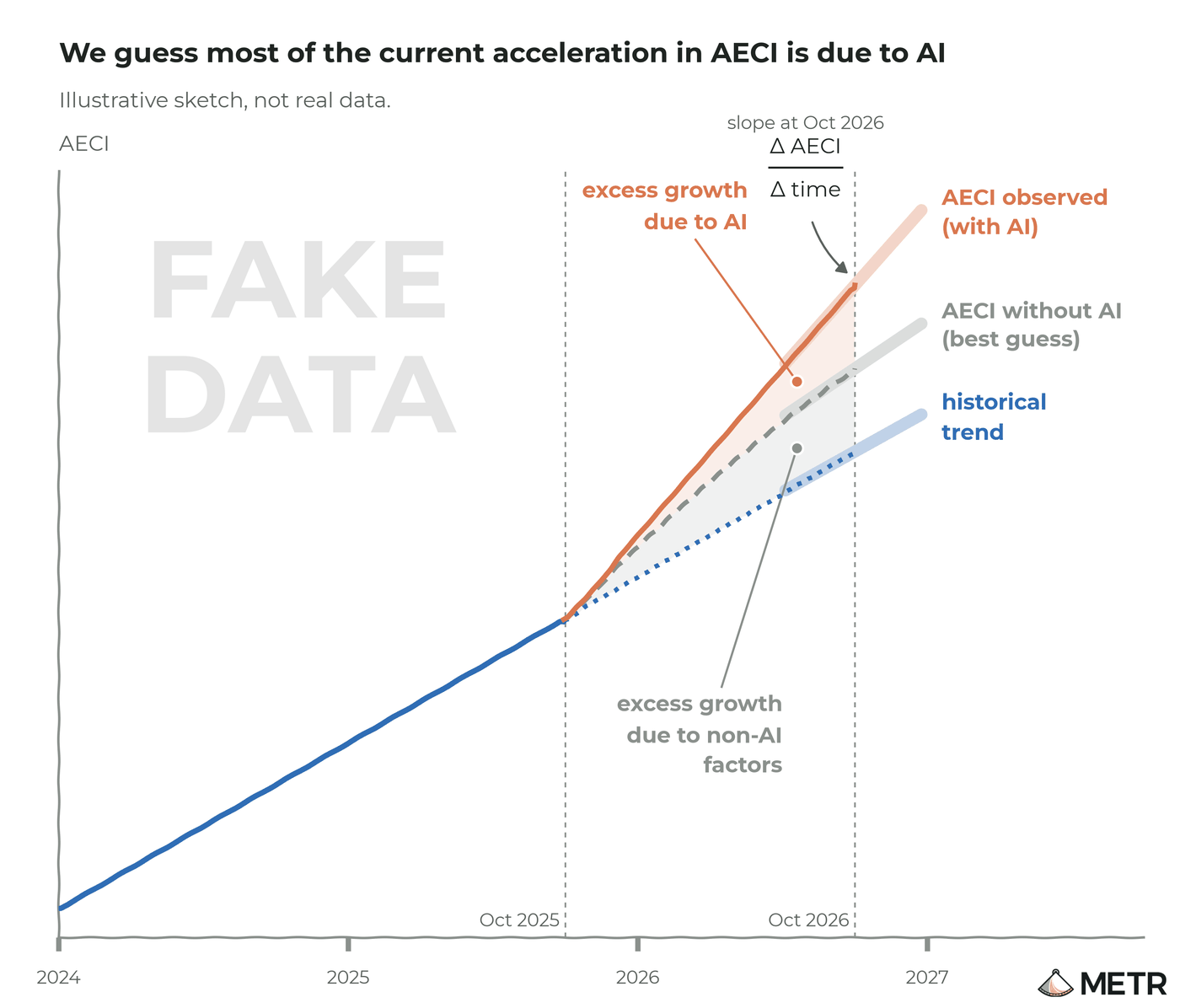
> Anthropic has made roughly two years of historical progress over the last year [...] We are confident that the acceleration was not due to an acceleration in the scaling of training compute.
Note that Anthropic has essentially heavily censored this report, and the authors themselves say "the public has to rely on METR’s judgment much more than would be ideal".
Comment by ctoth 3 hours ago
What information are you trying to either ask for or share with us?
The original article is pretty clear, agent swarms and token spend are AI automating AI, and the RSP attribution condition specifically excludes your capital thrown at training concern?
Comment by cronin101 3 hours ago
Comment by mapontosevenths 2 hours ago
Not at all. Have you tried local AI lately? Qwen 3.8 is legitimately much better than SoTA from 1 year ago (Opus 4.1). You can run it on a consumer GPU.
Qwen Next Flash runs on a DGX spark well and is as good as some things you need datacenter class GPU's to run even today.
Check out Artificial Analysis if you haven't. Sometimes you don't realize how fast these things are moving, but to compare things from a year ago to today is just wild.
They aren't just getting better, they're getting more efficient by many orders of magnitude.
Comment by Zambyte 3 hours ago
I'm not sure I follow. Are you saying a hardware shortage is going to restrict AI development? Because it seems to me like it would just push us towards an even greater focus on efficiency, which is still pushing the Pareto Frontier.
Comment by bunderbunder 2 hours ago
Comment by jmcgough 2 hours ago
Comment by bunderbunder 2 hours ago
But, then as now, what they didn’t have was profits.
Comment by rowanG077 1 hour ago
Comment by throw310822 1 hour ago
Comment by bunderbunder 55 minutes ago
But that didn’t stop the AI winter from coming. Because a technology being transformative does not protect it from over-investment. History perhaps suggests the opposite is true.
Nor did it prevent the AI companies of the 80s from going bankrupt when they got undercut by the commoditization that naturally came with the maturation of the technology.
Comment by bertmuir 40 minutes ago
Comment by GolfPopper 2 hours ago
We're coming up on four years since ChatGPT launched, and the only thing LLMs seem to excel at is the movement of imaginary little green pieces of paper.
Comment by lenerdenator 2 hours ago
We're getting the Claude efficiency talks at work. We're looking at all sort of optimizations, including local models and graphify, to reduce spend. There are people dedicating their nights and weekends to dropping token consumption and cache rebuilding. A few of these will likely catch on and be brought into common use. That will relieve at least a bit of the pressure, and enable some of the scaling to continue.
Comment by ctoth 3 hours ago
Comment by flanz_10 2 hours ago
the same thing you are:
> if I may ask?
asking.
Comment by deepsquirrelnet 2 hours ago
Comment by intenex 1 hour ago
In the original article he noted that getting to a 2x increase in capabilities would be crazy and require ~40x researcher productivity; that’s exactly the increase the new data now shows, and thus a huge number of the assumptions made in this earlier post about how it’s unlikely we would get to this point have literally already been proven wrong less than two months later.
I expect to see an update from Ramez moving substantially more in the direction of RSI in fact very much increasing the odds of reaching ASI soon.
Comment by cloudbonsai 1 hour ago
Given that frontier models are leapfrogging and massive infrastructure buildouts are ongoing, I don’t see why any of these three couldn’t be overcome.
Side note: I’m also curious why people (myself included) don’t seem to be getting much more intelligent as AI becomes widely available. As if humans are bound to the earth, while AI is leaping for Mars.
Comment by yfontana 1 hour ago
The ECI is basically an aggregate of benchmark scores, but benchmark complexity might not increase linearly. In fact, if LLM capabilities grew exponentially, then new benchmarks would also need to increase their difficulty / complexity exponentially to stay unsaturated and relevant.
Comment by RGS1811 2 hours ago
Comment by smlacy 1 hour ago
That is, unless this is saying that automated AI research is going to get us to "smarter models with fewer parameters" and of course, these are faster to train, then I can see how the exponential loop really gets going, but there's certainly an information theoretical limit here?
Comment by theptip 29 minutes ago
That is indeed what we have seen over the last 5 years or so. Algorithmic improvements have made a massive difference to every dimension of efficiency and performance.
AI researchers can do things like discover new attention algorithms to optimize inference efficiency (likely part of why Anthropic and OpenAI are slashing inference costs in their frontier models and no longer capacity crunched).
Comment by __MatrixMan__ 1 hour ago
Getting past this bottleneck is gonna mean training our models not in datacenters, but in places that more closely resemble the ones where we want them to act. A factory, a wet lab, outer space... imagine a million robots spending all day finding every way to fall off the monkey bars so that the next version doesn't.
Comment by joe_the_user 1 hour ago
Comment by jcims 1 hour ago
This combined with ability to massively scale experiments for even (or maybe particularly) the most mundane performance tweaks might just be making the process of improving AI more efficient.
Comment by fooker 2 hours ago
Comment by Tanjreeve 59 minutes ago
Comment by origini 3 hours ago
Im not telling it what to do, i ask it for ar eport/analysis and research and read its article and tell it what to implement based on 'feelings' and it works.
Limit is hardware and tokens and an AI Researcher not having hardware or tokens is probably not what they refer to.
Alone normal researchers were quite handicaped: converting data from tool a to python library x, understanding how tools work, doing basic google research etc.
Comment by 0x20cowboy 3 hours ago
On a more fun note, I also find just trying some hair brained idea is now extremely cheap - so why not? I used to have to weigh up spending a week of effort on something likely not to work and now I can now get spit out test in 20 minutes.
Comment by XenophileJKO 2 hours ago
The agent then works for 20 minutes and comes back with, "Yes this is a problem. Here is the evidence. Here is a golden data set. Finally I built a new evaluation metric and benchmark where we can back test or use for new model experiments to see if we are closing the gap."
Comment by origini 2 hours ago
I always wanted to build a specific event/sequence in one LSD trip into a small game to give that experience some kind of playability.
Then I saw some 4k demo, wanted to see how good it is in doing this.
Its really fun yeah :)
Comment by randomNumber7 1 hour ago
On the other hand I still only get meaningless blabla when I let them write s.th. without telling what is important.
Comment by asdfman123 57 minutes ago
Comment by gwbas1c 2 hours ago
I read it about 20 years ago, and once it got into nanobots and Kurzweil's vision that the whole universe would be intelligent, I didn't find the book credible.
But I'm wondering if the short-term prediction, that in the 2030s we won't be able to anticipate what tech does for us, (IE, the Singularity,) is useful?
Comment by senordevnyc 1 hour ago
Even if he turns out to be a decade or two off, that’s basically exactly correct in the sweep of history sense.
Wild time to be alive.
Comment by ilaksh 1 hour ago
I suspect that part of the reason some people are hoping for that to happen is that they thoroughly mix up AGI and ASI. We do not need some kind of omnipotent god-like super intelligence in order to get much greater than human level capabilities. We are actually almost there in a lot of ways. In some aspects like speed and breadth of knowledge, very superhuman.
What I think is going to happen is that within a few years, maybe 18 months to 5 years, the new materials and compute-in-memory research is going to land in data centers at scale.
That is going to be 10-50+ larger models, 10-50+ faster, much smarter than humans. 50+ less electricity usage.
At some point, it is going to be obvious to people that if we want to maintain control of planet earth then we need to maintain control of AI research to some degree.
Assuming that superintelligence will be benevolent and just.. going for it to me is something that might earn the human species a Darwin award.
Comment by nbvcllllogd 31 minutes ago
Comment by megadragon9 3 hours ago
Comment by bajard 2 hours ago
Comment by ionwake 2 hours ago
Could be from a sandwich that tastes like the best sandwich ever, but is super bad for your cholesterol or something.
I dont know where Im going with this.
Actually did some research I think the term is "Wireheading" from a story/theory from the 50s
Comment by michaelhoney 35 minutes ago
Comment by arthurbrown 1 hour ago
Comment by ImaCake 2 hours ago
Comment by uvesten 35 minutes ago
(Infinite Jest)
Comment by senderista 32 minutes ago
Comment by qahgf 3 hours ago
Comment by yorwba 2 hours ago
Comment by jimbokun 2 hours ago
Comment by gensym 1 hour ago
https://metr.org/assets/images/ai-rd-acceleration-assessment...
Comment by atemerev 2 hours ago
Comment by enraged_camel 56 minutes ago
Comment by matusp 1 hour ago
Comment by amelius 2 hours ago
Comment by 12dk-as 2 hours ago
Mathematicians for example have used it as cope for their current reliance on unsavory corporations, telling themselves "just one more year, and I can solve a millennium problem on my Asus Strix".
Comment by inshard 1 hour ago
Comment by jryan49 41 minutes ago
Comment by mlmonkey 3 hours ago
In my own work, I've found that it's much faster to brainstorm with a frontier model like Opus. I'll have an idea and be able to get a working implementation and try it out on toy problems within O(minutes), instead of O(weeks) earlier.
Comment by usernametaken29 3 hours ago
Comment by jimbokun 2 hours ago
They seem very strongly related to me.
Comment by porridgeraisin 2 hours ago
A lot of great papers by great people had a lot of AI involved and accelerating it of course, but the majority is meaningless (sometimes autoresearch) slop.
Specifically talking about recent neurips/iclr.
Comment by bee_rider 2 hours ago
Comment by lifeisloving 1 hour ago
These people are literally just a public relations operation for the big AI labs. I equate them more with a lobbying firm than I do a research firm.
Comment by azan_ 1 hour ago
Comment by usernametaken29 3 hours ago
Comment by strongwaddle 3 hours ago
Comment by thakoppno 2 hours ago
Comment by lukax 3 hours ago
Comment by tsunamifury 2 hours ago
Comment by rooftopzen 1 hour ago
Comment by binbag 1 hour ago
> we would reach extreme superintelligence within a year
What does infinite capabilities mean? How about putting the growth on a log scale and see how that curve might look?
What the hell is extreme superintelligence?
Comment by rtrgrd 1 hour ago
Since the sequence 6+3+1.5+0.75+... never actually reaches 12 (geometric series), within a year they capabilities would have already been 'doubled' infinitely many times.
Obviously this argument relies on a ton of spherical cow assumptions (and the author does acknowledge this), but i think there overall point is correct that this form of growth (where time horizons compress) is _even faster_ than exponential growth.
Comment by atemerev 2 hours ago
AIs do not kill people, people kill people.
Comment by intenex 1 hour ago
A simple thought experiment - imagine AI discovers a way to make nuclear bombs capable of destroying the entire world radically more cheaply and accessibly with common items anyone can purchase. AI can help anyone build these nukes trivially. Even if the AI and the nukes don’t kill people on their own, do you want literally every human on earth to have this power in their pocket? Do you think it would be a net positive outcome for us vs a world where that’s not the case?
Comment by conartist6 3 hours ago
Comment by brink 2 hours ago
Comment by conartist6 1 hour ago
Comment by jimbokun 2 hours ago
Comment by kennywinker 2 hours ago
Comment by lifeisloving 1 hour ago
I dont think super intelligence will be here in a year, I think within a year AI/llms will have a similar sentiment surrounding them that NFTs do know (it already does for most normies). And most people will be recovering from a hype induced mania they lived in for two years straight.
Of course its more useful than NFTs, but when there's no giant bag to farm these hype monsters will inevitably disappear.
The bags are drying up fortunately and tokens/inference seems to be experiencing deflation, and hardware prices will eventually pop and contribute to further deflation, Then all the bag chasers will move back to crypto or whatever gets hot next.
Comment by hoppp 2 hours ago
Opus 5.5 is so amazing I'm not surprised if it can improve itself.
Comment by spwa4 3 hours ago
Therefore it cannot avoid taxes the way they did before (using shell companies to route the money through tax havens). It'll be expensive, every government will double the price or more, and you're selling to consumers, and the products will be at the mercy of every government where they try to sell AI and other services.
People don't get how serious this is. If AI doubles revenue but drives silicon valley firms' tax rates from 5% to 10%, it's a loss.
Add to that that it's something silicon valley firms have never done before.
Comment by kennywinker 2 hours ago
Would you rather make $1,000,000 and pay $50,000 in taxes, or make $2,000,000 and pay $200,000 in taxes?
Unless you’re terrible at math, i feel like i’m missing something ;)
Comment by leafingensemble 1 hour ago
Comment by asanineassasin 2 hours ago
Comment by mapontosevenths 2 hours ago
That is factually incorrect, and seems to be much of the premise behind the authors way of thinking.
EDIT - No it doesn't. I replied to the wrong post. Mea Culpa.
Comment by hobom 2 hours ago
Comment by mapontosevenths 2 hours ago
Comment by likelybot 3 hours ago
Comment by Emjayen 2 hours ago
Comment by annodomini2019 3 hours ago
After the election, titles like this just irritate me. Every piece written about AI progress is:
"The machines taking jobs, flooding the internet with sludge and poisoning our online experiences, are getting better even faster! Isn't this incredible? Yeah but sorry we also think it's only riskier than ever to deploy these systems at scale. That being said, we're still going to do it, go public and take institutional money from people's retirement funds, destroy the job market, and make 3000 Anthropic employees and 500 investors really rich. There wasn't anything we could do besides write a lot of ink on it and be shocked we lost every local data center referendum."
Comment by reasonableklout 1 hour ago
The author of this article works for METR and not Anthropic, their whole job is supposed to be providing independent oversight on the labs. They are definitely not in the "this is incredible" crowd, they are the ones asking for development and deployment to slow down.