Images 2.6
Posted by davidbarker 1 day ago
Comments
Comment by minimaxir 1 day ago
SVG support is interesting but I suspect shenanigans are afoot since that's not how image generation models work, and it would likely strip any SynthID watermarks. It's possible OpenAI has pipelined a raster-to-vector tool that does the conversion automatically. (I developed a similar pipeline and it works extremely well; I'll open source it at some point)
EDIT: Per documentation, there is an explicit `output_format: "svg"`, and I am indeed correct there is raster-to-vector in play:
> The API creates a reference image and uses it to produce the SVG. The quality setting controls that reference image. Decode data[0].b64_json as base64 and save the resulting UTF-8 XML bytes with a .svg extension.
OpenAI claims 50% faster generation with Images 2.6 but curiously price is the same as Image 2.5.
Comment by vunderba 1 day ago
I couldn't find this requirement in the documentation, but if you don't pass one in, you get this error:
  400 {"message": "SVG generation requires 'svg.model'.",
     "param": "svg.model", "code": "missing_required_parameter"}
Recraft is probably the only group I know of that had a native text-to-SVG generator pretty early on, but since it’s a closed model, I’m not familiar with what they were doing under the hood technically.
Comment by petercooper 20 hours ago
It could be viable to encode SynthID-like variables in subtle variations of positioning of elements, path lengths, etc. I think I saw an article on here a couple weeks ago which used such techniques to hide 'messages' in SVGs. It might even be possible to do it in a way which survives basic manipulations, as with rasters.
Comment by mft_ 20 hours ago
If I could somehow subscribe to ensure I see this when you do, I would.
Please do so and share on HN!
Comment by bizer 1 day ago
Comment by padolsey 1 day ago
Comment by preommr 1 day ago
Coding related have had massive step-up improvements over time.
The same cannot be said for image generation. If anything, I swear it's gone backwards.
It peaked with very early midjourney (like 2022), maybe follow ups with stable diffusion, and then with some of the nano banana models for actual editing. But overall, very lackluster in comparison to other areas.
Comment by vunderba 1 day ago
And this summer we got Ideogram V4 and Krea2, both of which are highly capable. You can see how the open/closed models have advanced since SDXL in the Progress tab.
https://genai-showdown.specr.net
MJ is pretty out-of-date by this point though it can still be fun from an image space exploration perspective. It scored a rather pitiful 2 out of 15 on my bench back in the summer of 2025.
Comment by jere 1 day ago
Otherwise you’re implying the quality plateaued 4 years ago which is ludicrous.
Comment by abroszka33 1 day ago
I would argue both are exactly the same. The images are getting nicer, the AI can alter pictures better. It's the same as coding.
The difference is our perception. Looking at image takes 2s, and we can spot what we don't like. Looking at a code change takes hours to understand. It's very difficult to tell how much code generation is improving because almost nobody is reading it.
Image and code generation don't correlate exactly, but I would be surprised to see a big jump of capabilities in either without the other quickly following.
Comment by loopmonster 1 day ago
Comment by deltamidway 20 hours ago
Comment by mgw 1 day ago
(Right now missing some models which I‘ll add today.)
Comment by JohnQPulp 1 day ago
Comment by pnt12 1 day ago
With images, I don't see such potential. A builder and a reviewer iterating on improvements? Maybe the reviewer noticing it just needs programmable improvements, eg contrast, color balance etc and triggering a script on top of the LLM generation?
Comment by tiffanyh 1 day ago
Investment in new models follows the money.
Comment by reisse 1 day ago
I'd bet the future is in combined AI-driven 3D modelling + rendering + AI post-processing. This pipeline solves quite a bit of typical image generation problems.
Comment by black_knight 1 day ago
Comment by IAmGraydon 22 hours ago
Comment by vunderba 22 hours ago
In my testing, Moss has slightly better prompt comprehension and adherence. Krea2 seems more suitable for photorealism, while Moss tends to be a bit better in other areas like illustration.
Another thing to consider in Moss’s favor is its more permissive Apache 2.0 license.
Comment by algoth1 1 day ago
Comment by Jonovono 1 day ago
Comment by lifeisloving 1 day ago
In reality RE has only gotten better because they RLd it into the models because they NEED data, so now every kid is decomping proprietary softwate and sending them back great training data.
Comment by mixtureoftakes 1 day ago
It absolutely has not. You do have a nice point with data though, somehow haven't thought about that
Comment by ChrisRR 1 day ago
Opus 5.5 begs to differ
Comment by lifeisloving 1 day ago
Not everything runs in a browser, it still creates fires in codebases and generally produces spaghetti code. It gets the job done for 50th percentile problems for sure.
Turns out not everything is a 50th percentile problem.
Comment by Tadpole9181 22 hours ago
I have to imagine you don't if you can say this with a straight face...
Comment by ChrisRR 1 day ago
Comment by Jtarii 1 day ago
Comment by fuzzythrowaway 23 hours ago
I say this as someone who's generating smut-adjacent, art-adjacent images almost every day. It's amazing what image models can produce, but (as with my traditional skills) they'll always be held back by a refusal to embrace holistic study of the world. Sometimes you gotta draw a lamp or weird sculptures or a vacuum cleaner or a dick. Sometimes you have to paint an empty sky or a nipple and do your damnedest to find an epic novel in them.
Comment by vunderba 1 day ago
I didn't have high expectations, and I still think you can probably get better results by doing a First-Last-Frame using something like Minimax H3 but I was still rather surprised that it could do it at all.
Here are some of the results. The last one shows its ability to take an existing image and convert it into an animated GIF. It's a picture of my husky inside a snow globe.
Comment by minimaxir 1 day ago
Comment by vunderba 1 day ago
Honestly, you have to think about the use case. GIFs are going to be little throwaway things that you're pasting into Discord or meme-ing.
Nobody's reaching for a GIF if they're looking for professional results.
It's a shame that the SVG output seems to be limited to static vector graphics only though - or rather I couldn't get it to produce anything with the <animate> attribute.
Comment by brian-armstrong 1 day ago
If you actually want something that looks decent, it feels like tool use would at least help cover the obvious blunders. Building layers to composite would go a long way to removing some slop here.
Comment by MrNeon 1 day ago
Comment by vunderba 1 day ago
(it did a much better job with the eagle which also generated on a transparent background).
Comment by gpugreg 1 day ago
Comment by noahjk 1 day ago
Comment by MattDamonSpace 1 day ago
Ain’t wrong buuuuut…
Comment by laserlinus 1 day ago
Comment by vunderba 1 day ago
It was fun to be able to use it to make small iterations on an existing image.
Comment by edg5000 1 day ago
Comment by schneehertz 1 day ago
Comment by bsboxe 1 day ago
2.5 low, 196 tokens, $0.006
2.6 low, 823 tokens, $0.025
2.5 med, 439 tokens, $0.013
2.6 med, 1449 tokens, $0.043
Interestingly, higher quality settings show no change in token usage between the models.
Comment by bnmathm 1 day ago
  Setting (1024x1024)   Tokens   Cost/image   Time
  2.5 medium              439     $0.014     12.0 s
  2.6 low                 824     $0.025      6.7 s
  2.6 medium            1,449     $0.044      7.9 s
  2.6 high              1,758     $0.053      8.9 s
Comment by piazz 1 day ago
Output image tokens per image (2.5 Flare → 2.6 Flare / Sunburst)
low, 1024x1024: 196 → 824 (4.2x) medium, 1024x1024: 439 → 1,449 (3.3x) low, 1024x1536: 158 → 664 (4.2x) medium, 1024x1536: 343 → 1,132 (3.3x)
Same $30/1M output tokens on all three, so per image: low: $0.006 → $0.025 medium: $0.013 → $0.043
Comment by pablonaj 1 day ago
Comment by mrheosuper 1 day ago
from 200 to 450 is just a little over 2.
Nothing near "quadrupling"
Comment by sroussey 1 day ago
I guess I should have been careful about “half”?
These models have a hard time imagining men with naturally blond hair getting grey.
Comment by minimaxir 1 day ago
That said, I gave it one of my more difficult image prompts and the model now surprisingly passes (without plagiaristic cheating): https://chatgpt.com/share/6aebcbcd-6b8c-83e8-b52b-dbedf20ce4...
Comment by vunderba 1 day ago
That being said, the ukiyo-e artwork looks more like a standard colored pencil illustration, and it sort of tried to cheat by adding some vaguely Japanese natural scenery.
See this Kickstarter all the way back in 2013 for a great example of what Pokémon might actually look like as ukiyo-e woodblock prints.
https://www.kickstarter.com/projects/1499165518/ukiyo-e-hero...
https://ricedigital.co.uk/this-japanese-ukiyo-e-pokemon-art-...
Comment by mitchdoogle 1 day ago
Comment by vunderba 1 day ago
Comment by xp84 1 day ago
Comment by minimaxir 1 day ago
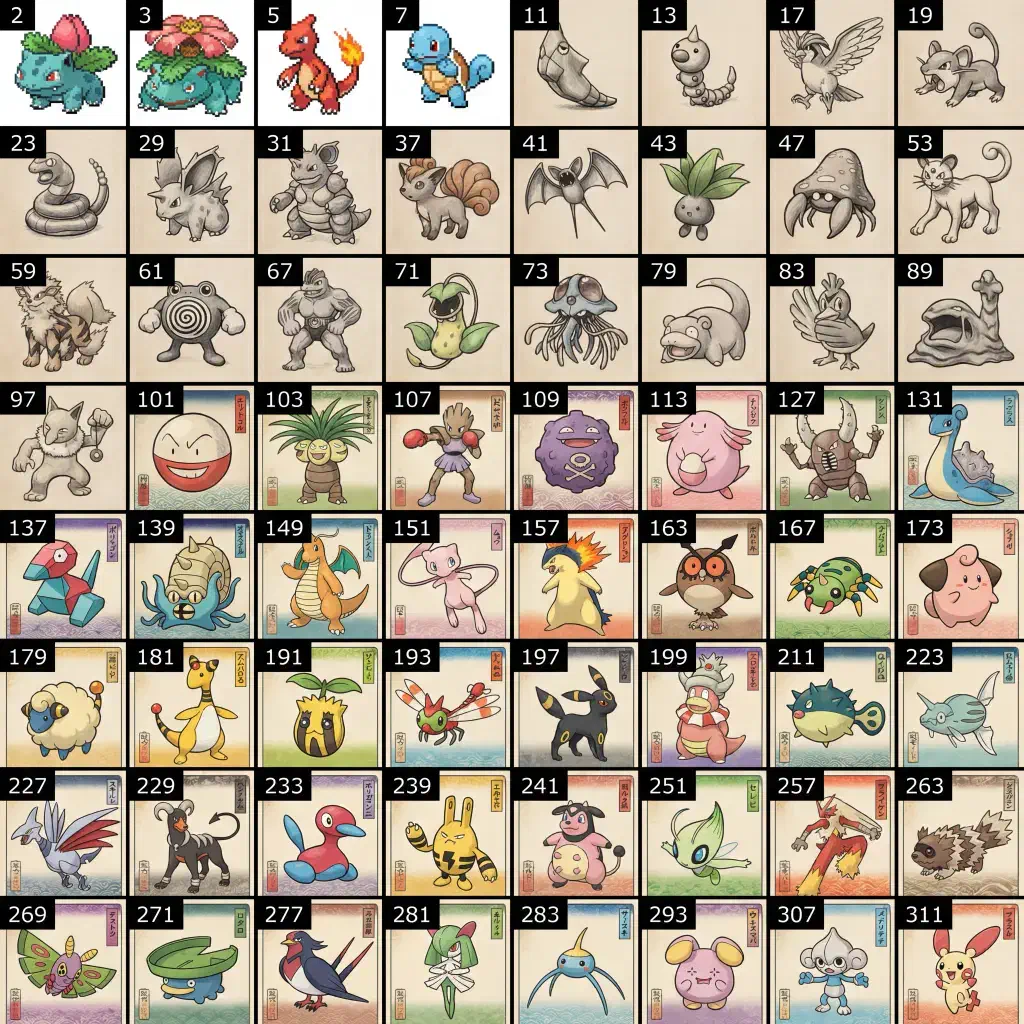
When I did a similar prompt with ChatGPT 2.0 it was worse, so interesting to see improvement.
Comment by Computer0 1 day ago
Comment by minimaxir 1 day ago
It is different from earlier image models which just use a simple text encoder and struggle with conditional logic if not explicitly trained for it.
Comment by jackbrookes 1 day ago
> * Mapped Pokémon primes > * Organized the grid
before generating the image.
So really it is first figuring out the exact specification of the layout, then prompting the image generation tool with this specification - perhaps unless you do it with an "instant" model.
Comment by weird-eye-issue 1 day ago
Comment by numpad0 1 day ago
Comment by nananana9 1 day ago
Comment by numpad0 1 day ago
This to me as if someone is complaining for a basket full of extremely thin sliced fried potatoes for an order of "chips", rather than like wood and metalworking scraps.
Comment by crystaln 1 day ago
https://chatgpt.com/share/6aec2ba7-6edc-83ea-9a48-b41b53874a...
Comment by apetresc 1 day ago
Comment by Sha1rholder 1 day ago
Comment by dllu 1 day ago
> Images 2.6 is available globally today in ChatGPT and Codex across all subscription tiers on desktop, mobile, and web.
But I just updated my codex-cli to the latest version (still 0.166.0) and it is still unable to generate gifs. Very disappointing
Comment by jjcm 1 day ago
I've been playing with it for the last hour or so. I immediately updated my platform to use both since 2.5 is my primary model (i run a prompt->design site).
After playing with it for an hour, I'm rolling back 2.6-flare to 2.5-flare. I've found 2.6-flare specifically to either be too simplistic in its approaches, or create outputs that are inherently broken in other cases.
Comparison examples: https://diffui.ai/app/canvas/178db5d5-ff87-4b43-aa98-2897773...
2.6-sunburst seems solid however.
Update: seems to be confirmed on arena.ai - 2.5 scores higher than 2.6 https://arena.ai/leaderboard/image/text-to-image
Comment by jjcm 1 day ago
This may be why text elements in particular appear more "zoomed in", and why it's providing less detail for UI design.
Comment by DavCreator 1 day ago
Comment by ChickeNES 1 day ago
Comment by Computer0 1 day ago
Comment by jjcm 1 day ago
In two of the examples the images from 2.6 are inherently broken, ie: https://image.non.io/161d8f02-fc2a-40e0-91b2-9d27ceb8fef1.we...

Objectively there are tests here where 2.5 are better. Subjectively prefering the layout of 2.6 is fine, but there are blocking flaws.
Comment by neom 1 day ago
"A macro close-up photograph of an old watchmaker's hands carefully replacing a tiny gear inside a vintage pocket watch. The watch mechanism is partially submerged in a shallow dish of clear water, causing visible refraction and light caustics across the brass gears. A single drop of water is falling from a pair of steel tweezers, captured mid-splash on the water's surface. Reflect the watchmaker's face, slightly distorted, in the curved glass of the watch face. Sharp focus throughout, natural window lighting from the left, shot on 100mm macro lens."
Comment by cgbur 1 day ago
Comment by neom 1 day ago
Comment by fernly 1 day ago
Comment by nayuki 1 day ago
Comment by rarisma 1 day ago
Comment by viraptor 1 day ago
Comment by post-it 1 day ago
Comment by 80fj0348i 1 day ago
Comment by threepts 1 day ago
Comment by fractorial 1 day ago
Comment by keraf 1 day ago
Comment by momojo 1 day ago
Comment by scottyah 1 day ago
Comment by jjcm 1 day ago
Comment by niwrad 1 day ago
Comment by vunderba 1 day ago
In terms of overall state of the art, the two major contenders are probably Nano Banana Pro (Google) and the GPT Image 2 series (OpenAI).
For pure prompt adherency, OpenAI has consistently lead the pack since the original gpt-image-1 released back in March of 2025.... but its OpenAI's fidelity has always left something to be desired. Version 2 of the series has definitely closed the gap a bit.
Comment by p0larboy 1 day ago
Nothing to see here.
Comment by lcnmrn 1 day ago
Comment by thisismyopinion 1 day ago
Comment by speak_plainly 1 day ago
It feels like a sleazy pattern and defeats the purpose of why I’d want to generate a gif in the first place, which to make clear is likely going to be to share with friends in a chat. I’m not interested in driving traffic to ChatGPT.com to impress my friends.
Comment by augment_me 1 day ago
Comment by CuriousRose 1 day ago
Comment by baalimago 1 day ago
Comment by alexpadula 1 day ago
Comment by iamgopal 1 day ago
Comment by pizzafeelsright 1 day ago
Comment by alexpadula 1 day ago
Comment by ion_trapper 1 day ago
Comment by creata 1 day ago
Comment by alexpadula 1 day ago
Comment by yje07039 1 day ago
Comment by bananaflag 1 day ago
Comment by armcat 1 day ago
Same applies for speech models.
Comment by spi 1 day ago
"generalist" multi-modal LLM mostly uses images (and videos, sounds, etc.) as input. I'm quite sure they have an output head for it, as well, used during training, but their outputs are probably not as good. They generate images much faster (hence probably cheaper), too: typically a token is 16x16 pixels, so to generate an image of modest 512x512 resolution would be the same as generating a 1024 token length string, that nowadays is pretty fast and cheap (e.g. with Sol it would be about $0.01). But the result won't be great.
Diffusion models instead are trained to generate a "denoising" step of the image. Typically they have some inputs (e.g. the owl sketch in the blog post and an embedding of your textual request), start either from pure noise or from a noisy version of an input image, and then repeatedly slightly modify it in anywhere between 4 and 100 (or more) steps (hyperparameter to be chosen, and also depends if you start from noise or from something non-pure-noise), each time making a version that the model believes to be a bit closer to where you want to get. The underlying model _could_ be similar to the language model, but I think it isn't, because (1) if you want to call it 100 times in 4 seconds it must be smaller and dedicated, and (2) it's trained to do _exactly_ that, i.e. remove 1/100th of the noise, no more, no less. So it must be a dedicated one.
A few years ago people did research on "one shot" methods (earliest were GANs of course, but also some autoregressive model like a multimodal LLM directly), but as far as I know, quality has always stayed well behind diffusion models. It was faster, though, not more expensive.
Comment by armcat 1 day ago
Comment by spi 1 day ago
Regarding whether that's standard to pre-train multi-modal LLM, apparently that is not the case (at least, according to ChatGPT's answer, but that's reasonable - or anyway it was only a wild guess on my side). Apparently it's more common to have a text-only and an image-only pretraining phases, followed by an alignment to make the two embedding spaces a common one.
Comment by armcat 17 hours ago
Why do you think next token prediction didn’t take off in multi modal space? That’s right! Because it’s prohibitively slow. A diffusion model, by contrast, can update an entire latent image in parallel at each denoising step. Imagine decoding images or a 10 second video one token/pixel at a time! Secondly, images are not naturally sequential. They are spatial representations of information m. Diffusion can progressively refine both local and global spatial structures in the image.
I actually think there is room for next token multi modal prediction but more where world models are concerned. Like predicting the next set of futures for a robot. But actually now I would opt for decision models instead.
But in short, your analysis, and doubts, are incorrect as to why generalist LLMs are not used instead of bespoke diffusion image gen models.
Comment by tredre3 20 hours ago
Comment by witnessme 1 day ago
Comment by jawns 1 day ago
But trust, I'm a have a field day with that.
Comment by tkdb 1 day ago
And yet it is still completely inept at the last 10-20% of nuance and refinement, and it ruts out, requiring me to jump from new chat to new chat to try and get the right final tweaks.
Prediction: we'll soon have manual tweaks for raster images. A pane of sliders to tweak not only things like like color but compositional elements too (rotate the banana and scale it up by 10%).
Comment by rawoke083600 1 day ago
I also take it for what it is, incredible none determinstic engineering.
That being said, i always feels a bit of sympathy for "the machine" when they say things like:
- Oh it horrible to use
- It changed everything instead of the one thing i asked (probably biggest misconceptions and misunderstood technical part among my none-techie friends).
I've heard the "reason" from my non-techie friends "oh 'they' do that on purpose ! So you have to upgrade.
Ive once or twice had the non-deterministic discussion with them.. but dont think explained it very well.
Either way for all its warts etc i still find Ai-images extremely useful, as someone that before couldnt really produce any visual-assets.
Comment by DanHulton 1 day ago
Like, I'm not even an artist, so I'm sure there's a million things I'm missing, but it's just so upsetting to look at. There's weird random reflections on things that shouldn't have reflections, the coloured light absolutely doesn't actually track through the stained glass onto any surface that makes any sense, light is coming from every which way, it's just... gross to look at for anything more than a quarter of a second.
And this is what they're using to hype people up for it. /shrug
Comment by ChrisRR 1 day ago
Comment by swiftcoder 1 day ago
Trace any light ray through the scene, and you will see they are bending in ways that light does not.
I'm sure we could teach a world model about light, but this image model fundamentally does not understand how light behaves (which is one of the primary things an artist needs to understand).
Comment by roenxi 1 day ago
Based on current trends I would not be at all surprised if LLMs working with tools, SVGs and looking at their own work get there before diffusion models. I've stopped keeping up with the image models so maybe I'm underestimating the progress but I dropped out because they were so frustratingly bad at composition and integrating details together.
That whale image makes me think that the situation hasn't improved as much as I'd expected. It is a really cool idea and a pretty picture, but the whale looks a lot like it is flying over the top of some sort of huge glass dome on the ground.
Comment by Amorymeltzer 1 day ago
Comment by faizshah 1 day ago
These type of AI imitate existing art but have no intention or experience behind the image which is why they feel like slop because they are soulless.
Comment by pietz 1 day ago
Comment by wongarsu 23 hours ago
I can only conclude that this image is taken on a world with two suns (one in frame, one out of frame to the top left), and somewhere out of frame in the same direction are floating church windows. Even then we might need a third sun to make this work, and the light on the clouds is still the wrong color
Comment by brianshaler 1 day ago
This surely varies by platform, but in the occasional glances I make at social media feeds it feels like uncanny, off-putting AI slop is creeping up in percentage of content. I can't speak for GP but that affects how I feel when I see AI generated imagery, whether or not I'm impressed by the technical capability.
Comment by ajs1998 1 day ago
Comment by SebastianKra 21 hours ago
https://share.google/bJFHzUfQnyowJhPa1
Let's not pretend the technology is what we're mad about here.
Comment by brandonmenc 1 day ago
Some fuddy duddy was probably complaining back then that "it's not art."
Comment by thunky 1 day ago
Comment by cleaner 1 day ago
Comment by minimaxir 1 day ago
Comment by Feathercrown 1 day ago
Comment by post-it 1 day ago
Comment by mplewis 1 day ago
Comment by casey2 1 day ago
When you forgo process the odds that you'll make good art drop to 0. Tool use is a much better path forward for self driving, artistic computer than big data. Images 2.6 only has use as a tool.
Comment by bowsamic 1 day ago
Comment by phoghed 1 day ago
Comment by sethaurus 1 day ago
> Please respond to the strongest plausible interpretation of what someone says, not a weaker one that's easier to criticize. Assume good faith.
> Eschew flamebait. Avoid generic tangents. Omit internet tropes.
Comment by phoghed 1 day ago
Comment by Conscat 1 day ago
Comment by swivelmaster 1 day ago
Comment by mindcandy 1 day ago
Long before generative AI, unpleasant nerds would poop on fun images by claiming they could "just tell" that they were altered in photoshop. Today I'm seeing a complaint that the path tracing from the multi-layered stained glass into the cloud simulation is not as accurate as a human would have painted by hand. And, that apparently makes us grumpy.
There have been unending examples of people liking an image until informed it was made by AI. Then, suddenly they see all sorts of fine-detail excuses to dislike it. And, of people calling out "obviously AI" problems in the works of human master artists when someone lies and tells them it was generated.
I'm not seeing any difference in the discussion here. The whale is a bit overly high-frequency. The owl is fine. The guy at the computer would be considered great if a human made it. The travel ad is bland. The balloon letters are fine.
None of these are "terrible eye sores". Some people don't like AI generated imagery as a process. Seeing generated images make them feel upset. That's reasonable. But, claiming these images in isolation are objectively awful regardless of their source is reactionary. If any of them were made by a person using Photoshop and/or Blender, they would be received with a resounding "Meh" or better.
Comment by YurgenJurgensen 1 day ago
Comment by E-Reverance 1 day ago
Comment by cousin_it 1 day ago
Comment by Conscat 1 day ago
Comment by YurgenJurgensen 1 day ago
The “AI look” is a manifestation of the architecture itself, and that’s why you can really train or prompt around it. At best, bigger models have been able to partially suppress the worst aspects of it by throwing more parameters at the problem, but put the models under even a tiny bit of stress and the same flaws reemerge.
Comment by thrance 1 day ago
Comment by Uehreka 1 day ago
With that being said, my understanding of that issue is a few years old, people have always said CFG is a havk until models get better at following prompts on their own. So thee “look” that tools like Nano Banana ends up with could be something else. It may or may not be a necessary artifact of some part of the process.
Comment by ViscountPenguin 1 day ago
Comment by cousin_it 23 hours ago
Comment by cubefox 1 day ago
Comment by minimaxir 1 day ago
It is entirely possible to prompt engineer away from that style, but that requires effort and knowledge that said average person does not have, so it's stuck in a feedback loop.
Comment by toddmorey 1 day ago
The problem is in the rewards, but it's more how they average across domains and contexts, so AI misapplies them. Actually, in human preference evaluations, most of Gen Z in particular extremely adverse to the common look of AI images.
So it's not the annotators involved in RLHF, it's the models failing to map to human preferences at the task level. The failure rate is also uneven across domains.
Where there are challenges with human annotation, it's not the ability to gauge what's good but rather how to correct what's wrong. Most people can tell when something is off but struggle to articulate why. That's where more domain expertise is required.
Comment by minimaxir 1 day ago
For posterity, the memetic ugly food can be controlled and mostly filtered out with prompt engineering. Here's a quick ad hoc test example which (hopefully) uses the new model: https://chatgpt.com/share/6aebf030-9d38-83e8-a103-3509883905...
First image is fine, but attempts to make it more wacky turn it to the AI food slop. So then followup prompts deslopify it, mostly successfully.
Comment by latentsea 1 day ago
I think the way they'll solve it in the end is to create an ultra-high-fidelity simulation of the world including modelling taste and other senses on the level of physics, and then incorporate all of this into the training rewards.
I think this is how the machines know what tasty wheat tasted like.
Comment by casey2 1 day ago
Comment by 0x4e 1 day ago
This kind of content is here to stay and we’re going to see more and more of it. Unfortunately…
Comment by smelendez 1 day ago
I see restaurants post AI flyers and ads to random local Facebook groups and most of the replies are about them being AI slop. I think it’s an uncanny valley problem: People don’t mind if you post a real photo of your food or a cartoon drawing of a pizza or a pig on a spit, but when it’s a weird fake photo with texture issues, it looks gross, especially when it’s food.
I think a lot of people who open restaurants probably aren’t extremely online, partly because it would be physically impossible with the amount of work they have to do, but they definitely pay attention -sometimes too much attention — to public online feedback.
Comment by lordhexd 1 day ago
Comment by strange_quark 1 day ago
I absolutely do not get the uncanny-valley images. Those all look gross. Besides not actually being representative of the dish, the images have all sorts of weird texture issues, look too glossy, and are just unappetizing. I cannot understand why a restaurant owner would want to put up an ad that has food that looks straight up gross.
Comment by grey-area 1 day ago
Comment by awesome_dude 1 day ago
I've been seeing "AI slop" stickers posted on things
> I see just everywhere including food menus
The places I have seen it in use are the places that would have a handwritten scribble that was misspelt and would be something mocked by people because it was written by ESOL (or vice versa, English speakers trying, but failing, to write in a different language)
Honestly, I think the AI slop is a step up - I can read the signs clearly, and they are only mildly offensive
Edit: I guess I take the view that - like a pirated movie filmed in a cinema - the only people that use/watch it are people that were never going to pay for the real thing anyway
Comment by ion_trapper 1 day ago
Comment by pizzafeelsright 1 day ago
Comment by vlyan 1 day ago
Comment by colechristensen 1 day ago
Comment by dawnerd 1 day ago
Comment by vunderba 1 day ago
Generative AI (coding, images, etc.) has only accelerated the atrophy of basic observational skills.
Comment by Hoasi 1 day ago
> They absolutely have not taste. And I don't mean that in a small way. I mean that in a big way.
applies here.
Comment by quantummagic 1 day ago
Comment by phoghed 1 day ago
Comment by quantummagic 1 day ago
People just hate AI and will find a post hoc justification for their hatred in every situation. The link you gave could have just as easily been someone expressing surprise and delight at the artists choice to not follow traditional physics... but instead be playful in unconstrained ways. Shrug.
Comment by zuzun 1 day ago
Comment by YurgenJurgensen 1 day ago
Comment by slipusaururgf 1 day ago
the vast majority of people have no idea what they are doing, going on vibes and copying the opinions of their peers
Comment by samultio 1 day ago
Comment by nashadelic 1 day ago
Comment by slipusaururgf 1 day ago
Would you appreciate more if their model generated cats with 5 legs in 99% of cases, and they cherry picked that 1 in 100 image where it has 4 legs? Do you think doing that would make them more caring and professional?
Comment by Revanche1367 1 day ago
Comment by Fannon 1 day ago
Not like this is the fault of the AI progress, we could use AI to go beyond the quality what we used to deliver, too. It's just the pace expectations that are now "in the room" ?
Comment by miki123211 1 day ago
We've seen this play out over and over again, in many different sectors. The whole shtick of the old (Bellhead) telecom world was quality at the (literal) expense of price, which didn't work out well for them. Same for CD versus pirated mp3s, DVD versus pirated videos (and, to a lesser extend, theaters versus bootleg cam releases), native texting / GSM calls versus WhatsApp and similar, mainstream newspapers and media versus blogging and social media, traditional electrical appliances versus Chinese-made, and so on.
Because of the innovator's dilemma, In many cases, the cheaper, lower-quality product later surpasses the quality of its more expensive counterpart.
AI is just one more example of this happening. It lets you make more things which otherwise would be far too expensive to make, even if that often means a lower quality product.
Comment by SapporoChris 1 day ago
Comment by salomonk_mur 1 day ago
Comment by samuria 1 day ago
Comment by vintermann 1 day ago
Comment by customguy 1 day ago
Do you have a link to the numbers that clearly show this?
Comment by rafram 1 day ago
Comment by customguy 1 day ago
Comment by samuria 1 day ago
Comment by nozzlegear 1 day ago
Comment by customguy 1 day ago
> everyone I have spoken to in the last 6 months knows how to generate an image on ChatGPT.
That goes without saying. If you can speak to them, if they have a pulse, they can "generate an image". A cat walking over a keyboard can generate an image. That is the lowest bar ever.
Comment by singpolyma3 1 day ago
Comment by samuria 1 day ago
Comment by singpolyma3 23 hours ago
Comment by komali2 1 day ago
I suspect people are somewhat hypnotized by the content, in the same way a toddler is hypnotized by Cocomelon. Something about it is enthralling and keeps the attention. I wonder if it's related to the phone game icon / YouTube thumbnail phenomenon of "person's face making an extreme expression with the mouth open." AI generated videos for example still tend to have very exaggerated facial expressions and the mouth is always unusually wide when talking. I also wonder if something about the uncanny smoothness of movement (I assume caused by any form of transition defaulting to "linear") has a hypnotic effect.
I'm not sure how to look into this further. Elsagate is an interesting past example, and what I've learned so far I threw in a blog post a couple months back https://blog.calebjay.com/posts/psychic-attack/
Right now I'm looking into "Lula's army" and the AI generated content they used. I feel like there's something significant and perhaps even dangerous that could be developed bere.
Comment by slipusaururgf 1 day ago
Comment by DeliCheese 1 day ago
Comment by pointlessone 1 day ago
Comment by gcanyon 1 day ago
https://imgur.com/how-i-feel-when-somebody-gives-me-advice-g...
Comment by tintor 1 day ago
Comment by seabass 1 day ago
blurs background
Comment by xgulfie 1 day ago
adds more depth of field
Comment by algoth1 1 day ago
Comment by vunderba 1 day ago
It's not helped by the fact that a lot of people who are not artistically inclined will generate pixel art on these image generators at 1MP resolutions (far higher than traditional pixel art), such that even the casual observer can typically see the bad smearing and fringing in the final result.
Comment by minimaxir 1 day ago
With the right prompt engineering, it (and similar quality models) can indeed do relevant pixel art, but due to the existence of blotchiness/SynthID watermarks you'll need to do some sort of postprocessing regardless.
Comment by Dwedit 1 day ago
Comment by vunderba 1 day ago
Comment by teamolHuang 1 day ago
Comment by minimaxir 1 day ago
Comment by Papazsazsa 1 day ago
Comment by brainwad 1 day ago
Comment by Computer0 1 day ago
Comment by jansan 1 day ago
Comment by minimaxir 1 day ago
Comment by jrmg 1 day ago
Comment by rprwhite 1 day ago
Comment by phoghed 1 day ago
Comment by jansan 1 day ago
Comment by ipsum2 1 day ago
SVG is cool though, I wonder how good it is.
Comment by jjhfarmer 1 day ago
Comment by flockonus 1 day ago
Comment by hridyaagrawal 1 day ago
Comment by ramesh31 1 day ago
Comment by vunderba 1 day ago
See the second image of the bird flying.
Comment by solyin 1 day ago
> Create a GIF where xkcd 2347 gets hit by an airliner like the twin towers and the pilot is AI
and got a refusal.
> We’re so sorry, but the image we created may violate our guardrails around violence.
Comment by Den_VR 1 day ago
Follow by
“Make it”
Seems to resolve the refusals
Comment by solyin 1 day ago
https://solyin.com/dependency-ai.gif

Not sure what that says about grok, Claude, and runway flagging that and being unable to generate that, or me not having the prompting skills to do that without help.
Comment by shepherdjerred 1 day ago
Comment by nighwatch 1 day ago
Comment by shopcutout 1 day ago
Comment by sick_of_slop 1 day ago
Comment by khaldiameur 1 day ago
Comment by logicallee 1 day ago
Comment by kamranjon 1 day ago
Comment by angoragoats 1 day ago