Solar surpasses nuclear power globally for first time
Posted by xbmcuser 5 days ago
Comments
Comment by philipkglass 5 days ago
https://ourworldindata.org/electricity-mix
Even though solar power has been a significant part of the energy conversation for decades, the majority of solar growth is very recent. Nuclear power generated 2762 TWh in 2021, when solar generated 1054 TWh. Solar power generated 2779 TWh in 2025.
Comment by silvestrov 5 days ago
Denmark had peak coal early (2003) due to early investments in wind power. Coal is now practically gone.
We might see China get the same shift in electricity source as Denmark had over the past 20 years, just much faster.
Comment by jakobnissen 4 days ago
Put more directly, our numbers look good because Norwegian hydro and Swedish nuclear saves our bacon when our windmills don’t work; China does not have that luxury.
Comment by defrost 4 days ago
Comment by phil21 4 days ago
China would actually have to build stuff to do that. Denmark can just pretend it doesn’t exist.
Comment by overfeed 4 days ago
and they do. Unlike Denmark, China is the world's factory and can use the windfall from exports to fund projects and have them on its balance sheet.
Comment by cycomanic 4 days ago
Comment by ben_w 4 days ago
Of course, both China and Denmark can do much better than me at every level, but like I said, analogy.
* I think theoretically I am allowed to install a wind turbine, but same applies.
Comment by yen223 4 days ago
they already are a major importer of energy
Comment by raffraffraff 4 days ago
Like you say, a lot of countries get a pass because a neighbour invested billions and decades building nuclear. Or else they fall back to coal/gas.
Comment by defrost 4 days ago
Comment by Gud 4 days ago
Comment by defrost 4 days ago
Perhaps I missed that, is there a source link?
Comment by thiisguy 3 days ago
Comment by defrost 3 days ago
Perhaps you'd be kind enough to link to which part of this thread gives that context, as you see it.
Comment by smallerize 4 days ago
China's wind power is at 1,000TWh/year, hydro 1,500 TWh/year, nuclear 326 TWh/year.
(Stats mostly from statbase.org which is a couple years out of date.)
So on the one hand, it's less likely that all of the wind power in China will lull at the same time. Then on the other hand, their hydro and nuclear can't absorb nearly as much % fluctuation. Maybe they could make up the difference with batteries though.
Comment by bobthepanda 4 days ago
Comment by smallerize 4 days ago
Comment by lovemenot 4 days ago
If the former, we may see China's coal consumption fall off a cliff, since the marginal cost of renewables is approximately zero. If so, it'll appear that the coal plants were overbuilt.
Comment by beej71 4 days ago
Comment by csomar 4 days ago
Comment by natmaka 4 days ago
https://ourworldindata.org/grapher/electricity-fossil-renewa...
Comment by defrost 4 days ago
Worthy of note for any readers new to this, electricity generation alone (which this figure is) is but a subset of energy consumption (fuel for transport, energy usage in industry) overall. Further not all human origin greenhouse gases come from energy consumption - coal and other fossil carbon sources are used as raw materials in industry (steel, fertiliser, etc) via processes that bind some of that fossil carbon away from the atmosphere and release a portion to the atmosphere as by product.
There's still work to be done on reduction of fossil carbon source extraction, CO2 capture from industrial processes, and direct CO2 capture from free atmosphere to mitigate the risks of over insulation for future generations.
Comment by seb1204 4 days ago
Comment by ViewTrick1002 4 days ago
It does help a bit with other consumers feeling the price differences and turning down their consumption though.
Swedish, Norwegian and Finnish hydro are doing the heavy lifting.
But Denmark also has enough thermal generation, mostly biofuels, to do without imports. But imported hydro is of course far cheaper.
Comment by AnthonyMouse 4 days ago
Comment by ViewTrick1002 4 days ago
We are already seeing coal plants add storage since they can’t cope with the grid demands, to squeeze a few extra years out of their legacy plants. Thats where nuclear is headed.
And nuclear doesn’t really help with cold spells, huge aircon loads or other strained situations.
Nuclear just pushes up the bottom, leaving everyone else to still solve the hard part.
Comment by AnthonyMouse 4 days ago
The answer is obviously that it delivers when they don't.
Every power plant has to hit a certain average price per kWh, and the ones with a variable operating cost (fossil fuels) also need a minimum price in order to generate right now, since the cost of fuel is a significant part of their costs.
What this means is that nuclear does pretty well in a market with high volatility, because its fuel cost is negligible so it can sell for $0.04/kWh when other supply is available and $1/kWh when it isn't, and end up at a viable average. Meanwhile solar never gets the $1/kWh because the reason the price is that high then is that the sun is down and the batteries are low.
> We are already seeing coal plants add storage since they can’t cope with the grid demands, to squeeze a few extra years out of their legacy plants.
This is just putting a battery storage unit at the site of an existing power plant because it already has a stout grid connection.
> Nuclear just pushes up the bottom, leaving everyone else to still solve the hard part.
Pushing the bottom up during the times when other generation methods have low output does help with the hard part.
Comment by no-name-here 4 days ago
But if we're talking about moving from a model where nukes run ~100% of the time (excluding maintenance) to one where they just cover the 1/x portion of the time that zero-fuel-cost renewables (+ storage) can't, then wouldn't nuke's cost per kwh end up 'x' times higher than before as a result because we still have the same amortized costs split over fewer generating hours per year, and nuke fuel cost is negligible?
Comment by AnthonyMouse 4 days ago
Nobody is talking about doing that. Nuclear plants are baseload. They always run 100% of the time because even if the current price of electricity is low, their incremental cost savings from reducing output is basically zero, so any positive price means they remain at full output.
This means you don't want 100% nuclear generation, because you don't have constant load. If you have 10GW of demand at night and 20GW during the day then you don't want 20GW of nuclear and nothing to do with half of it at night. But having 5 to 10GW is good, because you never need less than that anyway.
The thing people don't seem to have caught onto yet is that the combination of solar being cheap and solar not generating anything at night means that the price at night is going to be higher not just than it is during the day, but than it has been historically, because now whatever you're using to supply power at night -- regardless of what it is -- has to recover most of its capex exclusively at night. That's not great for nuclear but it's even worse for most other things. On top of that, the most competitive real alternative to nuclear there is natural gas, which doesn't work if you want to stop emitting CO2.
Comment by dalyons 4 days ago
(Yes there is a small amount of legacy nuke in California too.)
Comment by fpoling 4 days ago
Comment by dalyons 3 days ago
Comment by expedition32 3 days ago
It Three Mile Island that proved nuclear as a very bad business case- since then the government has completely stepped in.
Comment by no-name-here 4 days ago
So it seems like even if you run nuclear 100% of the time, you’re not going to earn much of anything or may even need to pay the negative rates if you don’t stop feeding into the grid, for a number of hours per day, so I don’t see how you get around having fewer hours per day to cover nuclear’s existing (noticeable) amortized costs?
And the trend line of renewable and storage costs getting cheaper doesn’t seem to be stopping.
Comment by AnthonyMouse 4 days ago
There is a huge difference between prices hitting zero from time to time and the year-long average daytime price being zero. The latter is the thing that would bankrupt solar because that's when all of its generation occurs.
> with storage we’re also already seeing solar cover significant demand even after sunset.
Which is completely expected, because a moderate amount of storage can be used to smooth out time of day misalignment of demand with supply, and it makes sense to charge that with solar during the day whenever it's available. But the thing that's displacing is peaker plants rather than baseload.
> I don’t see how you get around having fewer hours per day to cover
It's not about being exactly 24 hours every day. It's about averaging 20+ hours every day instead of 12, and getting not just all 24 hours but also the higher price for all 24 hours on the days when the output of other generation methods is lower.
Expect that the price per kWh at any given time is inversely correlated with renewable output. What does that do to the profitability of renewables and what does it to do the profitability of something whose output is uncorrelated with renewable output?
Comment by ViewTrick1002 4 days ago
Pretending they can just do “baseload” in 2026 doesn’t work. They can bid negative, but that’s just extending the life of the plant a few extra years.
And you still haven’t been able to explain why consumers should buy ruinously expensive nuclear electricity when cheap renewables or stored renewables are available.
And this is today a purely physical problem. You only need to look to Australia to see grids where rooftop solar today crowds out all other sources, even utility scale renewables. How do you force them to buy ruinously expensive grid based nuclear?
A new nuclear plant only making its money during the night becomes stupidly expensive. And nuclear is hit harder by this than say an open cycle gas turbine running carbon neutral fuels.
Gas turbines are cheap in CAPEX and expensive in OPEX. They can cope with it, although even they have trouble with the sliver of hours left after solar, wind and storage make up the bulk. Since that’s a far slimmer portion than their bread and butter peaking style of operation
Comment by AnthonyMouse 4 days ago
You're kind of answering your own question when you can't call them "cheap stored renewables". Ask yourself why the price is lower in France than in Spain.
"Stored renewables" are fairly expensive even on the days when renewable output is high. When renewable output is low they're not even available because you had no surplus generation to charge the batteries during the day and now the sun is down and they're empty.
> A new nuclear plant only making its money during the night becomes stupidly expensive. And nuclear is hit harder by this than say an open cycle gas turbine running carbon neutral fuels.
A nuclear plant is hit lighter than this than a gas turbine because it still generates during the day. And when your concern is cost, are you aware of what it costs to produce "carbon neutral fuels"? That's original electricity generation cost + fuel production infrastructure cost + conversion losses + fuel storage cost + conversion losses again + capital cost for the rarely used fuel-burning generators. That's the thing that's ruinously expensive.
Comment by natmaka 4 days ago
Because in France a quite high proportion of the very high real total cost of nuclear is paid by the taxpayer.
French ahead: https://makarevitch.com/edfHistorique
Comment by AnthonyMouse 4 days ago
Comment by adrianN 4 days ago
For hydrogen is gas turbines you’re right that the electricity thus produced is rather expensive, but keep in mind that it will only be used a few hundred hours a year. Total system cost can hence still be cheaper than the alternatives.
Comment by AnthonyMouse 4 days ago
The up-front cost of just the battery itself isn't the total cost. You have to add installation, land, time value of money (interest) since you're paying up front for something and then only getting those charge cycles over several years, etc.
Ends up being 10-20c/kWh, and that's on top of what you pay for the electricity to put into it.
Also gets worse the more capacity you want to have, because then you're doing less than a full charge cycle more of the time, which means it takes you longer to do those few thousand cycles, which means you pay more in interest.
Comment by defrost 4 days ago
From (2022): https://www.abc.net.au/news/science/2022-04-05/battery-solar...
Comment by adrianN 3 days ago
Comment by cycomanic 4 days ago
This is where you're wrong. That is the big problem for nuclear in particular. You just can't recover your capex during the night. The night is the low demand time anyway, and you are still competing with wind etc.. Nobody wants to build new nuclear reactors, because it's not economically viable. In fact operators even want to turn off reactors because even their running cost are too high (happened in Sweden, a while ago. IIRC the government wanted to turn it back on for political reasons).
Comment by belorn 4 days ago
Wind has a slight positive correlation to demand, but the storage requirement for wind can be calculated as weeks/months compared to hours for solar.
Sweden also has a free market for electricity without any price roofs. That mean prices can be zero for long periods during the summer when solar is overproducing, but it can also reach over €1 per kw/h during periods of supply shortage. Have the record price for 5 days and have the remaining 360 days free of charge, and you would still end up paying more than if you paid the average cost for a full year (to be fair, in the cheapest of the 4 energy regions).
To add some more aspect for the Swedish energy grid, currently the south of Sweden that is connected to the Danish and German grid are suffering from significant supply shortage. The main power plant to address this is an old Oil power plant that was supposed to exist only as reserve energy, but have since a few years now been running every day throughout the year.
There is construction of more new thermal power plants. The two main strategy to solve the shortage, split along the two political lines, is either nuclear or to combine wind power with power plants burning bio fuel and then carbon capture the emissions (both being technologies with absolutely zero controversies). The later is what is being constructed right now, while nuclear might see construction in the future.
Comment by ViewTrick1002 4 days ago
System studies find that renewable energy systems are cheaper than involving new nuclear in both Denmark and Finland.
The thermal plant you are complain about mothballed one of its two burners last autumn when the contract for firm emergency reserve capacity ended.
The final burner stayed open only with a new emergency reserve contract. Last time I checked it has ran like 50-100 hours per year. Never being called in as emergency reserve, although stepping up to hot standby a few times.
They also reactivated a mothballed CCGT plant in the same region for emergency reserve duties. But that was based on the war in Ukraine and ensuring local preparedness rather than needing the electricity.
Comment by belorn 4 days ago
And if you want to believe a different reality, please convince the political parties in Sweden, Denmark, Finland and so on to replace existing thermal power plants with renewable energy, and to stop construction of new ones! The green party in Sweden went into the election that we had just a few weeks ago on a energy platform that said: Thermal power plants are essential to enable renewable energy and keep prices low. Not even they believe that you can replace thermal power plants with only renewable energy and storage. Their local branch in south of Sweden is part of the coalition that approved and support the current construction of the new thermal power plant, together with the carbon capture plan.
Not that people read sources, but here is the reality check (all naturally in Swedish):
https://www.energinyheter.se/20251021/33900/nytt-varmekraftv... - The construction of the new thermal power plant
https://www.energinyheter.se/20261002/35404/oresundskraft-in... - The addition of carbon capture and storage (CCS)
https://www.mp.se/politik/energi/ and https://www.di.se/debatt/sank-priserna-satsa-pa-fjarr-och-kr... - The Swedish Green Party and their view of thermal power plants
Comment by dns_snek 4 days ago
https://www.sciencedirect.com/science/article/pii/S036054422...
Comment by belorn 3 days ago
> system costs are comprised by overcapacity of the technology itself, electrolysers and hydrogen storage, back-up power, influence on spinning reserve and transmission systems cost.
Green hydrogen storage solution has shown to be much more expensive than what earlier studies predicted, and are still not economical competitive to be used in industries that need the hydrogen itself rather than burning it for electricity.
> Thus, the simulation of, e.g., nuclear power involves back-up-power and peak-load power in order to cover all hourly electricity demands in a least-cost manner
This is an assumption that they don't explore.
> It should be emphasized that all the alternatives have exactly the same use of biomass and they all contribute with carbon for CCU, CCS and biochar to achieve a fully climate neutral society in all sectors including agriculture, industrial processes and LULUCF.
Again, they explicitly claim that all their solutions must burn fuel for electricity.
> The “LC mix biomass restricted” alternative is still comprised by a least-cost combination of offshore wind power (84%), solar PV (13%) and CCGT (3%)
> CCGT and therefore also the least-cost mix either use natural gas or biomethane
CCGT, as is thermal power plants, which is what is exactly what Sweden is constructing and what I linked above. A combination of wind, solar, and burning fuel for power. The difference between LC mix biomass restricted and least cost mix is how much fuel that grid is expected to burn.
Their model of just 3% CCGT do fly a bit against what Denmark is doing. They have over 100% wind capacity, and yet need to import almost 50% of the energy demand. Reducing that imports to 3% seems a bit like wishful thinking.
If the intent was disprove the need for thermal power plants by linking to that study, then the study itself disproves that in no unclear terms. The result of the study is that combining wind, solar and gas is the cheapest strategy to generate electricity.
Comment by dalyons 4 days ago
Comment by SJC_Hacker 4 days ago
Comment by _Microft 4 days ago
Comment by ViewTrick1002 4 days ago
Either way. France is wholly unable to build new nuclear given the outcome of Flamanville 3 and the ruinously expensive proposed subsides for the EPR2 fleet.
While Germany still pays for expensive early renewables. Back before the industry exploded in scale.
The relevant question is where to spend the next 100b to get the most decarbonization the fastest, today.
Comment by no-name-here 4 days ago
I searched wholesale costs - the first result - click 'Monthly' for the easiest view to digest: https://ember-energy.org/data/european-electricity-prices-an...
I also wonder how much of electricity costs in recent years have more to do with things like:
- Did France previously largely pay off the cost of building their old nuclear plants, while Germany has been spending heavily in recent years to majorly change their generation mix and build new generation? I've also heard that even France is now facing some significant challenges with the needed replacement of nukes nearing their retirement age being costly.
- How much of French and German generation buildouts were covered by the gov instead of ratepayers, if any?
However, I haven't researched the above questions.
Comment by bdauvergne 4 days ago
The 100b should be given to France to build its EPR2 fleet and save the italian electrical grid and provide backup to spanish solar production.
Comment by ViewTrick1002 4 days ago
The problem with nuclear is that it doesn’t solve stability. When cold spells hit Europe the French exports turn into imports. So all the French neighbors needs enough backup capacity, generally fossil based today, to both make up for the French exports vanishing, they experiencing the same cold spell, and exporting to France.
Stick two French grids next to each other and they would quickly collapse due to how brittle they are.
Comment by bdauvergne 4 days ago
All renewable are still subsidized now, at all time, without subsidy no renewable would be installed in europe currently, they would be crushed by nuclear production (who can sell at loss event when renewable are available). Most of the modulation of nuclear reactor is cause because nuclear is pushed out of the marked by subsidized renewable would be sold at loss otherwise.
https://analysesetdonnees.rte-france.com/en/electricity-trad...
You can look at the graphs there is no correlation between winter and imports and France mostly export at all time. You are just making things up. Nuclear production does not depend on the weather and the french production is exactly sized for the french consumption. Historically France used hydro as the other pilotable part of its mix (before the pan european electric grid and exchanges at spot price). Don't look at special events since 2020, look at the graphs for the last forty years.
Comment by qlte 4 days ago
But the economics of nuclear vs. renewables have drastically changed with current solar/solar+battery costs (without subsidies) which make it very difficult to justify new construction of nuclear in 2026. Plus, apart from the per megawatt price comparison, the most recent examples of new nuclear projects in the west have been plagued by budget overruns and deadlines repeatedly pushed years into the future.
Huge amounts of new solar/solar+batteries come online every year: it's a boring, proven investment at this point and actively benefiting from the learning curve given the rapid cadence and relatively short timelines for new construction. So your suggestion to give France a huge amount of money for nuclear over renewables, in the hopes that new plants could come online in 5-10 years (likely getting later pushed to 15+ years with individual projects scaled down/cancelled) seems driven more by a sentimental attachment to nuclear than objective weighing of pros/cons.
I get it, I'm a 90s kid and thought nuclear was the absolute coolest thing ever, staring at pictures of glowing pools while growing up and amazed by the idea of entire cities powered by a few semi-trucks worth of rocks. And I do regret that we missed the opportunity to take full advantage of its potential during its heyday. But technology is always changing and with every passing year it becomes increasingly hard to justify new nuclear construction against solar + batteries, both because of raw cost per MW and well known weaknesses not shared by solar.
Comment by bdauvergne 4 days ago
I'm not even speaking about the transport network overhaul needed to integrate so much distributed and uneven production, it's humongous cost still non budgeted by most countries (see the drama about power lines between spain and france), a lot more than the price of 20 new nuclear reactors (want to move 20Gw of intermittent PV power from spain to poland ? good luck).
60% of the newly installed PV are from China and Europe, both zone with an hugely distorted energy market, for different reasons. Europe is victim of Germany political choice to abandon nuclear power and over reaction to climate change (compared to the rest of the world), all their neighbors are angry at them. And China is edging geopolitical risk of being cut of from oil by over-investing in independent energy generation. Japan historically did the same (why did the japan economy not collapse after Fukushima and nearly stopping all their nuclear reactors ? France would have collapsed in the same situation. It did not collapse because knowing they are an island and so cannot rely on neighbors, they had double the needed production as thermal electric power generation, that's why, same situation for Great Britain but they mainly rely on power links to France and Benelux). If PV was such a cheap/easily deployable/marvel technology you would see more development from under-developped countries like in Africa or South-America, or from isolated developed countries like Japan; it's not the case, much come from already highly developed economic zone (EU and China, but not the USA, for contrarian ideological reason, see Trump/Republican/BigOil) which would have no need for it if raw economic calculus was applied (Gernamy would still have nuclear power, Italy too, and the grid would have been developed before deploying new power generation everywhere).
If you are right why is Italy (which does not have the installed industrial migth around nuclear of France) is intending to create new nuclear power generation if PV/wind are ideal ? Are they stupid ?
Comment by cycomanic 4 days ago
Variability and fuel costs have nothing to do with why nuclear is a bad idea. The problem why nuclear is expensive is that all the cost comes from capex, which is huge in comparison to all the other sources (which is also the reason why trying to quickly bring down emissions with nuclear is so fraud). But because they are not variable, nuclear has to accept the price which is set by other sources.
This is actually illustrated by Denmark. They are a net importer of electricity in terms of kWh, but a net exporter in Dollar amounts. In other words their energy mix allows them to export when prices are high and import when prices are low.
Comment by fpoling 4 days ago
Comment by sehansen 3 days ago
Comment by crote 4 days ago
Even that is unlikely. Most nuclear power plants operate with a "strike price": they negotiate a fixed price, and the government makes up the difference between that fixed price and the actual market price.
For example, Hinkley Point C in the UK has negotiated a strike price of about €160/MWh. When the market trades at €100/MWh, the taxpayers will pay them an additional €60/MWh for every unit they produce. To make it even worse: the contract is for every unit they could produce. If the reactor is technically able to generate power but the grid operator, for whatever reason, decides to source it elsewhere, the taxpayers are still on the hook for €160/MWh for every MWh the reactor could've generated but didn't.
The result of this is that reactors aren't turned off when the prices go low and will always be the last to get throttled down. Low grid demand? The expensive reactor will keep running at full blast, it'll be the dirt-cheap solar which gets turned off.
This is why building new nuclear is such a horrible idea from an economic perspective: you are essentially locking in those high power prices for the next ~60 years, no matter what happens. Someone could invent a magical zero-point energy warp drive and provide us with unlimited free power, and we'd still be paying for those nuclear power plants!
Want to build additional nuclear? First convince an investor to take the risk and operate on the free market, don't come begging the government for a giant guaranteed-profit handout.
Comment by fodkodrasz 4 days ago
Guess you just explained how one investor was convinced: the government.
Why? Because governments don't think in quarterly reports and short term profits, but also have to make strategic investments in stability. Ignoring the existence of baseload power needs is classical fallacy of "solar-pilled" westerners with the luxury of having 24/7 power from sources they are willing to ignore. I'm saying this with solar panels on top the house I'm living, and charging an electric car from them.
Solar and wind are not a panacea, and batteries won't solve all power needs, it is the same mindset as outsourcing polluting and humanely taxing industries to China or the third world and acting if we solved environmental or ethics problems, because we can now conveniently nott see them.
If we stop our industry, and civil infrastructure for the night, sure, no need for baseload, just some batteries... wish nobody wants to make a tea, make food, smelt aluminum at night...
Comment by GolfPopper 4 days ago
Looking at the United States government since the end of the Cold War I don't see a lot of "strategic investments in stability" but rather a lot of technically legal bribery to enable short term profits.
Comment by fodkodrasz 4 days ago
Comment by triceratops 4 days ago
The wind doesn't stop blowing at night.
> batteries won't solve all power needs
Citation please.
In 2025 I calculated it would cost only a year of German GDP for batteries to power Germany for 6 months. https://news.ycombinator.com/item?id=45443098
That's an absurd amount of batteries that would never be needed. And batteries have only gotten cheaper since then.
Comment by fodkodrasz 4 days ago
It is still intermittent, not available in such an amount everywhere, also when we take out insane amounts of energy from wind, weather patterns might be effected. Just because we ignored the global effects of mass-deployment of fossil fuel usage,m and are seeing the effects of "negligible amounts" of CO2 released, why should we ignore the effects of other antropocenic effects?
> Citation please. > In 2025 I calculated it would cost only a year of German GDP for batteries to power Germany for 6 months. https://news.ycombinator.com/item?id=45443098
I MADE IT UP, just like you "citing" your earlier HN post :)
Once again, you ignore that if you would make such insane amount of demand, supply couldn't keep up, and the price would definitely be effected.
Energy needs to be transported, stored. You need to solve winter heating, and energy needs of heavy industry, lot of which cannot be intermittently turned on/off and needing insane amounts of energy. Oh, I'm wrong, you can luckily ignore that, as that has been already closed down to the current energy strategy based on your single-minded approach, so we don't need to solve such demand, when it magically disappears. As long as the coffee machines and the macbooks can be powered we are all well.
Also it is not insane amount? For half a year's GDP Hungary gets a nuclear power plant that can power the 30% of the country's energy needs for ~60 years (plus some fuel cost)...
Comment by triceratops 3 days ago
Holy heck. I knew nuclear was expensive but that is absurd. Only 30%? And it's not going to run 60 years with 0 additional maintenance.
Comment by jiggawatts 4 days ago
Solar and wind have been branded as unreliable by propogandists working for billionaire fossil fuel magnates, oil sheiks, and oligarchs.
The converse is true: distributed power generation and storage is incredibly robust and can easily meet the needs of our civilization even under active attack.
If you want long term thinking, if you want robustness over short term profits, then solar + wind + batteries are you answer.
No super power can blockade the sun and wind.
No super power can blow up every rooftop panel without also nuking entire cities.
Comment by nec4b 4 days ago
You should look at some WW2 footage of German cities.
Comment by ViewTrick1002 4 days ago
For that we have energy futures, or just bidding negative, if you don’t want to turn off. But anyone buying the electricity will ask themselves why they should pay a premium for nuclear electricity at the height of summer when the continent is flooded with solar
Here’s an article in Swedish how a reactor was turned off for about a week due to consistently low prices. While another reactor at the same plant was already having maintenance done.
https://www.nyteknik.se/energi/forsmark-2-ur-drift-pa-agarna...
Comment by SJC_Hacker 4 days ago
Comment by ViewTrick1002 4 days ago
You need something with low CAPEX to do that. Which is the complete opposite of nuclear power.
Comment by belorn 4 days ago
Comment by arpinum 4 days ago
Comment by pfdietz 4 days ago
That's a bit cruel, because no such nuclear plant has ever been built and operated, anywhere in the world. :)
Comment by matkoniecz 4 days ago
yes, if magic unlimited free power arrives nuclear will turn out useless
if it will not, then it provides some stability to energy grid and ensures that low polluting, resilient source of power exists
somehow I think that risk of magic unlimited free power appearing is low - and if it appears, then costs of contracted power will be now negligible
personally I prefer to pay a bit more for reduced risk of blackouts
Comment by fpoling 4 days ago
Comment by adrianN 4 days ago
Comment by fpoling 4 days ago
Comment by adrianN 4 days ago
Comment by fpoling 4 days ago
But right now we do not have excessive capacity and smoothing the curve for nuclear allows to burn less coal and natural gas. Essentially right now batteries are killing peaker natural gas plants, not nuclear or coal.
Comment by cycomanic 4 days ago
Comment by AnthonyMouse 4 days ago
Comment by thinkcontext 4 days ago
Comment by AnthonyMouse 4 days ago
Comment by bobthepanda 4 days ago
Nuclear has declined as a share of power being built out in 5 year plans. The projected output of nuclear in 2030 is 100GW vs 2800GW for solar+wind.
Comment by tialaramex 4 days ago
500GW of power at 40% utilisation gets you the same amount of energy as 250GW of power at 80% utilisation, and [roughly] the same CO2 emissions. But 500GW of Solar PV is shadowed effectively by the former where it would not be possible with the latter (without ludicrous amounts of storage). You couldn't choose that in the US or Europe without some kind of sophisticated compensation scheme because it's not profitable, but China does not need to care whether it is profitable only whether it can be done.
I think for places like the US there will be a lot of stranded energy generation and related assets and Capitalism will struggle to make that work even if somebody competent was in charge which of course today they are not.
Comment by AnthonyMouse 4 days ago
"Not profitable" often has a strong correlation with "not efficient".
To begin with, you don't want to be burning coal even 40% of the time. The US generates ~15% of electricity from coal, China ~50%. Coal is the worst for both CO2 and air pollution, significantly worse than even natural gas. It's also worse than natural gas for non-continuous use because gas turbines at least respond quickly to load changes, whereas coal uses steam turbines that respond slowly the same as nuclear. And if you're going to do that in your "command economy" then why aren't you doing it with nuclear instead of coal?
> I think for places like the US there will be a lot of stranded energy generation and related assets and Capitalism will struggle to make that work even if somebody competent was in charge which of course today they are not.
The things that become stranded assets are the fossil fuel (especially coal) power plants, because they aren't viable to operate at times when the price of electricity is below their fuel cost.
It basically means they can't compete with solar during the day (unless it's cloudy and solar isn't available), whereas nuclear can because the negligible fuel cost means it can take any current price as long as it hits a given average price, and it can bring the average up at night. Which means that coal isn't even competitive with nuclear, since nuclear is getting something during the day whereas coal gets nothing, requiring coal to receive an even higher price than nuclear when renewable output is low and then gets out-competed by nuclear.
But the obvious solution to this is to stop burning coal whatsoever. Use nuclear for baseload, solar and wind for cheap variable generation with storage to smooth it out over the course of a day, and hydro or natural gas peaker plants combined with demand pricing to handle extended periods of low renewable output.
In capitalism, coal dies, so why is the "command economy" keeping it alive?
Comment by dmurray 4 days ago
Any solution that doesn't involve everyone agreeing to care about the externalities of coal (air pollution and greenhouse gases) will result in someone continuing to burn a lot of coal.
Comment by AnthonyMouse 4 days ago
Comment by tzs 4 days ago
Comment by AnthonyMouse 4 days ago
Or why they need that amount of coal when they have even more hydro than the US, which is much better at load-following than coal and should have been used to displace coal rather than nuclear.
Comment by tzs 4 days ago
They started way later.
What makes you think hydro displaced nuclear in China?
Comment by AnthonyMouse 4 days ago
Comment by fpoling 4 days ago
EDIT: batteries also help on China scale to throttle coal output much more smoothly and efficiently. Eventually the batteries will kill coal but for the next 5 years in China they are making coal plants cheaper to operate.
Comment by cycomanic 4 days ago
You keep saying that nuclear can keep operating during the day, because of neglible fuel cost. But fuel cost has absolutely nothing to do with any of this. So even we ignore opex, if you have to earn $100 a day to earn back your capex investment, if the price during the day is such that you can sell electricity for $0, yes you can still run your plant, but if prices allow you to only earn $80 during the night, you're still loosing money. So it's still a terrible investment. Calculations get worse if prices go negative during the day (but your plant can't easily be switched off) or if we include opex.
Moreover, other technology like batteries, are on an exponential trajectory. So average price differences between night and day are likely going to drop.
Comment by tzs 4 days ago
Comment by AnthonyMouse 4 days ago
Comment by tzs 4 days ago
Comment by AnthonyMouse 4 days ago
The majority of the electricity they actually generate is from coal.
Comment by tialaramex 4 days ago
My guess is that China sees strength in diversity. More solar yes, and more wind, more nuclear, even more hydro, to the extent that's possible. This has been what they were doing for a decade, but they're now deploying enough that it outpaces their system demand reducing the use of coal.
Comment by triceratops 4 days ago
Comment by cbmuser 4 days ago
Comment by PaulDavisThe1st 4 days ago
Err, no. from the first paragraph of the article:
> The World Nuclear Industry Status Report (WNISR) 2026, overseen by French nuclear energy consultant Mycle Schneider, shows that wind power alone surpassed nuclear generation on a monthly basis in March 2025, followed by solar in April – the first time global monthly solar generation exceeded nuclear output.
> From March 2025 through June 2026, either solar or wind individually generated more electricity than nuclear every month. In March, April and May 2026, both technologies independently surpassed nuclear generation.
Comment by jimbokun 4 days ago
Yep, that’s what exponential growth looks like.
Comment by 59percentmore 4 days ago
More solar asap is definitely a good thing, but we also need to plan for what happens 30-40 years from now when this wave of equipment starts failing.
Comment by maxerickson 4 days ago
Municipalities often have bonkers cost structures and imposed limits on tax increases (limits in state laws and such). Here they are redoing lead service lines, rebuilding substandard water mains and repaving streets. State and Federal grants are paying for a lot of it, along with increases to water rates (to maybe 5-10% above the national average, enough to make people unhappy, but not out of control).
Comment by AnotherGoodName 4 days ago
Comment by dralley 4 days ago
Comment by AnthonyMouse 4 days ago
Comment by Kon5ole 4 days ago
That's a common claim but it's not really correct.
Firstly, the average plant in the US spends it's construction costs every 2-3 years, I assume the situation is similar in the EU. New power plants are much more expensive of course, because the old ones were built before Chernobyl, Fukushima, 9/11 and other incidents that revealed horrible security flaws in existing plants and procedures.
Secondly, the costs of handling Chernobyl are way, way higher than the total cost of construction for all nuclear plants in the EU combined. Similarly the cost of managing Fukushima is way higher than the cost of constructing all the nuclear plants in Japan. These costs are of course never added to the cost of nuclear power, since nobody operating nuclear plants has any chance of paying such sums. But they are in fact a larger factor than the construction costs were.
These experiences did have some effect, thankfully, in that made new power plants more expensive, because we know that we must take any conceivable measure to prevent more Chernobyls and Fukushimas from happening.
And thirdly, the reason why Sweden closed the two most recent reactors was cost, despite them being paid off a long time ago. Meaning there is significant cost even after the construction is paid.
So it seems that the claim that "construction is the main cost" comes from the operator's point of view. Basically "the construction is the largest part WE have to pay, because taxpayers cover the rest".
Comment by AnthonyMouse 4 days ago
It's a common claim because it's correct.
> the average plant in the US spends it's construction costs every 2-3 years
That includes paying principal and interest on the construction loans, right?
> New power plants are much more expensive of course, because the old ones were built before Chernobyl, Fukushima, 9/11 and other incidents that revealed horrible security flaws in existing plants and procedures.
The modern cost increases have nothing to do with actual deficiencies in older US plants. Chernobyl had no containment building and a positive void coefficient. Even the US nuclear power plants build in the 1960s have a containment building and a negative void coefficient.
> Secondly, the costs of handling Chernobyl are way, way higher than the total cost of construction for all nuclear plants in the EU combined.
It's a good thing none of the US nuclear plants have ever been Soviet RBMKs then.
> And thirdly, the reason why Sweden closed the two most recent reactors was cost
The reason was that their electricity prices were very low at the time from a combination of having a large amount of hydro and the then-price of natural gas being low. Most places have no ability to control either of those things. Meanwhile how is the decision to close those reactors looking given how prices are now?
Comment by Kon5ole 4 days ago
One would think! But no, all US plants except Vogtle and Watts are paid off long ago.
Now, why did you just throw that out there without checking? Are you not interested in knowing the truth, you just want to argue for nuclear no matter what the facts say?
If so, let me assure you that neither one of us will enjoy a continued discourse on the topic.
Just have to say though - that the Swedish reactors were closed because electricity was cheap is the point. Sweden basically stated that even when paid off, nuclear can't survive if electricity is cheap. But surely we, the taxpayers and businesses and industries, want it to be cheap?
Comment by AnthonyMouse 4 days ago
Because it can't possibly be (and isn't) an accurate claim for the recent plants with modern construction costs. Whereas if you're comparing the 1970s construction costs to the modern day operating costs to imply that the operating costs are high, that's obviously not a useful comparison to begin with.
> But surely we, the taxpayers and businesses and industries, want it to be cheap?
We might want it to be free, but we also want some other things, like "doesn't burn carbon" and "can reliably heat your house on a cloudy winter night". And then the question is, what's the most economical way to get those things?
Comment by Kon5ole 4 days ago
If we learn that even if we make new nuclear as cheap as old nuclear, it's is still not cheap enough, surely it is a very useful comparison?
It's not useful if the goal is to defend nuclear at all costs, I'll give you that, but that's not a worthy goal.
>And then the question is, what's the most economical way to get those things?
Absolutely, and that's why finding out the real, actual truth of the costs is very important.
If you add the true cost to society from things like Sellafield, Asse II, the interest-free loans, the army personnel and national labs handling waste, the decades of countermeasures for Chernobyl in dozens of countries and so on - if you add upp all that, perhaps generating e-fuel is actually cheaper than nuclear?
If not already, the Chinese have taught us that once you get the wheels rolling, prices decimate pretty rapidly. They made solar and batteries viable, maybe we could do e-fuels?
Synthetic fuel, batteries everywhere, pumped storage, geothermal, gravity, pressurized air, heated salt - maybe all of those are actually cheaper than nuclear, if we really add up ALL the costs of nuclear?
Comment by uecker 4 days ago
Also one correction: It was Germany that get the wheels rolling regarding renewables, although China then took over.
Comment by AnthonyMouse 4 days ago
Only that's not what you're showing at all, because then you're comparing the existing operating costs to a construction cost that was very low. I mean we don't have to try to measure this in hotdogs per football field, the operating cost of US nuclear plants is a published number:
https://www.nei.org/getContentAsset/47fa8caa-9b0d-4029-932c-...
US nuclear plant 2025 operating costs (20.82/MWh) + fuel costs (5.95/MWh) together 26.77/MWh, i.e. 0.02677/kWh. Where would this measure as too high?
> If not already, the Chinese have taught us that once you get the wheels rolling, prices decimate pretty rapidly. They made solar and batteries viable, maybe we could do e-fuels?
They made solar viable during the day and batteries viable during the price spike at the early evening misalignment between demand and solar output. That's actually very useful, but it doesn't get you "how do you reliably power heat pumps to heat your house at night in winter". Proposing e-fuels is basically saying we should use a battery with higher conversion losses. That's inherently going to be complicated and expensive. On top of that it doesn't get you out of solar output being much lower in the winter.
> if we really add up ALL the costs of nuclear?
This is the traditional isolated demand for rigor. Add up all the cost for one thing, don't do it for any of the others.
Solar panels are semiconductors, so if you want to count things like Sellafield or Asse II (neither of which is in the US) against nuclear, don't you then have to count all the Superfund sites left behind from semiconductor manufacturing in Silicon Valley against solar?
And do we even need to enumerate the fossil fuel industries? They're the ones whose pictures are in the dictionary when you look up externalized costs and pollution.
If you want to account for all the costs then account for all the costs.
Comment by Kon5ole 3 days ago
Well, there are a few plants in the US (for example Kewaunee, rancho seco) that were closed for not being profitable. In one instance the owner took an over 300M usd write-off instead of continuing operations. So it measured too high there.
The explanation is likely that the 0.02677 is not the actual total costs of operations. In fact the report states it plainly on page 2: "not the full cost of owning and operating a nuclear plant."
I fully support your idea to identify ALL the costs not just for nuclear, but let's start with nuclear, since that's clearly where the largest misconception exists today.
>Proposing e-fuels is basically saying we should use a battery with higher conversion losses.
Thats dismissive, it is also a basically limitless capacity battery. We already have periods of 0 electricity costs, more electricity than we know what we can do with. This will increase, and having it generate e-fuel would be a nice option for it.
Comment by bigmadshoe 4 days ago
I'm genuinely interested, can you share the numbers you're referencing? It's surprising to me that a massive project like a nuclear reactor costs 1/3 of the inflation-adjusted total construction cost per year in upkeep. I'm not saying you're wrong, just the easy way to prove your point would be to provide some numbers.
Comment by ZeroGravitas 4 days ago
Lazard suggests the low end for new nuclear in the US is 131 per MWH (over a 60-80 year life at 97% capacity factor).
So, assuming that old nuclear cost the same amount as new nuclear that's about 23%. If you assume nuclear is more expensive today, which everyone appears to agree on, then you easily get to 1/3rd of the cost being the marginal cost of running nuclear when the original build is paid off (more if a substantial refit is needed, see France).
Comment by Kon5ole 4 days ago
My statement was based on findings from a few of the plants on this list: https://en.wikipedia.org/wiki/List_of_the_largest_nuclear_po...
Assembling operating costs is tricky, you will have to do some work. I arrived at around 400M USD/year but there is a big span depending on the size of the plant and other things. I also didn't check most of the plants, so I could be way off when all of them are considered but I don't think so. The figure is in the ballpark for some of the EU plants as well.
I did not inflation-adjust the construction costs, since they are not affected by inflation. They were paid "back then", not now. Construction costs are of course affected by interest on the loans, but that's a separate thing from both inflation and the construction costs, and it stops when the loan is paid. Makes sense?
You may feel this is unfair and that the construction costs should be inflation adjusted, but it actually doesn't matter because we have several examples of plants where construction was long-since paid still being closed.
Which means that even with construction costs being 0, plants close because they are too expensive. So why are we thinking construction costs are the key to making nuclear viable?
The best current plants from a running costs perspective are the ones that have several large reactors that produce lots of electricity with shared overhead in staffing etc.
Which makes the current chase for cheaper production by making many small reactors seem particularly misguided. It's not only solving the wrong problem but actually worsening the more important problem.
Comment by seb1204 4 days ago
Comment by crote 4 days ago
At a certain point it just becomes cheaper to build a brand-new one right next to it and decommission the old one, even with a nuclear reactor.
Comment by AnthonyMouse 4 days ago
There are nuclear plants built in the 60s and 70s that are not only still operating but in the process of extending their operating licenses in order to keep operating for decades more. The period of time it takes before this makes "keep operating it" unviable is evidently pushing 80 years without actually hitting the limit.
Control rooms and reactor vessels are themselves made of modular components and a lot of maintenance to those things happens during refueling.
> On top of that it locks you in to an old reactor design, which might be very undesirable for safety reasons.
That can't be the argument against building new ones. It's the argument that what you want is to build the newer, safer designs and then operate those for a long time.
Comment by president_zippy 4 days ago
Comment by 7952 4 days ago
Comment by jeffbee 4 days ago
Your concern would be valid for a nuclear thermal power station, a Goldberg machine with millions of moving parts. It is not really applicable to semiconductors.
Comment by SJC_Hacker 4 days ago
For solar PV it is ~30 years.
While the cell may continue to generate power, it may have diminished so greatly as to no longer justify its physical footprint
Comment by bruce511 4 days ago
So, as a rule of thumb, the solar panel loses approximately 1% per year. So after 30 years it's generating around 70% of rated capacity.
At that (or any earlier or later) point one could replace the panels. That's really cheap to do, and can be done with more-or-less unskilled labor.
If you are space-constrained (like your residential roof) then you'll likely do it earlier.
If you are a commercial producer, sitting in a desert somewhere, it'll likely be better to just "plant another field" next door. Keep the 70% (it's free), and bolster capacity by adding more panels, not replacing old ones.
And this is before we take into account places where the ecology under the panels has changed and become more valuable in its own right.
So 25 years from now, or maybe 10 years from now, it might pay to replace panels. Which may in turn lead to very cheap 75% 2nd hand panels becoming widely available.
Comment by jeffbee 4 days ago
Comment by tuna74 4 days ago
Comment by tialaramex 4 days ago
That 1% finger in the air estimate is what installers or sales people tend to use to give people a vague idea what to expect. Your panels will not make as much power in 25 years as they do today. But because weather happens the hypothetical input power - sunlight falling on the panels, can vary maybe 5% from one year to the next, larger than the degradation in any single year no question. So it's very possible a solar PV roof has its "best" year in year two or three even though that's not intuitive.
Comment by jeffbee 4 days ago
Comment by tialaramex 4 days ago
Comment by jeffbee 4 days ago
Comment by aldonius 3 days ago
Comment by simondotau 4 days ago
Comment by crote 4 days ago
This house of cards obviously falls down when expansion ever slows down. The only solution is to raise the property taxes per yard of road, but that means low-density housing becomes unaffordable, which would force towns to increase density by building things like row houses and apartment buildings.
Solar is in a completely different position, as the solar itself is profitable. There will be no shortage of cash to replace it, only perhaps a shortage of labor. But solar doesn't really have a fixed lifetime and will happily operate a few years longer, and due to its highly distributed nature it doesn't require a risky all-at-once replacement like the Boston Big Dig either.
The global solar rollout is going slow enough that it won't be finished before the first units will reach the end of their economical lifespan. I reckon it'll just shift into ongoing maintenance as time goes on.
Comment by 59percentmore 3 days ago
If you don't spend the profits on other things, which people are liable to do. The point is for there to be some awareness of oncoming costs.
Comment by seb1204 4 days ago
Comment by dyauspitr 4 days ago
Comment by thinkcontext 4 days ago
Comment by hackernud3s 4 days ago
Comment by newtwentysix 4 days ago
Comment by Gibbon1 4 days ago
People usually describe poverty as less than so many dollars a day. But you can consider energy poverty as well. There never was enough supply of oil and gas to lift the majority of humanity out of poverty, but there is enough solar.
Comment by kazinator 3 days ago
Comment by dyauspitr 5 days ago
Comment by cbmuser 4 days ago
Solar just produces when the sun is shining meaning you can’t build a power grid on it.
Just comparing total generation over a year is comparing apples and oranges.
Comment by natmaka 4 days ago
2010: nuclear 76.2% ; renewables 13.6%
2025: nuclear 68.8% ; renewables 26%
https://ourworldindata.org/grapher/electricity-fossil-renewa...
Comment by dalyons 4 days ago
Comment by ZeroGravitas 4 days ago
They appear to accept this as inevitable and are also really angry about it despite it being the greatest economic, technical and political miracle of our age.
Even though their beloved French nuclear grid never got this far, they have convinced themselves that only nuclear can deliver those last 20%.
The whole viewpoint is bizarre and makes no internal logical sense and seem mostly based on hating admitting you were wrong about something.
Comment by Timon3 3 days ago
Comment by simondotau 4 days ago
A kWh isn’t a kWh if one contributes to grid stability and the other relies on it.
Comment by tialaramex 4 days ago
Comment by simondotau 4 days ago
Comment by dalyons 4 days ago
Every kWh hour of solar entering the grid is a kWh of fossil generation that is no longer produced. Batteries just move existing power around. This is not very complicated, I’m not sure why the semantic crusade?
The article is about recorded actual supply contributions over a year, actual kWh, regardless of instantaneous capacity at various times.
Every kWh of produced and accepted(not curtailed) solar power is directly responsible for reducing our emissions
Comment by simondotau 4 days ago
Power is instantaneous. A solar panel doesn't get the same credit for generating electricity when there's already a surplus as it does when that electricity is needed. I don't just mean credit in principle, I mean literal credit. In a functioning market, the marginal value of surplus electricity tends sharply towards zero, potentially becoming negative. Solar generators have almost no marginal cost of production, so there's little reason to expect producers to withhold generation simply because the market price is approaching zero.
Batteries don't just "move existing power around". They can absorb worthless renewable generation that would otherwise have been curtailed, then supply it when the grid would otherwise fall back to coal or gas.
It should also be noted that the remaining solar production doesn't exclusively represent the curtailment of emissions-producing generation. It can also represent the curtailment of other zero emissions sources like wind. Probably not to a significant degree, but I'm sure it's not zero.
A kWh is a kWh in terms of energy. It isn't necessarily a kWh of equivalent economic value, emissions reduction or contribution to grid reliability.
Comment by dalyons 3 days ago
A produced accepted kWh is absolutely equivalent in terms of emissions reduction. It is one to one, over an annual timeframe. One renewable kWh in, one fossil out. This is a record of power actually supplied, not instantaneous capacity or whatever. KW is instantaneous, provided kWh is historical.
I think you’re just making different points about economic value or grid reliability. You’re probably right about those things! You are concerned about the grid integration and reliability of solar, which is fair. And those issues may impact the ability of solar to get higher grid kWh contributions than today.
but these points don’t take away from the facts in the article - that solar produced and this displaced more emissions than nuclear in the last year.
Comment by dalyons 4 days ago
Solar is now displacing more kWh of fossil emissions per year than nukes, despite whatever complaints you may have.
Comment by nntwozz 4 days ago
This I leave to your imagination.
Comment by tim333 4 days ago
Comment by asanineassasin 4 days ago
Comment by gryfft 5 days ago
> Global solar capacity increased by 510 GW to 2,383 GW, up 27% year on year, while wind added a record 159 GW to reach 1,291 GW, an increase of 14%. By comparison, installed nuclear capacity rose by just 1.5 GW to 399.5 GW, while operating nuclear capacity declined by 0.5 GW to 368.6 GW.
> More recent data from IEA PVPS indicate that global PV additions reached around 690 GW in 2025, about 180 GW more than the figure used by WNISR. This suggests the gap between solar and nuclear capacity – and their respective growth rates – was even wider than indicated in the report.
> The report identifies falling battery costs as a potential enabler of continued PV expansion, particularly as grids contend with growing volumes of variable renewable generation and periods of low or negative electricity prices. Grid-scale battery deployment accelerated sharply in 2025, with 104 GW and 257 GWh connected during the year. More than 78% of cumulative battery energy storage system (BESS) capacity was installed between 2023 and 2025.
Comment by embedding-shape 5 days ago
How much of all of that is China vs the rest of world? They seem to just in the last decade or two absolutely exploded when it comes to solar and other renewable energy sources.
Comment by Sayrus 4 days ago
With this being said, Australia, Netherlands and Germany are leading in solar capacity per capita according to https://en.wikipedia.org/wiki/Solar_power_by_country
Comment by crote 4 days ago
If those two are at the top, it means most of the others aren't even trying.
Comment by markus92 4 days ago
I live in Texas now where there's a lot more sun and a lot more electricity usage (though it's cheaper per kwh). Panels and inverters are a significant percentage more expensive due to tariffs and stuff, but that's not even the biggest cost driver. It's the permitting and installation costs that make it so so so much more expensive. If I could get a bunch of panels on my roof for $5k, they'd be there already. But typical costs I'm seeing is low five figures which is well beyond my appetite or electricity costs.
Comment by samat 4 days ago
Comment by actionfromafar 4 days ago
Comment by sushibowl 4 days ago
The subsidy is set to expire next year, however. Although it was extremely successful in getting People to install roof solar, it is a severe adverse incentive for home battery systems (why store your generated power in a battery when you can give it to the grid and get it 100% back for free whenever), and it is making electricity more expensive for those who cannot install solar.
Comment by SapporoChris 4 days ago
https://www.solar-secure.com.au/blog/balancing-heat-and-effi...
Comment by ema 4 days ago
Comment by Symbiote 4 days ago
Comment by bobthepanda 4 days ago
Comment by colechristensen 4 days ago
in other words, local solar irradiance while not of no concern is very often overstated as a concern. the part of the cost which is related to panel count isn't particularly dominant especially in areas with high energy and labor costs
Comment by detourdog 4 days ago
Comment by salynchnew 4 days ago
Comment by expedition32 3 days ago
But look on the bright side solar is not complicated. If America ever changes it's policies they can switch pretty fast.
Comment by throwaway19012 4 days ago
They will probably end up less dependent on oil which is a good thing for them, considering the conflicts this causes
Comment by lurk2 4 days ago
If global solar capacity was 1873 GW in 2025, global wind capacity was 1132 GW, and global nuclear capacity was 398 GW, how could solar and wind have surpassed nuclear in March of 2026 for the first time?
Comment by tialaramex 4 days ago
Multiply them together to make a crude estimate for energy. For a nuclear power plant 95% capacity is attainable, for a big solar farm 20% might be all you could hope for.
Comment by ACCount39 4 days ago
Late is better than never.
Comment by fulafel 4 days ago
Comment by kulahan 4 days ago
Comment by bruce511 4 days ago
The problem with fusion is not technical (although we've not yet solved the technical challenges, which are considerable) but financial/economical.
Let's assume all the physics are sorted out later today. Now all we need is $100 billion to build a demo plant. Because we live in a real world, it will take 10 years before we can break ground.
Probably 5 more years of construction, testing, etc. So your $100b should start earning a return 15 years from now. If all goes well.
And returns should be pretty good. Assuming no great breakthroughs in storage tech between now and then.
Of course, returns will be seasonal, and mostly at night. We can expect solar to supply daytime demand. (Hey, solar is a form of fusion energy as well!)
So yeah, we need $100 billion now, perhaps more later as costs spiral, theres no prospect of a return anytime soon, actual returns are hard to forecast, and frankly life-span of the asset is hard to predict.
All of which is to say that it's unlikely to be privately funded. Govt maybe. Assuming the project survives multiple govt funding rounds. And, of course, being govt funded, timelines will drag and costs will overrun.
Unless of course, well, China. Cost is no object, experienced at getting major stuff built. Fewer delays. Money no object. But even there, why choose fusion when solar is so cheap? What strategic advantage does it hold?
Betting on fusion today means betting that it gets to production faster than storage. Indeed that it beats storage hy 30 years. And that's some bet to make.
Comment by kulahan 2 days ago
The problem with solar is not technical (although we've not yet solved the technical challenges, which are considerable) but financial/economical.
Let's assume all the physics are sorted out later today. Now we need $500 billion to build 15 mines around the world for whatever new magical element we need in massive amounts. Because we live in the real world, this will be fraught with global pushback, because finding the political support today for creating insanely massive mines in favor of hopefully one day breaking even on carbon neutrality is a fool's errand.
Probably 25 more years of litigation, and you should start getting access to mines which would allow you to pollute to insane degrees so we can fight climate change in a century.
I could go on, but you get the point.
Comment by dyauspitr 4 days ago
Comment by crote 4 days ago
Comment by Levitz 4 days ago
Comment by bobthepanda 4 days ago
Individual wind turbines aren’t very big, solar panels get laughably small, and while they are not efficient at their small form factors they are very easy to scale up and down. Nuclear is the exact opposite, representing a very large single point of failure, and even under pre-renewables hard to absorb; some of the first pumped hydro was developed to take excess nuclear capacity because it cannot scale up or down very easily.
Comment by xbmcuser 4 days ago
Comment by cbmuser 4 days ago
Comment by xbmcuser 4 days ago
Comment by bagacrap 4 days ago
You are right that China has structural advantages when it comes to building nuclear, and they are making use of them.
Comment by bobthepanda 3 days ago
By 2030 there is 110GW planned of nuclear and 2800GW of solar and wind.
Comment by dalyons 4 days ago
Comment by tootie 4 days ago
Comment by pydry 4 days ago
Without price anderson act dumping the liability on to taxpayers nobody would build nuclear reactors even at the cost they are.
Comment by cco 4 days ago
Unfortunate, but that's the way the cookie crumbles.
Comment by rebeccapowell 4 days ago
The cost to produce such components that must safely operate in very demanding conditions is prohibitively expensive in comparison to producing a solar panel.
Solar panels will always win because you’ll never have the required demand to mass produce nuclear power station components.
It’s really that simple.
Comment by kulahan 4 days ago
You can also bypass most project overrun concerns if you use already-approved reactors instead of trying to use a brand-new one, but of course this pushes back the schedule for profitability.
Comment by bruce511 4 days ago
Given the current instability of oil prices, where considerably more than 4 countries are producers, it's perhaps dangerous to bet the farm on future fuel supply.
Edit: for reference each reactor consumes about 140 tons of uranium each year, and current production is lower than demand by about 10%.
So if there's a growth in nuclear reactors (which there is, in China alone) I guess we're hoping for an equivalent growth in uranium supply? Do yeah, you're not wrong. Currently nuclear, once built, is very reliable. But equally it has a "single supplier" problem as well.
Comment by ponector 4 days ago
Nuclear is a good technology but not commercially viable.
Comment by pfdietz 4 days ago
It's a shame it wasn't competitive.
Comment by ACCount39 4 days ago
Nuclear isn't uncompetitive due to some inherent technological reason. It's uncompetitive due to overregulation and gold plating.
Solar used to be completely uncompetitive, but improvements in technology and increases in scale made the economics work. Nuclear got kneecapped before that could have a chance of happening.
Comment by Emma_Goldman 4 days ago
Compare a nuclear project to a solar panel. Solar is cheap, simple, commoditised, flexible, and is riding on almost miraculous learning curves. If dispatchable energy can be solved, beyond just gas/coal plants, ideally with long-duration storage based on the conversion of electricity, then this is going to be an infinitely better option. It's also just not clear what role nuclear plants have given that renewables need highly dispatchable power to ramp up and down according to their variable output, not baseload nuclear power.
Comment by triceratops 4 days ago
Is there a study that identifies which regulations are unnecessary and how much removing them would save?
Comment by dalyons 4 days ago
This is an oft repeated point by pro nuclear folk, but it’s not true. There are many regulatory regimes all over the world, and new nuclear is competitive in effectively none of them. Even in single party state china with few regulations , nukes are a declining share of total power every year.
They’re just giant big complex pieces of machinery. With huge ongoing security, insurance and deferred decommissioning costs.
Comment by pfdietz 4 days ago
That's the go-to nuclear apologist argument, but it doesn't hold water. Nuclear is struggling globally, even in China. That points to inherent problems. Regulation also doesn't explain why costs have been so widely underestimated. That's a function of dishonesty of the cost projections, not of regulation.
I'll add that regulation is the price you pay for implicit subsidy like government insurance against accidents. You don't get the latter without the former.
Comment by cbmuser 4 days ago
Nuclear is so competitive that they had to ban it in Germany to get rid of it.
Comment by audunw 4 days ago
France is now on ancient fully depreciated nuclear reactors that are soon in dire need of replacement. Of course it’s cheap. But they have huge investments ahead of them to replace, upgrade, refurbish, etc. They have identified that that need to expand renewable energy to 50% of power generation, at least.
We’ve also seen recently that Germany has had to save France during hot summers when their reactors have had to shut down.
What’s the lesson from France? Build lots of nuclear all at once many decades ago when labor was cheap and then stop investing and letting your infrastructure rot, and you’ll have cheap power for some limited time? Is that something anyone can or should copy today? No.
Now, even VALCOE (value-adjusted LCOE) of wind and solar is coming down well below all other fossil and nuclear alternatives. So how can you say betting on renewables was the wrong at this time? It has been expensive to transition but long term it’s drastically cheaper than everything else. And we haven’t even started getting the benefits of how repowering old renewable power plants is significantly cheaper than building new ones.
Comment by hobo123 4 days ago
Simply not stopping the most modern nuclear plants we had (like Isar 2 in Munich) would have made a nice impact on costs and CO2 emissions.
Building new (nuclear) ones is probably not worth it, though.
Comment by pfdietz 4 days ago
The implication you're trying to draw there is a non sequitur. That situation doesn't contradict what I said. Moreover, France is going to be dragged kicking and screaming into the renewable age because they can't afford to subsidize nuclear builds enough to make a nuclear approach work.
Comment by jl6 5 days ago
We need to accelerate clean energy generation even more so we can replace not just dirty electricity sources but dirty energy sources entirely, and produce synthetic petrochemical feedstocks. Modernity runs on hydrocarbons-as-chemicals, not just hydrocarbons-as-fuels, so despite electrolysis and synthesis being hugely energy inefficient, there is literally no alternative. We just have to brute force it at petascale.
Comment by api 4 days ago
Comment by AnthonyMouse 4 days ago
Comment by thinkcontext 4 days ago
Comment by 7952 4 days ago
Comment by m463 4 days ago
From wikipedia energy density:
  Coal, anthracite... 26–33 MJ/kg
  Natural gas........ 53.6 MJ/kg
  Diesel fuel........ 45.6 MJ/kg

  Plutonium-239...... 83,610,000 MJ/kg
Antimatter......... 89,875,517,874 MJ/kg
or:
In light-water reactors, 1 kg of natural uranium - following a corresponding enrichment and used for power generation - is equivalent to the energy content of nearly 10,000 kg of mineral oil or 14,000 kg of coal.
https://en.wikipedia.org/wiki/Energy_density#Fission_reactor...
Comment by Garlef 3 days ago
Comment by jostmey 4 days ago
Comment by tombert 4 days ago
He then asked "isn't pretty much all power on earth outside of nuclear fission technically done by fusion if we give enough of a delay?". I didn't really have a rebuttal to that.
Comment by ozyschmozy 4 days ago
Comment by tombert 4 days ago
Comment by 3form 4 days ago
Comment by pfdietz 4 days ago
Comment by 3form 3 days ago
Comment by grumbelbart2 4 days ago
Comment by delta_p_delta_x 4 days ago
[1]: https://upload.wikimedia.org/wikipedia/commons/3/31/Nucleosy...

Comment by jfengel 5 days ago
Comment by k__ 5 days ago
What a time to be alive.
Comment by yangm97 4 days ago
Comment by thinkcontext 4 days ago
Comment by tootie 4 days ago
https://spectrum.ieee.org/fervo-cape-station-geothermal
It's still small scale but it's up and running and the site has plenty more capacity that can be added on bit by bit.
Comment by thinkcontext 4 days ago
Comment by dzhiurgis 3 days ago
We have water, decent legal system, safety, talent, infinite power. Could be printing money with datacenter buildouts. Instead in upcoming election good portion of promises is anti-AI.
Comment by gnabgib 3 days ago
Comment by OptionOfT 4 days ago
Comment by AnotherGoodName 4 days ago
A cup of water with salt added doesn't get noticeably warm since there's just not much entropy difference in salt water vs fresh water. These days you can reverse the process at very low electricity cost with reverse osmosis.
Comment by dyauspitr 4 days ago
Comment by dzhiurgis 3 days ago
On grand scheme of pollution, microplastics is basically a fad.
We haven't solved 10 different things that kill us every day. And haven't even started solving 10 another things that is also killing us. After that we can start worry about microplastics.
Comment by PaulDavisThe1st 4 days ago
Comment by Andrex 4 days ago
Comment by tialaramex 4 days ago
Sol ("the Sun") is a ball of hydrogen so ludicrously massive that its own gravity compresses it to the point where nuclear fusion occurs. The fusion produces ludicrous amounts of energy and so in some sense the hydrogen is from our point of view very, very hot, however it's not on fire because fire needs Oxygen and there is none.
Comment by testing22321 4 days ago
Comment by Andrex 3 days ago
I take respite that colloquially what I said is still valid.
Comment by dghughes 5 days ago
Comment by NooneAtAll3 4 days ago
Comment by pfdietz 4 days ago
Given this, and given the apparent failure of Zap's scheme to scale, I don't think fusion has any significant chance of succeeding now.
Comment by NooneAtAll3 4 days ago
if by "now" you mean schedules proposed by all those fusion startups, then you should've known better the moment they became "viral" in a very fake way (same for quantum computers)
for a more serious timeline, ITER is coming online early 30s, add a decade to get to more-than-even tokamak and another decade for something "commercial"
and by then it will be just in time to support operations on the Moon, I guess
Comment by pfdietz 4 days ago
No, I mean the impossible economics of their schemes. For example, the ARC reactor is about 40x the volume and mass of a fission reactor of the same thermal power output. It cannot possibly be competitive as a source of heat with a fission reactor. And fission is not competitive with renewables. So fusion is doubly cursed economically.
Comment by pfdietz 4 days ago
Comment by toomuchtodo 5 days ago
Comment by matheusmoreira 4 days ago
Comment by cbmuser 4 days ago
Comment by Ygg2 4 days ago
Comment by ZeroGravitas 4 days ago
It first lost to PV for daylight generation, then it fell back on storing the heat for use generating after sunset but cheap batteries made that obsolete too.
Comment by pfdietz 4 days ago
Comment by hitekker 3 days ago
It's like arguing about the scoreboard while someone else owns the stadium. Or pretending to have a seat at a table that's (literally) in another country.
Comment by ShadowOfThePit 3 days ago
It doesn't matter, none of it matters. +90% of the world's electric buses are in China. Like what the fuck. The west could do nothing and it wouldn't make a difference. I wonder sometimes why we even bother.
Comment by triceratops 2 days ago
Of course it would make a difference. The "West" (North America and Europe) still emits nearly as much carbon as China. 11 billion tons vs 12.3 billion.
https://ourworldindata.org/grapher/annual-co-emissions-by-re...
Comment by eigenspace 4 days ago
Wind power has been undergoing a very similar rapid fall in cost, and rapid rise in installations, and is a fantastic natural resource (and also one that complements solar almost perfectly!), but it always feels like solar gets 10x the attention and conversation that wind gets.
Comment by lisplist 4 days ago
Comment by dividefuel 4 days ago
Contrasting that with solar, where any surface area receiving direct sunlight doesn't prevent other adjacent areas from also capturing solar.
Comment by eigenspace 4 days ago
For that reason, there is very little reason to build small wind turbines, even if there wasn't a down-stream loss of power from putting too many close together.
Comment by eigenspace 4 days ago
But as I write that, I guess it becomes more clear to me that a personal interest in installing the technology makes one pay more attention to it elsewhere, and promote more conversations about it that get others involved.
Comment by pfdietz 4 days ago
It's because solar gets cheaper faster than wind does. The experience rate is higher.
Comment by eigenspace 4 days ago
Over the last 5-10 years, wind has been learning faster than solar.
Comment by pfdietz 3 days ago
I harp on one of this ideas a lot, Standard Thermal's resistive artificial geothermal idea. Their idea is to use densely packed fix orientation (to reduce mounting cost) panels feeding DC resistive heaters to produce heat that is stored in dirt for 100% availability. The projection here is 600 C heat at $3-5/GJ, which is close to the cost of heat from combustion of Henry Hub natural gas (natural gas at the customer end of the pipeline/distribution network will be considerably more expensive.)
Comment by Rexxar 3 days ago
Comment by eigenspace 3 days ago
Comment by FloatArtifact 4 days ago
Comment by fittingopposite 4 days ago
Comment by matheusmoreira 4 days ago
Comment by fittingopposite 3 days ago
Comment by Retric 4 days ago
The old model of cheap peaking power plants and cheaper base-load power is equivalent to cheap peaking power + cheap but inconsistent green energy. It’s a very complicated optimization problem to work out the optimal mix of locations and quantities to of each, but price signals can help assuming you haven’t completely distorted the market.
Comment by braiamp 4 days ago
Comment by Retric 4 days ago
Chile still wants transmission north south because in the winter solar closer to the equator has longer days and in the winter solar near the poles does.
Comment by braiamp 4 days ago
Oh boy, you are very naive, ain't you? No country will put their energy stability in hands of their neighbors. Or do you see China, Korea, India and Russia interconnect their grids? What other supranational grids you know of?
Comment by Retric 4 days ago
This is a map of where the grid is frequency matched across internal borders allowing easy exchange. DC connections don’t need this synchronization, but it reduces losses with AC. https://en.wikipedia.org/wiki/Continental_Europe_Synchronous...

In war this might be a minor issue, but in war electrical infrastructure ends up a target so it doesn’t matter that much.
Comment by braiamp 4 days ago
Note how there are only 7-8 regional connections spanning multiple countries (counting Europe and North America as one block each). One is there for historical reasons (IPS/UPS, Russia), others for economic integration (post-Soviet) or political affinity. With the exception of one, none are integrated with aggressive countries, and in most cases the distance isn’t far enough for it to become reasonable to do what you think can be done. The US ended up with separate interconnections because a single one proved unstable anyway. Hell, Japan has two networks!
DC links do exist outside those blocks, but they’re bilateral and small. The problem isn’t that it’s technically impossible, it’s that states won’t make their grid reliability depend on a neighbor. Just to point a single case, in 2018 a dispute between Kosovo and Serbia was enough to throw off the frequency of the entire continental European grid. Something being technically possible doesn’t make it practical
Comment by Retric 4 days ago
You may discount England but it’s got enough DC links to move a large fraction of demand.
Japan has two networks for historic reasons, but they can move well over 2% of each grid’s average demand to the other. It’s just significantly less efficient but that’s relatively minor vs the other disadvantages of a split 50hz vs 60hz national grid.
Comment by tills13 4 days ago
Comment by fps-hero 4 days ago
So saying that solar has caught up with nuclear, well that's great, but it's a long way off where it needs to be, and energy storage is even further off again.
At least in Australia, the solar + battery combo has become realisically genuinely competitive against energy costs from the grid for domestic use. At commercial scale, there is still a long way to go.
Comment by chicken-stew 4 days ago
Comment by cbmuser 4 days ago
Comment by triceratops 4 days ago
https://about.bnef.com/insights/clean-transport/china-alread...
Comment by smartmic 5 days ago
And no, there will be better solutions for base load as well. Battery storage, for example. Sure, it’s a transformation, but those who refuse to think for the future can see the consequences of stubbornness and backward-looking attitudes today.
Comment by Aboutplants 5 days ago
Comment by toomuchtodo 5 days ago
Comment by gcheong 4 days ago
https://www.statista.com/chart/33754/countries-with-the-larg...
https://www.techpolicy.press/us-critical-mineral-aggression-...
Battery storage is only a solution if you can actually generate a surplus of energy that can be stored, which is not a given.
We absolutely need to move off of fossil fuels but thinking that renewables are the only solution seems very short-sighted to me.
Comment by crote 4 days ago
Take lithium batteries, for example. They were attractive for early BEVs because the consumer electronics market already developed an industry for them, and they were attractive for early grid storage because the BEVs scaled that industry up. But that doesn't mean you have to use lithium for grid storage, and when push comes to shove we could also use sodium-ion batteries, or iron redox flow batteries.
If your country no longer has access to iron and salt, I reckon you have bigger things to worry about.
Comment by gcheong 4 days ago
Comment by dalyons 4 days ago
Comment by drysine 4 days ago
Comment by Gareth321 4 days ago
Comment by defrost 4 days ago
Other papers exist with a different opinion (eg: Australia's more recent CSIRO energy report finds nuclear not providing bang for the buck in the Australian market)
Further, despite claiming Level Full System Costs, there's no factoring in for externalities - eg: climate costs of dragging out fossil fuels while waiting for nuclear to come online, political costs of being steadily reliant on outside countries for fuel and supply (cost of gas to non gas nations, etc).
There are other issues - it's a paper with an opinion - not the foundational rock you want to base strong assertions on, as you did.
Comment by Gareth321 4 days ago
The ERCOT LFSCOE-95 scenario assumes another generation source supplies the remaining 5% of demand. Even then, wind and solar cost $97/MWh versus $32 for gas. And in Germany, the same model gives $220/MWh for wind and solar, $90 for nuclear and $31 for gas. So even your preferred scenario doesn’t support the conclusion you’re drawing.
Dismissing a peer-reviewed paper published in Energy because it’s four years old is particularly weak when you haven’t demonstrated which assumptions are invalid or how newer data overturn its conclusions.
And here’s a May 2026 peer-reviewed ERCOT study using detailed hourly dispatch modelling. It found that a more renewables-heavy electricity mix increased average costs by 12.1% relative to the alternative:
https://www.mdpi.com/1996-1073/19/9/2195
As for externalities, those are legitimate additional costs to quantify, not an excuse to pretend that intermittency, storage, backup capacity and grid integration are free.
Calling a quantitative study an “opinion” while offering little more than your own opinion is rather ironic.
Comment by jdlshore 4 days ago
Comment by Gareth321 4 days ago
Comment by layer8 4 days ago
Comment by tonfa 4 days ago
Comment by jillesvangurp 4 days ago
The fallacy here is counting barrels of oil, shipments of coal, or whatever and assuming it needs to be replaced 1:1 by what used to be called alternative energy to get the same useful energy. But of course with electrified systems, the losses from generation to use are a lot less. Things like wires and transformers have their own inefficiencies of course. But the numbers are pretty good. You end up with 80-90% useful energy. As opposed to 30-40% for typical fossil fuel plants. And far less for any combustion engine vehicles.
It's called the primary energy fallacy. As Michael Liebreich suggests, there are people using this term that genuinely don't get it. And there are those using it intentionally that do. But the bottom line is that their math tends to be off by about 3-5x.
Comment by pzo 4 days ago
Comment by xbmcuser 4 days ago
Comment by triceratops 4 days ago
40% of all global shipping is used for fossil fuels. [1]
10% of the energy in a barrel of crude oil is used to refine it. [2]
I'm not even counting the energy cost of crude oil extraction, pipeline leaks, hauling gasoline, diesel and LPG to its final destination, or the million other places where energy is lost.
1. https://cleantechnica.com/2026/06/16/shipping-freight-energy...
2. https://autoexpert.com.au/posts/the-energy-cost-of-petrol-pr...
Comment by layer8 4 days ago
Comment by crote 4 days ago
"One-third done" sounds an awful lot like we're going to start seeing optimistic "we'll be halfway there at the end of the decade" headlines soon...
[0]: Things like the grid and car batteries don't operate at 100% but closer to 95%, but things like heat pumps operate at 300% efficiency, so I reckon that'll more-or-less cancel out for back-of-the-napkin math.
Comment by tonfa 4 days ago
Comment by esarbe 4 days ago
Comment by cbmuser 4 days ago
Comment by esarbe 3 days ago
So of course this didn't change in the 30 years following 1980, right?
Comment by pzo 4 days ago
Comment by cbmuser 4 days ago
Comment by t_tsonev 4 days ago
Comment by fittingopposite 4 days ago
Comment by slfnflctd 4 days ago
In the really long run that's of course true, but in the nearer term we are not going to have a replacement for jet fuel any time soon. So, for example, I personally would not speculate financially on this expectation quite yet.
Comment by fittingopposite 3 days ago
Comment by FloatArtifact 4 days ago
Comment by chickenbig 4 days ago
Comment by ninalanyon 4 days ago
Comment by cbmuser 4 days ago
Comment by ninalanyon 4 days ago
Comment by solarpunk_enthu 4 days ago
That does not negate the celebration of solar generation growth, but we should consider that nuclear did not have as much enthusiasm and investment as solar did in the recent decades.
Comment by hinkley 4 days ago
Meanwhile once you’ve installed 10% of a solar project, the rest of the project is almost exactly the same, and you can ramp up or ramp down the size of the final build as you go and capital either becomes constrained or part of the build goes online and starts subsidizing the rest. Your experts have journeymen under them that can start taking on more work allowing the throughput to increase.
How Big Projects Get Done talks about how roads, solar and wind all have this property, and most special projects don’t, which leads to either massive cost overruns or dead projects.
Comment by pfdietz 4 days ago
Comment by syngrog66 4 days ago
Comment by Gud 4 days ago
Please remind me how my native country Sweden could build so many reactors for cheap in the 70s? Because to me it is evident that political decisions have killed European(and American) nuclear industry, thus creating this catch 22 where making new nuclear power is expensive because how expensive it is...
Nuclear power has been an outstanding success for Sweden, despite the irrational pushback. It could have been an even greater success...
Comment by AngryData 4 days ago
Comment by bdauvergne 4 days ago
Comment by pfdietz 4 days ago
Comment by cbmuser 4 days ago
There is a reason even Germany is still heavily dependent on coal despite investing hundreds of billions into renewables
It simply does not work without dispatchable energy sources.
Comment by otherme123 4 days ago
Germany still uses coal, but I wouldn't say they are heavily dependent. They consume ~100TWh per year of coal (20% of total), down from ~300TWh in 2015 (50% of total). They plan to close them all by 2038, and they are on the way to do so even before that.
But coal is a political problem because the are producers, thus a good chunk of voters work in that industry. Political parties that promise to keep coal running could still get many votes.
Comment by pfdietz 4 days ago
Your argument about Germany is obviously BS, basically "it didn't happen yet therefore it can't happen". Solutions must apparently leap fully implemented into the world or else they are impossible, by your logic. Do you apply the same logic to nuclear, since no country gets the majority of its energy from nuclear (not even France)?
Storage can be dispatched, you know (and it's not just batteries.)
Comment by bdauvergne 4 days ago
Comment by pfdietz 4 days ago
> All western civilization is built on 24/24 7/7 available energy (from direct use of petroleum or electricity).
Petroleum != electricity. You were talking about more than just electrical power. No goal post shifting!
Comment by bdauvergne 4 days ago
But it's a lots slower than newly added power generation by renewables so there are market distortions (cheap uneconomical electric power from renewables is wasting investment in nuclear for example, just stupid) so we have economic warfare between germany and all its producing neighbors (see France/Scandinavia) for example.
Comment by pfdietz 4 days ago
You said "a civilization". Is that not a global concept? But regardless, there is no country which gets the majority of its energy from nuclear.
Comment by goodpoint 4 days ago
Comment by tdhz77 4 days ago
Comment by president_zippy 4 days ago
Comment by mitxela 4 days ago
Comment by mhh__ 5 days ago
The one thing I really wish people would take away from thinking about energy / grid composition and so on is that its a portfolio construction problem.
If you ever, ever, see anyone banging on about how expensive or cheap a particularly type of generation is please just write them off as either an idiot or a liar - what matters is the cost of constructing a portfolio of electricity production that meets the requirements of a nation e.g. running an industrial economy solely off solar power is probably impossible but it seems realistic to imagine a "modern" (politics aside) economy that runs off sending emails on a mixture of solar power and storage.
Comment by Joel_Mckay 5 days ago
However, the upfront cost of Full-sized Fission power facilities are often still around 1/2 to 1/3 the end user $/kWh. The issues arise with the long term waste stewardship costs, and the cognitive disconnect people can engineer their way out of the liabilities.
Now that "AI" data-centers are acting like a public infrastructure equity siphon, in some places private solar can have a payback period measured in under a few years. =3
Comment by yxhuvud 5 days ago
Comment by __MatrixMan__ 4 days ago
So if you get tired of banging the energy cost drum, consider a fill or two on the adversarial resilience drum.
Or if you prefer, consider resilience in the face of a heat wave. The fear that maybe the power will go out mid-disaster... it's just not actionable. That changes with a distributed system: you can channel it into making sure your house's or your neighborhood's battery is up to the task.
Comment by yangm97 4 days ago
Unless you make rooftop solar + batteries with variable rate accessible for everyone (like Australia is said to have done), then yeah there will be no easy target.
But even then, your enemy could still target your grid stabilization infrastructure/peaker plants and make those who were not able to afford batteries lose power.
I wish grid operators could have some sort of remote control/feedback of “smart residential inverters” to be able to stabilize the last mile of the grid independently, maybe through a lora mesh or whatever their meters use.
Comment by crote 4 days ago
It's like trying to starve a country by bombing its supermarkets: you could try, but in reality you're mostly wasting bombs.
Comment by __MatrixMan__ 4 days ago
If you're targeting many many instances of cheap decentralized infrastructure that doesn't take the whole region down when hit, it merely degrades slightly, then you're looking at something like $1:$1.
At efficiencies like that you might as well give up and resort to diplomacy.
Comment by PaulDavisThe1st 4 days ago
supply chain, supply chain, supply chain.
Comment by dalyons 4 days ago
Comment by pfdietz 4 days ago
That minimum amount is none.
Comment by mhh__ 4 days ago
Comment by onraglanroad 3 days ago
I despair sometimes...
Comment by pfdietz 4 days ago
Comment by braiamp 4 days ago
Comment by dalyons 4 days ago
There are a lot of different regulatory regimes all over the world and nukes are expensive in all of them. The only way to make them cheapish is if the state builds , secures and insures them (eg china) , but that’s just hiding the costs in govt subsidies . And even then chinas % share of nukes continues to decline because they cost more than anything else.
Comment by braiamp 4 days ago
Comment by trimethylpurine 4 days ago
Manufacturing? Population growth? Pure coincidence?
https://www.statista.com/statistics/271823/global-crude-oil-...
Comment by wodenokoto 4 days ago
Put at the same time it just seems solar is growing and growing and I’m wondering if there is a technical innovation that makes this less important now a days?
Comment by EliRivers 4 days ago
I understand it can also be done with battery powered systems, which respond an order of magnitude faster than gas turbine stabilisers.
Comment by salynchnew 4 days ago
[1] Really, climate change risks already a massive liability in so many places (forst fire-caused particulate air pollution, etc.). We need far more solar and battery capacity to bend the curve.
Comment by thelastgallon 4 days ago
These numbers would've been 20% higher? 20%+ of solar production is curtailed. All we need is EVs to soak up all the excess production.
Add EVs as a gigantic distributed storage reservoir (think like hydro, but WAYY better), all of this curtailed power can be stored. EVs can supply power back to the grid, EV batteries are humongous, most trips are very short.
Comment by Leherenn 4 days ago
Sunny places close to the equator can probably go 90%+ from solar + batteries. Somewhere like Europe will have a lower number, maybe more like 40/50%.
And there's still the big question of: what do we do when solar and wind and storage are not enough? Because the numbers above are averages, not constants.
Right now all the answers are unsatisfactory: do not match supply to demand, but there's only so much you can do before people can't afford to heat themselves, and it's not good for your industries. Use gas-powered plants, but we want a carbon free grid. Nuclear but it's very expensive. Massively overbuild renewables but it's also very expensive. Add transmissions to far away places where they have power: also very expensive, and an added dependency/geopolitical risk.
Comment by yoochan 4 days ago
Comment by linsomniac 5 days ago
Comment by PaulDavisThe1st 4 days ago
Comment by antisthenes 4 days ago
Comment by kulahan 4 days ago
If only hippies hadn't destroyed progress on nuclear so many years ago, this headline that reveals a rather depressing reality wouldn't exist.
Comment by declan_roberts 4 days ago
PG&E rates basically quadruple when we pass solar noon. Why should the average person care how much solar we have?
Comment by zhivota 4 days ago
But at some point we won't have to care once we've decarbonized, that is the goal for sure. Just aren't there yet, and incentives work.
Comment by hobo123 4 days ago
Comment by tianji-astrolog 4 days ago
I work on a small energy analytics tool. The households that come out ahead aren't the ones with panels on the roof, they're the ones who move the shiftable 20-30% of their load (EV charging, dishwasher, water heater, pool pump) into the 9am-3pm window. That's typically 20-30% off the bill with zero capex. EV owners on EV2-A charging after midnight do even better.
So the answer to "why should the average person care how much solar we have": every new GW installed widens the cheap window. Load-shifting is how a regular person actually collects the solar dividend instead of just paying for the peak. (We track CAISO prices against your utility's rate schedule at energy-iq.app if you want to see your own meter's cheap windows.)
Comment by tialaramex 5 days ago
So e.g. a few months ago in July because it's Summer in the North, solar production peaked significantly higher than the less fluctuating Nuclear but come January it may well produce less globally than Nuclear.
The cited publication is based on Ember's data, which was published in this case a few months ago. It doesn't cite anybody else, so if you're interested in the data and its sources you should look at Ember themselves. This particular publisher (pv magazine) cares about solar specifically, but the nuclear industry publication actually also talks about wind.
Globally wind is much less seasonal (not entirely non-seasonal, but much less so) and it's also generally only sane to build wind farms where there's plenty of wind because they're relatively expensive whereas solar panels are cheap. As a result there's a smaller fluctuation maybe 5:4 between the windy and less windy seasons. However wind power is also growing much more slowly than solar.
You can wake up tomorrow, buy some panels and stick them on a roof, buy an inverter and next week you have solar electricity. Good luck going from "I want a wind turbine" to owning a working wind turbine in anywhere close to that time, even in the unlikely case that you own a hilltop or somewhere to put such a thing.
Comment by PaulDavisThe1st 4 days ago
We do own land that we could install a turbine on, which would be awesome to supplement our solar PV. But we live in New Mexico and when I asked an electrical inspector why there were so few smaller wind turbines here, he told me that there are few that can survive more than a couple of years of NM winds.
There's a reason the world's largest wind generating facility is about 60 miles SE of where I live, and they are not using turbines of a sort a typically home owner could contemplate.
Comment by whh 4 days ago
Comment by bvcp 4 days ago
Comment by api 4 days ago
Comment by Supermancho 4 days ago
Comment by wizardforhire 4 days ago
I’ll see myself out
Comment by hobo123 4 days ago
Comment by capr 4 days ago
Comment by tianji-astrolog 4 days ago
Comment by jdw64 5 days ago
Comment by sehw 5 days ago
Comment by radu_floricica 5 days ago
There is very little actionable information here. Nuclear is still worth building, in countries that don't overregulate it (China is doing it, even while they export the solar panels that everybody is buying). Solar is hitting pretty steep marginal returns on the value of generated watt, because it's all running at the same time and not necessarily when energy is most needed. We still haven't solved cheap battery storage. etc.
Comment by jeffbee 4 days ago
Comment by pfdietz 4 days ago
Comment by phreeza 5 days ago
Would be interesting to know how much nuclear vs solar they are building per year domestically.
Comment by jeffbee 4 days ago
Comment by phreeza 4 days ago
Comment by tonyhart7 5 days ago
we literally already have salt battery
Comment by Kuyawa 5 days ago
Comment by dv_dt 4 days ago
Comment by mallets 4 days ago
Comment by jes5199 4 days ago
Comment by jeffbee 4 days ago
Comment by bob1029 4 days ago
Comment by jooops1 4 days ago
Comment by henry2023 4 days ago
Comment by tcfhgj 5 days ago
Comment by Hobadee 4 days ago
I'm sick of everyone saying that solar is this great solution that will solve all our energy woes. There are times and places for it for sure, but we don't have the battery capacity to actually go all-in on it. (And nobody will ever approve the large-scale hydro-batteries we need, and manufacturing conventional batteries is terrible for the environment, negating the gains that solar gives us.)
Comment by p_j_w 4 days ago
Comment by Hobadee 4 days ago
At best this is confusing. At worst, deceptive.
Comment by pfdietz 4 days ago
Comment by Hobadee 4 days ago
If it does, please prove me wrong and show me some sources showing that grid-scale storage exists, but I have yet to see it.
Comment by Nemo_bis 4 days ago
> Pumped storage is by far the largest-capacity form of grid energy storage available, and, as of 2020, accounted for around 95% of all active storage installations worldwide, with a total installed throughput capacity of over 181 GW and as of 2020 a total installed storage capacity of over 1.6 TWh.
https://en.wikipedia.org/wiki/Pumped-storage_hydroelectricit...
Comment by Hobadee 3 days ago
Comment by pfdietz 4 days ago
Really, you're making another "it hasn't been done therefore it can't be done" clown argument.
Comment by Hobadee 3 days ago
Pumped (hydro) storage requires MASSIVE areas, all sorts of approvals, and often resettling people. This works fine in China where the government can just do whatever, but in places like California, we can't even approve new resevoirs for drinking/farming water, much less energy storage.
Can that change? Certainly. Is it likely to? Doubtful.
Comment by pfdietz 3 days ago
Realize that even in a fully nuclear powered world, huge amounts of batteries are needed. Replacing every ground vehicle in the US with a 70 kWh BEV would require enough batteries to store about 40 hours of the current average US grid power. So the scaling is needed regardless of the post-fossil energy source.
A longer term storage mode is also needed to deal with seasonal storage and covering rare Dunkelflauten as batteries are not suitable for that. Fortunately there are multiple ways that could be handled, so it's a question of which is best.
Comment by thisisauserid 5 days ago
Comment by jfengel 5 days ago
If mainstream news sources do pick up this story, they'll likely cite this article as the source. That's how journalism works. It's not all investigative journalism blowing the lids off of things. They start with knowledge sources. They check the sources against independent ones before publishing, so that they're not just repeating propaganda, but they also tell you where the information came from initially. They may add context from their own knowledge, but the actual news rarely originates with them.
Comment by epistasis 5 days ago
What is your note, precisely?
Comment by gustavus 5 days ago
Whenever there is a discussion about nuclear I always remember this XKCD https://imgs.xkcd.com/comics/log_scale.png
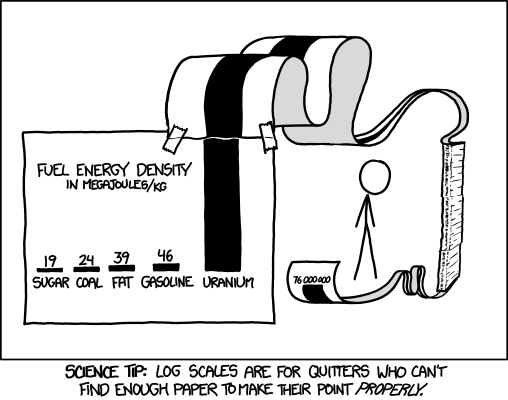
Comment by this_user 5 days ago
Comment by dboreham 5 days ago
Comment by tdb7893 5 days ago
Comment by MentalM 4 days ago
Idk, when you because of that implementation, for 20 years pay for the energy 10 times more comparatively to coal generated energy, that seems pretty fanatical by me.
Comment by crote 4 days ago
Only when you completely ignore the cost of its externalities, of course.
Comment by the_why_of_y 4 days ago
https://www.imf.org/en/publications/wp/issues/2025/12/20/und...
Comment by dgacmu 5 days ago
Comment by jkahrs595 5 days ago
Not supported by the stats in TFA:
>According to the report, the gap between renewables and nuclear widened substantially in 2025. Global solar capacity increased by 510 GW to 2,383 GW, up 27% year on year,
Sounds like a quarter of the growth was in the past year.
Comment by maxerickson 5 days ago
https://ourworldindata.org/grapher/installed-solar-pv-capaci...
Comment by toomuchtodo 5 days ago
We solved fusion at a distance with cheap solar and batteries. And not a moment too soon.
Comment by ksec 5 days ago
They plan to increase 50% for Wind and Solar in 5 years, and possibly double in 10 years. Since 80%+ of all future planned Nuclear reactor are also in China, they would have more than double their renewable energy in 10 years. China is the number one in electricity production and usage, more than twice the size of US and 33%+ of the world. Given the size of China this is both exciting and scary.
Comment by toomuchtodo 4 days ago
Comment by junofan 4 days ago

and this: https://thumb.wikimedia.org/wikipedia/commons/thumb/b/bf/His...

Comment by toomuchtodo 4 days ago
China’s AI Dominance Rests on Harnessing Excess Energy - https://www.bloomberg.com/graphics/2026-china-ai-energy-futu... | https://archive.today/6dq8B - October 8th, 2026
- Official curtailment figures — effectively, the share of renewable energy that could have been generated but was never sent out into the world, because of insufficient grid capacity or demand — suggest about 9% of wind and solar energy was wasted in the first half of this year. That almost certainly underestimates the problem, given the scale of green production.
- China could have generated an extra 401 terawatt-hours of power in the first six months alone, according to the Centre for Research on Energy and Clean Air, a nonprofit supporting efforts to curb pollution — nearly as much as Spain and the Philippines’ combined annual generation. [My note: !!!]
Ember Energy: China Energy Transition Review 2026: China’s energy transition is moving toward “building while breaking,” as its clean energy system begins assuming functions long performed by fossil fuels - https://ember-energy.org/latest-insights/china-energy-transi... - September 2026
Bloomberg: Solar Surpasses Coal as China’s Top Source of Power Capacity - https://www.bloomberg.com/news/articles/2026-09-01/solar-sur... | https://archive.today/i3TSe - August 31st, 2026
China Crosses Energy Milestone as Coal Falls Below 50% of Power - https://news.ycombinator.com/item?id=49110187 - July 2026
China Keeps Beating Renewable Targets And Missing Nuclear Ones - https://cleantechnica.com/2026/07/25/china-renewable-targets... - July 25th, 2026
> China set a 2020 wind target of 210 GW and finished the year with about 282 GW. Its solar target was 110 GW, while delivery reached roughly 253 GW. The later commitment to reach at least 1,200 GW of combined wind and solar by 2030 was crossed in 2024, six years early. By the end of 2025, China had about 640 GW of wind and 1,202 GW of solar, for a combined 1,842 GW. Nuclear moved in the other direction: about 50 GW against a 58 GW target in 2020, and about 62 GW against a 70 GW target in 2025. The current goal of 110 GW by 2030 may still be achieved, but the previous record gives no reason to convert it directly into a forecast.
China: Renewables now top 60 percent of capacity - https://denkstrom.org/en/goodnews/china-renewables-500-gw-ca... - June 1st, 2026
> If China maintains expansion at the 430-gigawatt-per-year level, installed wind and solar capacity would reach roughly 2,700 gigawatts by 2027. That would be more than five times the entire wind and solar capacity in the EU. Whether this value is realistic depends mainly on two factors: expansion of high-voltage transmission lines connecting generation and consumption regions, and political will to actually decommission the coal power plant fleet.
Every year renewables consume another ~10% of fossil generation in China, and should push out almost all fossil generation in the next 5-10 years, at current deployment rates. China is relying on coal for peaking until their battery deployment rates catch up to negate the need for coal generators.
China Battery Storage Use Surges After Policy Shift, Ember Says - https://www.bloomberg.com/news/articles/2026-07-15/china-bat... | https://archive.today/QBXxV - July 15th, 2026
- "As the power system integrates more renewables, the true value of batteries to China’s energy transition is becoming undeniable," Yang said. China added a record amount of new battery storage facilities in 2025, ending the year with more than half of global capacity. Growth has continued this year, with installed lithium-ion battery storage reaching almost 150 gigawatts by the end of the first quarter, according to Ember. The country is targeting 300 gigawatts of battery storage capacity by 2030, up from 136 at the end of 2025, in addition to expanding its fleet of longer-duration pumped hydro storage to around 160 gigawatts from 66.
- The government ended co-location requirements last year and most new battery storage projects are now standalone systems that can earn revenue through a variety of ways, such as by purchasing electricity when prices are low and selling it when they rise.
- Still, China can do more to improve utilization as its systems still fall short of the internationally recognized benchmark of about 350 cycles a year, Yang said. If they had reached that level last year, they could have captured and stored an additional 23 billion kilowatt-hours of renewable electricity, enough to power Singapore for about five months.
How China Built a Big Lead in Global Race for Batteries That Last for Days - https://www.bloomberg.com/news/articles/2026-03-03/china-s-b... | https://archive.today/i7n3B - March 3rd, 2026 (Control -F "China Leads on Batteries That Can Store Power for Days" graphic)
- BNEF analysts attribute China’s lead in the sector largely to policy support. Beijing identified LDES as a crucial component of its net-zero roadmap in 2023. The following year, China’s energy regulator launched 56 pilot projects, which helped launch the current boom. The country has built a massive lead in other climate tech sectors as well, from solar panels to hydrogen.
("China speed")
Comment by jkahrs595 4 days ago
Comment by happytoexplain 5 days ago
Comment by vlovich123 5 days ago
Comment by crote 4 days ago
Assuming we'd instantly switch from zero solar demand to unlimited solar demand, we'd need some kind of scaleup of PV manufacturing first, and with a fixed construction capacity of PV factories we'd see a linear rise in PV factory capacity - which would result in an exponential growth in yearly PV factory output.
But the same applies to the factories as well: the construction capacity is going to scale up as well, so as more PV factory part manufacturing becomes available we'll start to see an exponential growth in new PV factories, which would result in even larger PV factory output.
Scaling from "lab experiment and niche application" to "significant chunk of the grid" is a lot harder than scaling from "significant chunk of the grid" to "the entire grid" - especially with solar being embarrassingly parallel rather than requiring mega-scale deployments.
Comment by tempest_ 5 days ago
Solar just thrives in places without dependable established grids and has way lower buy in.
Two different tools for different things.
Comment by thinkcontext 4 days ago
Comment by trophycase 5 days ago
Comment by toomuchtodo 5 days ago
If you believe solar is ugly and deserts are beautiful, well, “beauty is in the eye of the beholder.” I believe clean, solid state hardware that will reliably produce low carbon energy for decades without causing any harm and potentially contributing positive benefits to its surroundings, with no other inputs required, is incredibly beautiful. Like simplicity, it is the ultimate sophistication (da Vinci).
The Great Solar Wall: China doubles down on its ambitious effort to tame deserts - https://www.scmp.com/news/china/science/article/3363108/grea...
Triple win: solar farms in deserts can boost power, incomes and ecosystems - https://www.nature.com/articles/d41586-024-00516-8
Swathes of Earth are turning into desert — but the degradation can be stopped - https://www.nature.com/articles/d41586-023-03621-2
Comment by ape4 5 days ago
Comment by metalman 4 days ago
Comment by luqtas 5 days ago
Comment by megaman821 5 days ago
Comment by plqbfbv 4 days ago
We have a giant fusion machine in the sky delivering energy in great excess what we use, and we only capture a tiny fraction of it at the moment. We can make each household practically independent. Fission and (hopefully soon) fusion will be good for meeting grid demand when renewables can't, but a distributed grid is simply more resilient to everything, from local events to country and nation-wide disruption of central generation points.
Comment by hobo123 4 days ago
Comment by natdavidson 4 days ago
Comment by plqbfbv 4 days ago
- https://www.nsenergybusiness.com/news/veolia-opens-new-facil...
- https://www.6wresearch.com/market-takeaways-view/top-solar-p...
- https://solarstoragextra.com/five-companies-spearheading-sol...
Apparently it's still mostly about Aluminum and Glass as that's 95% of the weight of panels. The silicon is often recycled for precious-metals recovery and not circular. ROSI does try to do high-purity recovery. It seems volumes are still on the smaller side, probably because most of the volume has been deployed in the last 5-10y and they have 20-30y life expectancy. Still a lot of recycling.
Comment by luqtas 3 days ago
a primer on actual numbers of recyled solar panels [0] [1]
[0] https://pmc.ncbi.nlm.nih.gov/articles/PMC12260433/
[1] https://www.sciencedirect.com/science/article/abs/pii/S09560...
stop eating startup and journalism headlines good intentions promises
Comment by uecker 4 days ago
Comment by ninalanyon 4 days ago
Comment by Aboutplants 5 days ago
Not to discount your point of renewables having massive issues, they just simply do not compare to the destruction that is caused by getting fossil fuels out of the ground and the damage it does once we start burning it