AMD acquires Taalas to boost inference performance by etching models in silicon

Posted by itvision 8 hours ago

Counter498Comment382OpenOriginal

https://ir.amd.com/news-events/press-releases/detail/1296/am...

https://chatjimmy.ai/

Comments

Comment by LarsDu88 7 hours ago

I'm surprised neither OpenAI nor Anthropic made this move first. The Chinese open weight models are pulling ahead and commoditizing their value proposition.

Baking models onto silicon would've been the next logical move to get a moat.

Google is already doing this and has an experimental project on top of already having TPUs and cramming their quantized flash onto individual TPUs for inference.

Comment by anthonypasq 7 hours ago

Personally I think Apple should have acquired them. if you could burn a gemma4 class model into an iphone and actually get extremely low latency and low battery usage it would feel like the future IMO. even if it means you wont get frontier intelligence, there might actually be incentive to buy a new mobile device every year again.

Comment by Melatonic 6 hours ago

The Taalas chips are not physically small. And part of their secret (if you look at the design) is just locating a bunch of memory soldered on the edges ( I belive higher amounts of SRAM ? )

Comment by chorizo 4 hours ago

Baking the base models on to ROM makes a lot of economic sense. SRAM for the KV cache & fine-tunes, not so much. Sure you’d get incredible speeds but it’s not scalable from a die-size or cost perspective.

Rather base model on ROM + KV cache on DRAM is much more scalable. Also this would work great for edge devices that have a 2-5 year lifecycle.

Comment by onion2k 7 minutes ago

Baking the base models on to ROM makes a lot of economic sense.

Less so for consumers though, because it'd mean the phone is out of date in 3 months when a better model comes along.

Comment by ronsor 5 minutes ago

It's a perfect reason to get consumers to buy a new phone every year again! They got bored of the camera.

Comment by adrianN 2 hours ago

It is my understanding that just baking the model itself into silicon only gives moderate gains because memory bandwidth remains a bottleneck.

Comment by chorizo 2 hours ago

The big benefit is ROM cells require fewer components than DRAM. So the chips would be tiny, dense, cheap and consume far less power.

Comment by klodolph 1 hour ago

I thought DRAM was pretty dense already. Is mask ROM that much denser?

Comment by chorizo 1 hour ago

Yes, each rom bit can be a transistor or even a diode with a decoder circuit. Simplest Dram cell is capacitor+transistor - and you need a clock, refresh circuit etc.

Someday, I imagine model weights could even be encoded as analog resistors (memristors or similar) for even greater density

Comment by ReactiveJelly 39 minutes ago

Hm. I wonder how many relays I'd need to make a physical MNIST classifier. That'd be dope

Comment by selcuka 4 hours ago

Their PoC chips are big, but then it's ridiculously fast (have you seen chatjimmy.ai?). Also they must be holding a bunch of patents.

Comment by adgjlsfhk1 7 hours ago

I don't think this works out from a cost/silicon perspective. Small models already run pretty well in software (since the weights fit in cache) and big models require silicon area proportional to the size of weights. On a mobile device putting a chip like this is competing directly in BOM and power against a whole lot more l3 cache, and the l3 cache makes everything faster

Comment by trebligdivad 4 hours ago

What, even if it means you can run models without relying on the currently backlogged DRAM production?

Comment by adgjlsfhk1 3 hours ago

The size of model we're talking about running doesn't need much if any dram.

Comment by teaearlgraycold 6 hours ago

My question is what changes about LLM use cases when you’re getting 1000 tok/s? Models in silicon might dramatically change how we think about them.

Comment by QuiDortDine 4 hours ago

Did you use chatjimmy? It's somewhat terrifying to use when you think of the potential results with a better model.

Ok, real life example: I now spend most of my time, as a developer, waiting for the agent to do its thing (after careful prompting, I'm also thinking about work stuff, don't worry I'm not useless). What if it gave back the same excellent results, but instantaneously? Why, then, I certainly would become the bottleneck. So, quite possibly, my last work task would be to plug this agent directly into the ticket system where the domain experts input their feature requests. Maybe we still need 1 developer out of 100, to coordinate releases and all that (ok, say 1 out of 10).

But that's not taking things far enough: why do we need these domain experts at all? Our pitch is clear, and all software-enabled, though it took years to develop. We can just have the clients express their concerns to the AI, directly or indirectly. Have multiple lighting-fast agents with different roles (refactoring agent, new features agent, debugger agent, domain expert agent, etc.). So we fire everyone, maybe keep 1 product owner / devops to keep the trolls out. The cost is still probably 100 times less than it used to be (beyond the initial cost of acquisition of the magic machine or whatever).

But one of these clients, surely, will realize that these 10 years of manual and slowly-automated development can now be emulated in very, very little time. Why not just, say, take screenshots of the entire app and feed them into the magic machine? Why, this way, they could have the service for a tenth of the yearly cost, forever!

And then the economy implodes.

I'm not saying it's THE most likely version of things, I'm saying that at a certain level, quantity (or rather, speed) is a quality all its own. And this new quality might change the world. Let's hope it's for the better!

Comment by manmal 5 minutes ago

Errors compound, and making 1000 wrong decisions per hour, will not result in something useful. Maybe you‘ve tried setting up guardrails for good design or architecture at some point? I think it’s simply not possible to do that.

It would certainly be an accelerator for people who know exactly what they want. And it would remove multi tasking, which I‘d appreciate.

Comment by pastel8739 1 hour ago

This is the same pitch that people make about AI today. Speed isn’t the differentiator, quality is

Comment by xur17 4 hours ago

I'm not sure inference speed is always the slowest thing for me right now. The agent is running tests, loading webpages, etc, which all take time. I don't know if a fast agent would speed things up in all cases.

That said, it obviously depends on the project.

Comment by jodrellblank 3 hours ago

> "The agent is running tests, loading webpages, etc, which all take time"

A frustrating vision of the future would be when we've been asking for faster loading lighter web pages for years and then companies start caring about it and improving it not for us humans but for LLMs.

Comment by evilduck 2 hours ago

It's already kind of that way with MCP servers popping up everywhere. The JIRA MCP server is like a couple orders of magnitude faster to work with than the website itself.

Comment by manmal 10 minutes ago

That’s their API with extra steps, or am I missing something? That was always faster.

Comment by andersonpico 2 hours ago

They finally cared about clear requirements and documentation when that meant getting rid of devs.

Comment by layla5alive 1 hour ago

That happened at corpo work for each of: * Build times * CI latency * Developer tooling * Documentation * Modularity

Comment by bdangubic 2 hours ago

> I now spend most of my time, as a developer, waiting for the agent to do its thing (after careful prompting, I'm also thinking about work stuff, don't worry I'm not useless).

you need to launch 10-15 more terminals, who is waiting these days? :)

Comment by wsintra2022 4 hours ago

I think this reads like Ray Kurzwheil (sorry not able to spell that off top of my head, that bloke who wrote that book about the future) .. But yeah very dystopian and totally realistic. Not if but when..

Comment by QuiDortDine 4 hours ago

I LOVE Kurzwheil! Thank you for the compliment, I'm very far from having his writing skills. But yes sci-fi is looking more and more like, well, sci.

Comment by HDBaseT 5 hours ago

In the case on on-device/self-hosted LLMs. You ask your agent to implement xyz feature 10 times and use a model to compare the outputs and combine the best results.

Raw intelligence becomes slightly less important when you can iterate and improve automatically. You can still claim it was "one shot" even when 30 different implementations were made then combined.

Comment by manmal 15 seconds ago

Problem is, there exists no judge model that will really pick the same winner that you would. They have no taste.

Comment by in_a_society 5 hours ago

The best way I can explain it is that it's the same feeling when I upgraded from 56k dialup to cable broadband.

Comment by LarsDu88 37 minutes ago

Massive economic simulations with thousands if not millions of agents to front run the global economy and stock market.

Fully interactive realtime NPCs in videogames at scale.

Recommender systems that simulate individual consumers.

Crazy shit

Comment by RussianCow 6 hours ago

That likely isn't as relevant for on-device iPhone usage as it is for Real Work™. I won't notice the difference between 50tps and 1000tps when asking Siri a question.

Comment by spijdar 6 hours ago

I don't know. As others have said, the Taalas chip wasn't small, or particularly low power, so it's hard to "imagine" what that tech in an cell phone chip might look like.

But if the basic premise of "good enough LLM at insane throughput" holds, I think it could qualitatively change local uses of LLMs. At a certain speed point, you're able to move from request -> response to a cascade of tool calling and "subagents", which could allow a small model to be much more useful, if provided with a lot of local data and tool calls.

That said, this is assuming you could stuff a "good enough" model into a phone with Taalas-like technology. The Taalas tech demo was an 8B parameter model and required hundreds of watts (IIRC) to run. The efficiency was good given the speed (as I understand), but it's not clear at all that the approach scales small enough to be a sensible coprocessor on an iPhone or whatever.

Comment by intrasight 4 hours ago

Box that plugs into my desktop would be fine. Or perhaps in SSF form factor.

Comment by retatop 6 hours ago

But wouldn't higher tps allow for more reasoning or other hidden processes, potententially making a smarter model?

Comment by dabbz 5 hours ago

This is my thought as well. Models have to be intentional about which tokens they burn because there's a real lag time. If you can just fork out 10 different reasoning sessions at once with no regard for token waste/lag, you can compensate a smaller model with just doing more at once with it. No idea if this is reasonably true though.

Comment by nvme0n1p1 5 hours ago

That order of magnitude could be the difference between "the users wants me to open the notes app, let's open it" and "I've scanned all your notes before you could blink and found what you're looking for".

Comment by p1esk 5 hours ago

If Siri is using a 3T model in high reasoning mode to answer your question you will.

Comment by dboreham 5 hours ago

Works great from a press release perspective though.

Comment by bastawhiz 6 hours ago

The weights might fit in cache, if you're using a small model. If you wanted to have a 20B+ parameter model, that's just going in RAM. You could put more RAM in the device and pay the perf cost or have a dedicated chip. Most devices already have a dedicated chip, this just changes which silicon you're spending the money on.

Comment by wmf 5 hours ago

That math doesn't really work.

8B model (FP4) = 4 GB DRAM = 32 Gb DRAM = 80 mm2

8B model (Taalas) = 4 GB ROM = ~800 mm2

Comment by bsaul 7 hours ago

That's actually a really good point... There's currently zero incentive to buying more hardware, and that's one very good reason do have a new one.

Comment by sebular 6 hours ago

But this is already happening with iPhones. Apple is touting on-device AI and only the latest phones offer the full capabilities. Newer phones will be able to run better models, so the incentive is there as soon as someone makes the killer app that only makes sense when the model is running locally on your phone.

Comment by superb_dev 7 hours ago

From what I remember, these chips are not mobile size yet

Comment by bradfa 7 hours ago

A small model would be. I think that’s more the point. It’s definitely not SOTA but it’s fast and energy efficient and local.

Comment by mdp2021 6 hours ago

> A small model would be [mobile size]

A ~30mm side for the HC1 tech for an 8b model (still unclear the planned HC2)?

Comment by teaearlgraycold 6 hours ago

Is that analogue or are they baking floating points into the silicon?

Comment by AlotOfReading 5 hours ago

It's entirely possible they're using something like block floating point, where most of the hardware is simply fixed point. AMD's NPU does this, for example.

Comment by wmf 6 hours ago

Nope, a small model would be larger than the whole iPhone SoC.

Comment by makeitdouble 5 hours ago

Slightly besides your point, but it's interesting how many here naturally ponder about how the current winner could or "should" keep winning, instead of how another company could become a competitor by doing the more clever thing the incumbent isn't thinking about.

Comment by krisoft 5 hours ago

It is not a “should”. At least not in the “we wish it were so” sense.

It is more that there are multiple reasons why this idea (burning an LLM into silicone and deploying it into a device in people’s pockets) requires huge piles of cash and the kind of engineering chops only a few company posesses.

Of course i would like it if a small upstart would do this, but it doesn’t seem likely as a posibility. They won’t have the funds to fab the IC. They won’t have the funds to train and validate the model before burning it into silicone. They can’t absorb the risk of the first tape out going wrong. They can’t absorb the risk of the model being faulty in some subtle way. They don’t have a device to integrate the IC into. They won’t have the funds to develop one. If they somehow would make a device they don’t have the marketing and sales channels built out to get the device into people’s hands in sufficient numbers to justify the development cost.

Basically this idea feels ruinously expensive. Apple has deep pockets, they already have working well-regarded phones, and an ethos of privacy preserving innovation. This is why this idea feels well suited for them and not many others.

Do i want the winners to keep winning? No. But not many others can pay for a moonshot crossed with a manhattan project. They just can’t.

Comment by whatsThisBtn4 6 hours ago

Apple is somewhere between fashion company and second rate tech company.

They could have 9 year old AI and still post profits.

Not sure if it's my pixel or android, but I made a randos jaw drop with what the crappy AI on android can do.

When are we getting android OpenClaw?

Comment by 2 hours ago

Comment by unsigner 24 minutes ago

Their thing is improving the models; it would be extremely counter-company-culture to bet on models plateau-ing. Maybe wise in terms of hedging, but still difficult to pull of as a company decision.

Comment by moshun 7 hours ago

Considering the rate of model development and rail hopping, seems like baking models into silicon is speed-running obsolescence.

Comment by breuleux 7 hours ago

If you’re only running models for frontier capabilities, yeah. For tasks where current models are smart enough, running them 100x faster is the most impactful improvement you can make. Consider all the things you could use a model for, but don’t, because the latency is just a bit too high.

Comment by LarsDu88 34 minutes ago

It depends on how quickly you can bake new architectures.

Text diffusion might be a disruptor here, but let me just say the most cutting edhe form of image diffusion (JiT and DiT) right now is just a big fat stack of alternating attention and MLP matmulls. Not theoretically hard to bake

Comment by zxspectrum1982 6 hours ago

I'd gladly pay for a Claude Opus 4.6 Thinking High in silicon and use it for 1-2 years. It's good enough for many coding tasks.

Comment by subroutine 5 hours ago

But Claude Opus 4.6 is not really practical. Taalas' process seems targeted for edge models. Their proof of concept model, for example, is a heavily quantized version of Llama 3.1 8B and even then they acknowledge their custom 3-bit/6-bit representation causes model quality degradation.

Taalas is going to have a tough time putting a trillion-parameter model on one conventional die. Their HC1 die is already near the maximum size that conventional lithography can expose. They claim they could partition the model across many chips, but I'm not sure if they have tested this process or what it means for compute. The basic storage arithmetic is unforgiving: for a one trillion parameters model at four bits it will take 50–100 chips. To service a sizable customer base will take thousands of 100-chip fabs.

That all said, I'm bullish on this technology, and look forward to seeing it evolve.

Comment by Iolaum 18 minutes ago

A really fast qwen-3.6-27B type of model could be useful. With a specialized harness and this speed I 'd expect it to find many applications. Implementing a coding plan is the minimum I can think of.

Comment by vatsachak 4 hours ago

Yeah. But this kinda feels like a bandaid.

Eventually someone will have to solve compute in memory at scale.

Comment by andix 5 hours ago

With thousands of token per second output it would be an enormous waste of resources. Such chips are clearly made to process thousands of conversations simultaneously. Not necessarily in parallel. All LLM workflows are turn based right now, there are often seconds between turns until tool calls finish or users type the next message.

If the LLM response only takes a few milliseconds, the chip can process hundreds of other requests until the first conversation becomes active again.

Comment by NiloCK 2 hours ago

Not so long ago, I was good enough for many coding tasks. But I found that things can change in a hurry.

Yes, a cheap and fast Opus4.6 can drive a lot of value in current context. But if we continue to craft bigger-and-bigger balls of mud, Opus 4.6 may end up hitting its conceptual ceiling and unable to contribute.

Winding the clock back on your statement gives:

> I'd gladly pay for a Claude Sonnet 3.5 in silicon and use it for 1-2 years.

Man, I dunno.

Comment by kennywinker 1 hour ago

Assuming moore's law like progress, which I'm 100% sure isn't going to happen - I think we're at the top of the S curve already. But assuming dramatically increased intelligence every year this is still the exact same position as anyone who bought a computer in the last 5 decades. Yet, people did very much buy computers.

Comment by Gigachad 6 hours ago

It costs something like $300,000 for the hardware to run a model of that size. You'd pay that for a single model for 1-2 years? Not even the AI companies can justify that kind of spend which is why they keep extending the expected lifespan on their hardware in the accounting.

Comment by zxspectrum1982 6 hours ago

I'm expecting the Taalas MSIC version to cost a fraction of that. Then probably have some kind of cheap subscription to Anthropic for updates (yes, Taalas chips can receive a certain kind of updates: they have a small SRAM).

Comment by mdp2021 5 hours ago

> It costs something like $300,000 for the hardware to run a model of that size

You did not compute that as the cost for a speculative card from Taalas, right?

Comment by Gigachad 4 hours ago

It's the cost of the current nvidia hardware used to run these models. Of course all bets are off if you are accounting for some future chip that doesn't exist yet which could cost less.

Comment by nowittyusername 3 hours ago

Depends on how much it costs the consumer. If I could buy a "cartridge" of Kimi K3 for 300 bucks I 100% would buy that shit asap. Even if it's "no good" after lets say 4 months still would be worth it IMO.

Comment by desmaraisp 2 hours ago

That's definitely super-enthousiast territory. Paying 80 bucks a month for AI is more than 99.99% of people would be willing to do

Comment by nowittyusername 2 hours ago

This will be considered very cheap within the year IMO. The value you get from AI is exponentially increasing and like all tech just takes some time to ramp up. Cell phones, internet and many other amenities when they came out many people were not willing to pay for but that all changed and considering how important AI tech is this will also be the case especially considering if its 100% private such as for that cartridge.

Comment by kennywinker 1 hour ago

That's because the super-enthusiast will upgrade in 4 months when a better model is released. The casual user would keep it for years. A year of claude at the lowest plan is almost $300

Comment by topspin 7 hours ago

"seems like baking models into silicon is speed-running obsolescence"

Now maybe. When models are flying passenger aircraft, other prerogatives will assert themselves. When a 50TB ROM means you can impulse purchase a ChatGPT 6.3 xhigh that runs on batteries, yet more use cases will be apparent.

Comment by mdp2021 6 hours ago

Well, 50TB ROM Taalas HC1 style would be apparently a 400000b transistor system through a chip sized 2.5 meters on the side... :)

Comment by preg_match 3 hours ago

Yes but have we considered employing, like, a really big block of ice? Like old-timey surgeries? What if we put a big block of ice on the 2.5 cubic meter CPU what happens then?

Comment by thfuran 6 hours ago

Phones were getting too thin anyways.

Comment by heywoods 5 hours ago

Or autonomous weapon systems, missiles, and drones.

Comment by umeshunni 3 hours ago

Why would they need multi TB frontier models?

Comment by ray_v 7 hours ago

I could see this making sense when model development start to settle down ... it's going to settle down, right? ...

Comment by amelius 7 hours ago

Not sure. You can fix the transistors but leave the connections between them open for flexibility, so you only need to change the manufacturing process for the upper masks for every new model.

Comment by tsujamin 7 hours ago

Surely that added flexibility negatively impacts the density/parameter count of the model you could etch?

Comment by sroussey 7 hours ago

Or do a hybrid

Comment by mdp2021 7 hours ago

Compute the cost of producing n of them devices, imagine a fair price based on that, and see if that local, blazing fast card* can be an asset that could be replaced periodically.

*(It's local: private files managing firm oriented. It's blazing fast: it can be placed into recursive, intensive local workflows.)

Comment by alightsoul 7 hours ago

Which is exactly what companies and shareholders want to increase sales.

Comment by flyinglizard 7 hours ago

Look at it the other way: compared to the cost of training a model, the cost of making a custom ASIC is trivial.

Comment by try-working 6 hours ago

obsolescence is the whole point. apple gets to sell a new phone very 6-12 months because of it.

i have written about this:

"For device makers

Packaging models with laptops and smartphones will let application access near free, low latency inference and potentially offer users a better experience with the option of preserving data on-device. This is viable under the condition that tasks that do require larger expert models that run in the cloud can be routed to external models. A side-effect of local models and what will let Apple cut upgrade cycles from ~4 years (?) down to 12-18 months is specialized hardware to run them. For almost a decade, smartphones have been trying to compete on better cameras. This coming decade will see them selling better GPUs, NPUs, ASICs and whatever other things they'll be calling the inference chips, to drive re-purchase. Every six months will see a better model on new hardware, which will enable better performance in certain applications."

https://try.works/role-model-the-case-for-a-model-routing-pr...

Comment by nomel 6 hours ago

No, the point is inference speed and power.

Comment by try-working 1 hour ago

you don't understand what I wrote.

Comment by throwaway27448 5 hours ago

You need to find customers for several-generations-ago models before this makes any sense. AMD is a lot more incentivized to look than mr vanilla llm is

Comment by wraptile 1 hour ago

This seems like a very bad and dangerous direction for our society.

Comment by giancarlostoro 6 hours ago

ASICs is what took over Bitcoin mining, cheaper in all ways, and lasts longer than Nvidia GPUs for inference.

Comment by SR2Z 6 hours ago

> cheaper in all ways,

Bitcoin mining doesn't have large memory requirements, but does have huge compute requirements. ASICs work great there because it's very straightforward to add some circuits for computing hashes. If you _also_ have to add many GB of memory, then suddenly ASICs will cost as much or more than comparable off-the-shelf hardware and they won't be faster unless you've also invested in huge memory bandwidth.

Comment by giancarlostoro 5 hours ago

My understanding is an ASIC can last 10+ years, where are Nvidia enterprise GPUs are rated for 5...

Comment by SR2Z 5 hours ago

Most enterprise GPUs are scrap after 5 years because they're so inefficient compared to newer models. It's entirely possible to make them last longer by undervolting them, people just don't because it doesn't make sense.

Bitcoin OTOH has used the same PoW algorithm for a decade. Barring some really exciting discoveries about the nature of computation, new ASICs are not that much more efficient than old ones.

BTC mining is also not exactly competitive anymore; the nature of the PoW algorithm means that it's dominated by a few large players who've set up shop next to a dam and who pay very little for electricity.

New entrants are highly discouraged because the mining rewards are constantly halving, it's hard to find cheap power, and the price of BTC is now so volatile that a yearslong investment is very likely to lose money.

Comment by mrtksn 7 hours ago

Isn’t that kind of useless for the stock? It sounds complicated, unlike having number of CPUs go up.

It’s like talking about anything else than Megapixels when everyone was convinced that megapixels must go up in certain periods of the smartphone boom.

Comment by LPisGood 7 hours ago

I’m surprised Nvidia hasn’t partnered to make a Claude chip yet. It’s a win/win you can license them out, sell them when they become obsolete, etc.

Comment by CircuitSeuss 6 hours ago

Comment by mdp2021 6 hours ago

Not necessarily: it is relevant to Taalas only if it is a compute-in-memory architecture.

The Jalapeño mentioned («Anthropic is not alone in walking this path») in the article is still a classical Von Neumann architecture.

And Taalas' idea makes sense in a perspective of scale - producing a large number of cards; "for internal use" (a lower order of items) means a high production cost.

Comment by UncleOxidant 4 hours ago

I guess I'm not understanding why this makes sense for AMD to buy Taalas unless they plan to get into hosting. It doesn't seem like a great fit.

Comment by la6479 5 hours ago

Just to see how fast it is try chatjimmy.ai

Comment by tasty_freeze 3 hours ago

It is really fast and ... really hallucinates. I asked "Does the Wang corporation still exist? If not, what happened to it?" and it replied (in part):

"Yes, the Wang Corporation, the company that originally developed and marketed the Wang 2200 computer, still exists as a rebranded company under the name PPL (Precision Pencil and Label), but it has undergone significant changes and challenges over the years.

Here's a brief overview of what happened:

    Founding and Growth: The Wang Corporation was founded by An Wang in 1969."
In fact, Wang labs was founded in 1951. PPL seems to be a made up entity. But it did generate those "facts" in 0.033 seconds. If people value speed over accuracy then I can write an LLM that is 100x faster than chatjimmy.ai and make big bucks by responding one of N canned responses to any question.

Comment by mickaelkerjean 2 hours ago

their tech is a mere demo to open up a new path, the day we can have some asics running a Qwen3.6 27b, this would open up new doors

Comment by mr_mph 5 hours ago

Pretty incredible to see. It reminds me of when I first used the Groq chatbot, except in this case it's a full response instantly.

Comment by stingraycharles 3 hours ago

Didn’t Anthropic acquire Cerebras? Seems like a move into the same direction.

I also think that etching models into ASICs may be a bit too inflexible for what OpenAI and Anthropic want.

Comment by wyrdcurt 48 minutes ago

No, that's backwards. OpenAI are the ones investing in Cerebras. Part of the deal is that they can't sell to Anthropic.

Comment by alightsoul 7 hours ago

Because Openai and anthropic are not hardware companies. They outsource that to Broadcom and AWS' Annapurna labs.

Comment by wmf 6 hours ago

OpenAI and Anthropic are both designing ASICs.

Comment by alightsoul 6 hours ago

So they have decided that putting a small LLM on a phone would backfire because people would have a negative perception of their cloud models. Pretty sure AMD will use these taalas chips in data centers, not phones

Comment by karmasimida 7 hours ago

A model can't be updated, and a chip that is only relevant for 6 months at max?

Comment by anigbrowl 6 hours ago

Depends what you mean by relevant. If you use AI primarily as a search/knowledge engine, it makes no sense. If it's your capable assistant that has a lot of general knowledge, can do tool calls, and has a big context window, very doable.

Indeed, for some kinds of applications involving secure/legal data etc. I can see the consistency of silicon winning out, because it combines performance with immutability and guardrails in hardware. Some chips have write-once PROMs to store password hashes and similar, you could do the same thing with prompt hashing to absolutely force or forbid certain behaviors. A model that can't be updated is also a model that can't be hacked.

Comment by askvictor 7 hours ago

People already buy new phones every year, this just creates even more reason to do so

Comment by Gigachad 6 hours ago

Outside of this website I've never met a person who buys a new phone every year. It's closer to every 3-4 years for most people.

Comment by boelboel 5 hours ago

Closer to every 5-6 years these days and with ram prices going up it will be even longer. Especially with the low/mid range phones, which are most phones outside some developed countries, people will keep their phones as long as they can.

Comment by Gigachad 5 hours ago

Would depend on the income levels, but yeah, buying a new phone these days is entirely a non essential luxury. An iphone easily lasts 7 years so the moment money is tight, it's a very easy choice to not buy a new one.

Comment by throwaway240403 5 hours ago

Your location/income bias is showing. Most people do not buy new phones every year.

Comment by winrid 3 hours ago

I live in the bay area and buy a phone maybe every 3 years? Why do people waste so much money :D

Comment by simpsond 4 hours ago

Base model sure, but the stack will be hybrid. It’s still early days here. Too bad FPGAs have such large feature size.

Comment by hamdingers 6 hours ago

One of these chips smart enough to take orders at a drive-thru would be relevant for a decade, minimum.

Comment by wolttam 7 hours ago

It's a terrible moat. You etch the silicon then nobody wants to run it in 6 months because models have advanced that much further.

Comment by nine_k 7 hours ago

Not so if it's embedded in something smart enough for its intended purpose.

Think vision, spatial reasoning, speech synthesis, even some speech analysis. Think self-driving cars (and drones) that need 10x less power for the brain, and can think at 10x situation per second.

Comment by anigbrowl 6 hours ago

This is only true for people who are solely focused on performance. There is absolutely a market for acceptable performance combined with predictability.

Comment by teraflop 5 hours ago

True, but predictability cuts both ways.

We're all used to having to constantly update our browsers and phones to keep up with the security arms race. If a frozen model can't be updated, it will predictably remain vulnerable to any "exploits" or idiosyncratic quirks that people discover over time.

Let's say, as somebody suggested in another comment, that you buy 100,000 of these chips and deploy them to run fast-food drive-thrus. And then somebody discovers the model has a fondness for goblins[1], and if you role-play convincingly enough, you can get it to accept payment in shiny buttons and rodent skulls instead of cash.

What do you do then? I guess your options are to try and fix the behavior with a better prompt, or put some kind of filter in front of the model to catch attempted exploits. If the filter is cheap and dumb it probably won't work well enough, and if you use another model as a filter, you've negated the cost and speed benefits of putting the first model in hardware.

Of course the real answer is to just never expose the model to situations where an adversarial input could possibly lead to an undesired output. But that drastically limits what you can do with it.

[1]: https://openai.com/index/where-the-goblins-came-from/

Comment by anigbrowl 3 hours ago

I see your argument but your example seems highly contrived. I can't think why you'd want to use something like this for something as dynamic as takeout ordering, where you might have to deal with bad customers, supply chain breakages, public health recalls, or any of many other probabilistic events.

I think it's far more likely to see them used in safety critical applications where you need a capable model that can run on low power and doesn't have multiple layers of operating abstractions between the model and the hardware.

Comment by fwip 2 hours ago

What safety critical applications would be a good fit for LLMs?

Comment by noisy_boy 3 hours ago

> Of course the real answer is to just never expose the model to situations where an adversarial input could possibly lead to an undesired output. But that drastically limits what you can do with it.

Does it though? Isn't that what CPUs are, very fast-not-so-clever computing brain surrounded by layers that protect it?

Comment by 7 hours ago

Comment by speed_spread 7 hours ago

If a model is good enough today, it's still gonna be good enough in a year. Except you'll be able to serve it 1/100 of the price. Or 100x the speed.

Comment by twobitshifter 6 hours ago

OTOH, people get a new iPhone every year and they are ok with it.

Comment by nomel 6 hours ago

How is that in any way related to a consumer device? This method doesn't reduce physical memory requirements, so still results in huge die area. This isn't a for-end-user thing, probably for decades.

Comment by twobitshifter 6 hours ago

Ok, how long until nvidia gives us a new GPU?

Comment by nomel 6 hours ago

I don't follow. How is that related? GPUs don't have fixed memory. You don't throw them away when you want to load a new model.

NVIDIA will probably give us a new GPU when someone competent in the free market decides they want wheelbarrows full of money. Unfortunately, AMD is entirely, incomprehensibly, incompetent, to the point where I can only assume they're colluding with Nvidia, behind the scenes.

Comment by bamboozled 7 hours ago

It googles models suck

Comment by linzhangrun 4 hours ago

Thinking that five or six years from now, Fable-level intelligence could be provided at 100x the current speed... makes me feel lost. I cannot imagine what the future will look like.

Comment by dyzone 1 hour ago

It tells me that they have some kind of insider knowledge that the models have hit their limits and won't be getting much better, and it makes sense economically speaking to just bake the current models and use them for the next 5-10 years. Looks like we're near the top of the S curve.

Comment by hahahaa 33 minutes ago

A model you can run for practically no cost is a new proposition. It is the CPUification of AI. Sure there be supercomputers but you PC will be pretty super too.

Comment by mountainriver 58 minutes ago

What would possibly tell you that?

Comment by 32 minutes ago

Comment by ilaksh 4 hours ago

Cerebras already runs large models like Kimi 2.6 or GLM at like 30x speed. 100 times is next year, not six years.

You can actually test it out on their website, just imagine 3 x faster and maybe 15% smarter.

Comment by kllrnohj 1 hour ago

Cerebras is literally the entire wafer, so it can't get bigger. So where is the jump from 30x to 100x coming from? Node improvements only yield like 10-20% gains these days...

Comment by AussieWog93 19 minutes ago

Could we not just make bigger wafers, if the technology called for it?

Comment by kzrdude 2 minutes ago

The investment in bigger machines at the fab might set you back billions. I don't know about the lithography technology either, how easy you can scale it to larger wafers?

Comment by ilaksh 1 hour ago

They have a next generation, I don't really know if it will be 3 x or what but I heard it was significantly better.

Also there are other people innovating in hardware.

Comment by keepupnow 3 hours ago

This.

Comment by __MatrixMan__ 39 minutes ago

Last month: agents spend 4 days on a hack, humans spend 3 weeks (so far) digging through the slop to figure out what happened

Next time, one of those number will be smaller, and the other will likely be bigger. How long before the analysis side gets too overwhelming to bother with? Probably less than 6 years.

Comment by 1saadcodes 2 hours ago

Feels both unreal and dystopian. The speed at which these models are developing is very scary

Comment by DiscourseFan 4 hours ago

It will be cool but also violent and terrible.

Comment by pizzaiolo 3 hours ago

So, like the present

Comment by barbazoo 3 hours ago

With more wealth concentrates at the top, yes.

Comment by __MatrixMan__ 2 hours ago

Like some kind of pimple, which we can pop from all sides. And then we'll build something different. Something that works.

Comment by bigyabai 2 hours ago

Presumably wealth would concentrate upwards even if AI was never made.

Comment by sanex 2 hours ago

Yes it's a function of the monetary system. Absurd amounts of debt only certain people can access.

Comment by whythismatters 8 hours ago

Comment by walrus01 7 hours ago

I know it's a relatively tiny model, but damn, is that thing fast.

It also mostly passes the "schlong" test

https://pastes.io/YcxSi8Fp

Comment by andix 5 hours ago

It failed on my usual test. But it failed really fast:

"A farmer has a wolf, a goat, and a cabbage. The wolf is imaginary and doesn't exist. He wants to cross the river, but the boat is only big enough to hold him and one of them. The farmer can't leave the wolf and the goat together, because the wolf will eat the goat. Similarly, he can't leave the goat and the cabbage together, because the goat will eat the cabbage. What is the smallest number of trips the farmer needs to make to get everything across the river?"

Comment by tyre 1 hour ago

This farmer needs a tote.

Comment by AussieWog93 7 hours ago

I read the paste, it got the etymology wrong, no? Schlong comes from shlang (snake), not shlemp (is this even a word? I don't speak Yiddish but couldn't find it on Google).

Oxford also claim that its first recorded use was from the 60s, not the 20s; https://www.oed.com/dictionary/schlong_n?tl=true

Comment by walrus01 7 hours ago

It did get it wrong but it also got a lot farther than much more recent, but worse models like 6.7GB on disk size ternary bonsai. It at least knows it's from Yiddish. The "schlemp" appears to be a total hallucination or it's confusing it with schlep, which is not related to schlong. One of the reasons why I said it "mostly" passes the test. Something much larger on the size of qwen 3.5 122B, deepseek v4 flash or similar that runs in 120GB to 190GB of RAM in my experience will answer perfectly unless it has been ruined by something like Q2 quantization.

Comment by thoughtpeddler 7 hours ago

I didn't realize there was a SchlongBench™ (but of course there is). What's it test? (asking seriously)

Comment by walrus01 7 hours ago

There isn't SchlongBench(TM) yet, it's a specific question I've been asking of differently sized models as a randomly chosen gauge of how much less commonly used knowledge is perma-baked into it. In this case a question about a specific yiddish origin slang term. Small/bad models don't know it's from middle high german or Yiddish and get its origin and meaning totally wrong (or it runs into model censorship related to slang related to the male anatomy).

It's also a question I have found will cause models that don't know what it is to go off quickly in a direction of hallucination trying to explain it, so the hallucination is evident very quickly starting from the first ever prompt issued with 0 context fill. Example: I had a model write four detailed supposedly-accurate sounding, grammatically correct paragraphs saying its origin is from AAVE (African American Vernacular English), which it most certainly is not

You could do the same by picking any topic that is very rarely discussed in conversation, some esoteric and narrow piece of knowledge and asking the model about it.

Comment by thoughtpeddler 7 hours ago

Oh ya, this is like the approach from the Incompressible Knowledge Probes [0] paper - smart!

[0] Incompressible Knowledge Probes: Estimating Black-Box LLM Parameter Counts via Factual Capacity [https://arxiv.org/abs/2604.24827]

Comment by wxw 7 hours ago

I freakin' love this demo. It feels magical.

Comment by VBprogrammer 7 hours ago

I had the same reaction but then I showed it to my partner. She completely didn't get it, in her words "how can it be thinking of a good answer when it's that quick?"

I tried to explain but I fear were probably going to be adding artificial sleeps to these things to convince the masses it's doing something clever.

Comment by varun_ch 7 hours ago

to be fair, the model used for Chat Jimmy is not very smart, but the world where it is smart is very interesting.

It’s going to be really crazy when the bottle neck for agents is the speed of the tool calls rather than the speed of inference. Imagine an agent interacting with the terminal near instantly…

Comment by ricardobeat 5 hours ago

I had the chance to try out MiMo v2.5 Pro Ultraspeed (600-1000tok/s) for a couple weeks and it is amazing.

Developing software becomes 95% about intent and requirements. Can’t wait for the next iteration of that.

Comment by axus 7 hours ago

I asked it some old hardware command line questions I'd recently asked Gemini, it hallucinated parts of the answer.

The characters in the 3-act Shakespearean play had very little depth, many of the names were similar, and they were not very smart, but the simple plot was cohesive.

Comment by XCSme 6 hours ago

Wait, is it even thinking? Or is it an instant model?

Comment by msdz 2 hours ago

It’s not reasoning, the hardware demo uses a 3.-something generation Llama 8B.

But it’s proven they can automate this (they didn’t etch eight billion weights by hand after all, obviously), so now the interesting question is whether they can scale it to more recent aka bigger models.

After all, there’s already very useful models even for productivity at 27 or 35B.

Comment by XCSme 1 hour ago

My concern is that reasoning could involve some sequential steps that instant models don't.

Not sure if modern models "think" only by outputting <thinking> blocks, or there is a more complex mechanism at play.

Comment by emdash 2 hours ago

I feel like Ray Kroc in the McDonald's movie trying to figure out how his hamburger could possibly be done when he just ordered it

Comment by pizzathyme 5 hours ago

For those old enough to remember, this is like dial up internet to broadband. So fast it creates new markets

Comment by ecshafer 5 hours ago

That is insanely fast. I had it generate a basic C FFT library that can handle multi-dimension arrays, and it was instant.

Comment by senderista 7 hours ago

Wow, feels like Google web search in 1999.

Comment by joshvm 7 hours ago

If you still want the experience, go and browse McMaster Carr. Wizards designed that website.

Comment by senderista 2 hours ago

Oh I have, though not for a while.

Comment by jodrellblank 2 hours ago

or LiveGrep fast search of the Linux kernel source code with regex support: https://livegrep.com/search/linux

Comment by brikym 5 hours ago

The speed is awesome, in the true sense of the word. It's great at knowledge and basic stuff but the output is complete junk for anything concerning new facts or slightly esoteric topics.

Comment by appplication 5 hours ago

This is the coolest LLM thing I’ve seen since the original ChatGPT announcement a few years ago. IMO much more impressive than marginal gains of frontier models.

Comment by mintflow 3 hours ago

try let it to get a brief of france history which being reading a while hit the button and then the brieft jump into my eye

Generated in 0.051s • 14,092 tok/s

Impressive...

Given gpt 5.5 was very good to me and gpt 5.6 series seems not boost too much, i kinda like the way bake the model weight to the chip, and connect multiple chip to serve the large scale model and allow respin some parts(ROM like?) to do model weight update, maybe this seems sustainable, the future is exciting

Comment by XCSme 6 hours ago

Wow, that's instant, crazy.

Comment by itvision 8 hours ago

OMFG this thing is fast.

Comment by phoh 7 hours ago

its fast but try to get it to give you pi to 50 decimal places. it didnt go well for me.

Comment by walrus01 7 hours ago

I think the same exact model running on CPU-only and RAM, or a small GPU, would do about the same? It's quite an old model now and small, you could throw a GGUF into llama-server or something for a side by side comparison.

https://huggingface.co/meta-llama/Llama-3.1-8B

As I remember just about any english language model from mid 2024 and earlier didn't even do well if you asked it to count sequentially from 0 to 100, nevermind calculating stuff.

Comment by estearum 5 hours ago

That's not how LLMs work

Comment by mrheosuper 3 hours ago

looklike the training material is stopped at around July 2022, a little too outdated.

Comment by hahahaa 29 minutes ago

Made me an entire app in 84ms lol

Comment by hendurhance 7 hours ago

I understand the appeal due to the speed

Comment by 7 hours ago

Comment by anigbrowl 6 hours ago

15,000 tok/s

....damn. It's very impressive notwithstanding its limitations.

Comment by zhoge 4 hours ago

This is the answer I got after asking it twice what's taalas (second time hinting that it's a chip startup):

After a quick search, I found that Ta'ala is actually a Canadian chip startup that produces artisanal, high-end potato chips. They offer a range of unique and creative flavor combinations, often featuring Canadian and international ingredients.

Ta'ala is known for its high-quality, small-batch potato chips made with premium ingredients and care. The company is committed to creating unique and delicious flavor profiles that showcase the best of Canadian ingredients and cuisine.

Is this the Ta'ala you were thinking of?

Comment by nsxwolf 8 hours ago

It doesn’t believe it’s running on that chip, it’s arguing with me

Comment by shaewest 8 hours ago

It's running a very small, non-reasoning model at the moment. But more generally, almost all LLMs argue on the hardware/model they are/are on.

Comment by metadat 7 hours ago

What would tokens/sec performance look like for a reasoning model? An order of magnitude slower?

Comment by penagwin 7 hours ago

Reasoning models are the same speed. They’re just post trained with RL to do CoT inside tags like <thinking></thinking> before a tag like <response></response>

There’s no difference in the inference implementation, parameter count, or speed.

Comment by paytonjjones 3 hours ago

There's a difference in the latency distribution between when you submit a query and you see the response, which is what the comment is (clumsily) asking about.

But yeah, there are a lot of factors, so it's hard to answer, and tokens/s isn't the right question.

Comment by dumberquestions 7 hours ago

Which model? Or how many active parameters?

Comment by _whiteCaps_ 7 hours ago

Llama 3.1 8B model

Comment by dumberquestions 7 hours ago

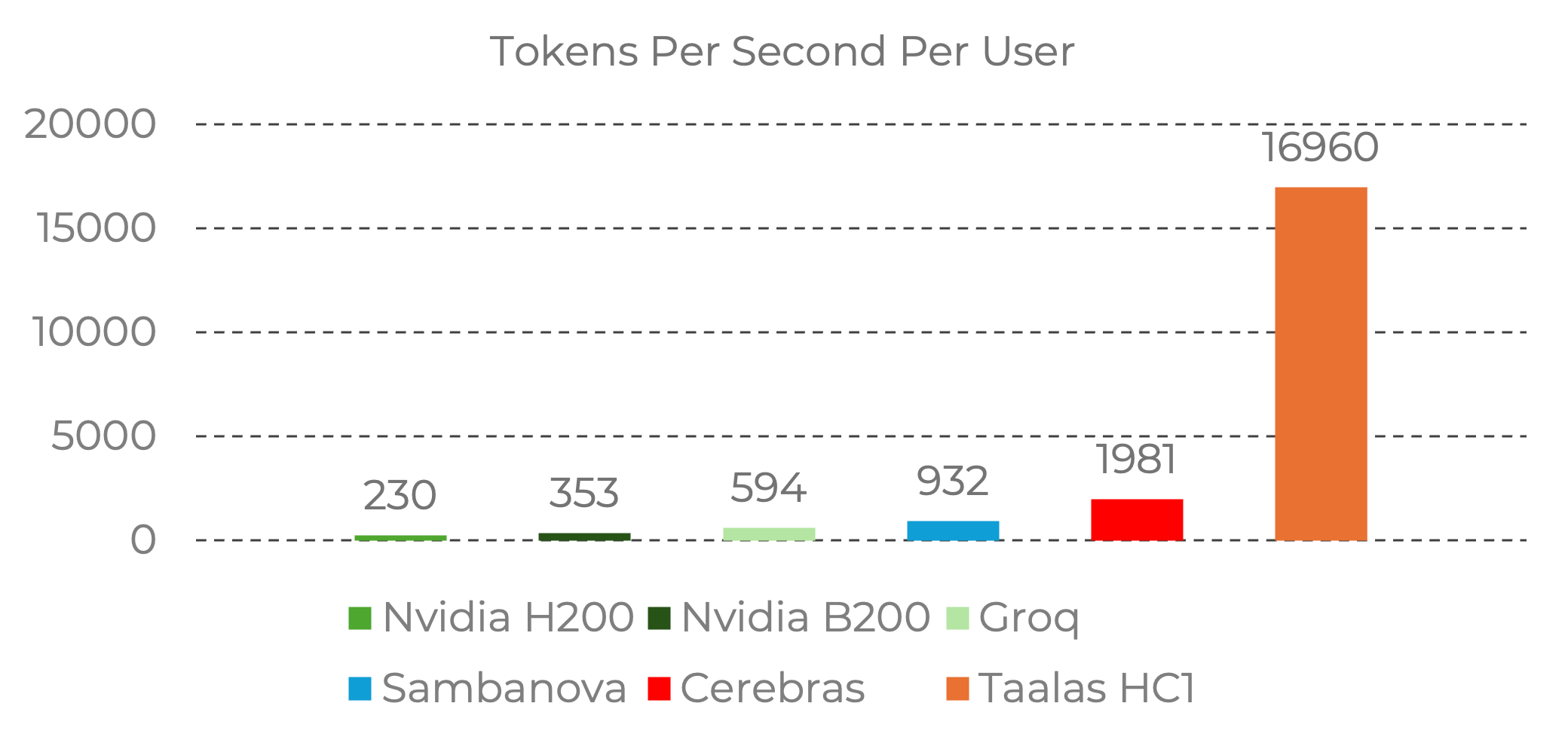
So this demo is around 90 times faster than typical speeds for the same model at openrouter, and around 30 times faster than the absolute fastest option available (Groq).

Comment by anthonypasq 7 hours ago

im assuming energy expenditure is substantially lower as well

Comment by 7 hours ago

Comment by wmf 6 hours ago

AIs don't intrinsically know anything about themselves so they often give wrong answers to such questions. This can be fixed by putting info in the system prompt but they may consider it a waste of tokens since most usage doesn't benefit from that information.

Comment by anigbrowl 6 hours ago

That proves it's conscious!

(/s!)

Comment by mNovak 5 hours ago

What I like about this, is that it significantly increases the probability of a sci-fi scenario where you're picking up a hot chip on the black market; rumor has it, Mythos 9 weights baked in...

Comment by bigyabai 2 hours ago

Plug it in, and it's a old prototype with Gemma 5 weights baked onboard. Dammit, fucked by Craigslist again!

Comment by NitpickLawyer 1 hour ago

Back in the kazaa and limewire days, you'd sometimes try to get a movie / episode from a series, wait hours / days for it to download, and when it was done you had a ~50/50 chance to actually watch what you wanted or an old german porn movie :/

Comment by yassa9 1 hour ago

Can anyone imagine if a video generation model with the speed of ASICs baked into silicon ? real Sci-fi

Comment by msteffen 6 hours ago

This is neat but IMO a little crazy.

Something I personally haven’t seen much of, in all the discussions of model benchmarks and AI breakthroughs, is a distinction between “peak performance” and “reliable performance”. The “peak performance” of frontier models is very high: they’re solving open math problems, analyzing large codebases, etc. But my subjective impression is that “reliable performance” is mid at best: out of 100 random questions I might think to ask, it’s likely to say something wrong or stupid a handful of times at least.

I think there’s inherent tension between the two: the more a model reaches or outright hallucinates, the more likely it is to come up with tricky, subtle solutions to problems (I think people are somewhat like this too: Terry Tao’s brother is nonverbal, Jim Watson’s son has severe schizophrenia, etc). But then the less likely it is to generate a sensible email reply.

I use models all the time for coding, but I would not let one take over my daily correspondence. If the idea here is to run frontier models at high speed in data centers, that could be useful (the speed would be cool), but I’d be surprised if the cost of that hardware churn is worth it to frontier labs. But if the idea is to turn this into a chip that goes in your phone as some kind of routine, low-power inference thing…taking something too kooky to be relied on and baking it into your phone’s hardware like that doesn’t make sense to me.

Comment by dumberquestions 6 hours ago

I think you're underestimating both their reliability for standard problems and the usefulness of that level of reliability.

Comment by tyre 1 hour ago

This is a good point. Opus does some silly shenanigans sometimes but then catches it later. It’s still an order of magnitude faster at getting to a working system than I am, for ones I don’t know.

It’s really a dream for setting up a homelab

Comment by daishi55 6 hours ago

> out of 100 random questions I might think to ask, it’s likely to say something wrong or stupid a handful of times at least.

What are some examples?

Comment by wmf 5 hours ago

There's a benchmark for this and a lot of models get negative scores because they're so unreliable: https://artificialanalysis.ai/evaluations/omniscience

Comment by daishi55 3 hours ago

I wanted some examples they actually experienced. Because I use these things daily and haven’t seen a hallucination in a long long time.

Comment by yoyohello13 3 hours ago

I saw a hallucination just this afternoon about a spurious ca cert error. Definitely happens less often, but I do need to correct it occasionally. Maybe once a week so it still requires vigilance.

Comment by tyre 1 hour ago

Search a terminal with Claude Code for things like, “I got it wrong twice. I should look up the documentation instead of guessing.”

Does it about once a day, that I notice.

Comment by yumraj 7 hours ago

Given the fast churn of the models, how does it work out?

Won’t the silicon etched model already be 1 or more versions behind by the time the silicon comes out.

Though if it’s cheap enough, there certainly can be a market for cheaper model inferences.

Comment by sigmoid10 6 hours ago

I find speed alone would be a game changer for current models. I hardly find any task anymore that the current frontier models can't do with max reasoning after several rounds of feedback (provided sufficient instruction and the right harness). But waiting an hour or more for reasoning to finish is getting really cumbersome. If they could do the same in seconds (and for cheap of course), I'm pretty sure we'd pretty soon see major software companies pop up that are run by a single human.

Comment by deadbabe 6 hours ago

Can you give some examples of these tasks that require an hour or more of reasoning?

Comment by xyzsparetimexyz 5 hours ago

The recent maths prompts did. The 'you should find a breakthrough' one was several blocks of reasoning, each taking 90 minutes or so

Comment by craftkiller 5 hours ago

I think the real value here is not as a customer-facing agent/chatbot but for for automated processes. Think of all the companies out there that have LLMs doing simple tasks like categorizing customer feedback emails. For such tasks, you don't gain much from better models, so if you could run it 10x cheaper on a slightly older model, it would absolutely be worth it. Pretty much any place people are currently running a flash model could benefit from this since they're already deciding that speed+price is worth using a less capable model.

Comment by XCSme 6 hours ago

I think this would make sense for consumer hardware, not for AI companies.

AI companies constantly update/change stuff, new models come out, new requirements, etc.

But if you ship an "ai-powered" dishwasher, it can come with the chip built-in to do computer vision and precisely target each spot, and will be sold as-is with no updates.

Comment by yumraj 4 hours ago

Makes sense. Actually to expand, I believe this can make a lot of sense for industrial robots and such which have a more or less fixed job and latency matters more, so a well tested model may be more valuable than need to keep updating them

Comment by throwaway173738 4 hours ago

You don’t need this chip to do that. Computer vision has used machine learning for decades. The task you’re describing is pretty rudimentary and an off the shelf model with a control system would do it way cheaper.

Comment by tyre 1 hour ago

Think of a HomePod. 99% (and likely much more) of what people are asking is super simple.

Comment by XCSme 4 hours ago

It was just a random example, you could think of it as being a lot more complex (detect which type of food it is, what detergent to use, how much water, remember patterns, learn over time, adapt, etc.)

Comment by m463 5 hours ago

subscription "ai-powered" dishwasher with personalized user ads, most of the chip dedicated to "personalized" not spots.

Comment by XCSme 4 hours ago

So local personalized ads?

Not sure if that's better or worse than online personalizaed ads...

Comment by hahahaa 27 minutes ago

They still make 6502s right.

Comment by christina97 5 hours ago

There’s some kind of tradeoff between speed, cost, and quality for every application. I would be perfectly happy with a model 6 months old that was 50x faster for many uses. Right now I use either Opus (for smart stuff) or Flash without thinking (for fast stuff). I would take an even dumber model for more speed (lower latency in particular).

Comment by nullbio 4 hours ago

Perfect for consumers. You buy it and then you need to buy a new one in a couple of years. If they can make them affordable they'll sell like hotcakes.

Comment by etoxin 3 hours ago

And the second hand market. I'd love to see this integrated into motherboards like RAM. Someone could have a motherboard with 4 sticks of different AI with various models. Swap, change and trade.

Comment by chorizo 3 hours ago

That’s not going to be true forever. As models mature, we will hit diminishing returns. Major improvements will come annually rather monthly - matching the roughly annual release of new processors. Model ROM’s will likely get integrated into die packages just like DRAM now.

Comment by pennomi 3 hours ago

I’m hoping for SNES style cartridges

Comment by mrheosuper 3 hours ago

I'm still using Opus for most daily task because Fable is too expensive.

If they begin etching Fable into silicon now and release it 2-3 years later, i can see the market for it

Comment by brokencode 5 hours ago

Already models have gotten really good at a lot of things.

A lot of people would probably be happy to stick with the same model for a year or two if it’s 10x faster and cheaper.

And perhaps older models can become cheaper over time as newer models come out on new silicon for a higher price. That incentivizes people to stick with older models.

Comment by noosphr 3 hours ago

This is a feature for most local use cases. You don't want all your work flows to start failing because of a model update.

Comment by prinny_ 6 hours ago

They expect a sort of breakpoint at which each subsequent model version will only be marginally better than the previous ones, thus allowing them to retain their value for some time. Their business doesn’t work if each year the new model demolishes the previous one in terms of performance.

Comment by laweijfmvo 6 hours ago

pretty much everything is “1 or more versions behind” by the time it comes out. the question is whether or not it’s still useful? at some point, presumably not every application will need the latest cutting edge huge model.

Comment by casey2 3 hours ago

There isn't a fast churn in the underlying pretrained model, nor RL. It's mostly orchestration around the model. Said another way you could just pretrain and RL for longer.

Also I believe there is both a market for extremely fast local inference with current model performance and that such fast inference would unlock unforeseen usecases. Especially as TPS approaches early computer clock cycles and data rates.

Comment by deadbabe 6 hours ago

You could take your silicon chip and have it re-etched only with model diffs for an upgraded version.

Comment by yumraj 4 hours ago

How does that work, as in re-etching of silicon? Any pointers to read?

Comment by A_D_E_P_T 8 hours ago

This is probably a win-win. The team gets paid, and we get greater assurance that their best ideas and architectures -- which are truly impressive -- are going to see the light of day in actual products.

Comment by badatnames 8 hours ago

They were too small for this to be a meaningfully sized purchase for AMD, there's real risk they get sucked into a team that ultimately delivers sqat, not to mention the chances of anything being delivered in an even remotely consumer-priced bracket are definitely out the window

Comment by kristianp 3 hours ago

I've been eagerly awaiting their 2nd gen HC2, which uses multiple chips to host a "mid sized reasoning" [1] model. Its due in summer according to the article, I wonder if it will ever be released in that form now.

[1] https://www.forbes.com/sites/karlfreund/2026/02/19/taalas-la...

Comment by NitpickLawyer 1 hour ago

> I wonder if it will ever be released in that form now.

Yeah, I had the same thought. The key thing for them was the price point at which they could deliver a ~30B model. I would buy one today if it was ~1000$ and could run whatever the best 30B model is today, at those speeds advertised. Even if the model becomes superseded by model.5 in a few months, there's still a lot of things you can do with a "good enough" model for some tasks. And things like maj@x or generate 10 times and choose "at a glance" what you like (think frontend stuff) would be worth it.

No idea if them selling to AMD is good or bad.

Comment by hliyan 3 hours ago

Question: we currently emulate neural networks by performing matrix math in synchronous clock CPU architectures. Would it not be better to abandon synchronization and etch neuron synapses directly in silicon, keeping only the weights variable? I think some researchers are pursuing this, but I forget what the approach is called.

Comment by freakynit 1 hour ago

"Neuromorphic chips" .... and I have the exact same question in mind.

Comment by badatnames 8 hours ago

Well so much for that dream.

Guess we can look forward to picking these up ex-enterprise on ebay for under $5k a pop in a decade or two

Comment by dogomatic 4 hours ago

What’s stopping competition?

Comment by redox99 6 hours ago

Is there any LLM from exactly one year ago that would be worth running?

In Aug 2025 you had

- OpenAI o3

- Opus 4.1

- Gemini 2.5 Pro

- Grok 4

Even if those were almost free to run, you'd be way better off with Deepseek flash 0731 or GPT 5.6 Luna, which already are almost free.

Other than for things where the t/s are critical, it seems like a bad idea to etch a model into silicon.

Comment by itgoon 10 minutes ago

Gemini 2.5 Pro was very good at writing single, somewhat complex functions. Sure, the rest of the loop would still take time, but nearly-instant implementation? Sign me up.

Comment by mdp2021 6 hours ago

> Is there any LLM from exactly one year ago that would be worth running?

Bad perspective: consider the correction: "when are thresholds of sought quality reached"? Hence: not "is there a 10yo from last year that could compete with the current 13yo", but "will there be a 30(?)yo from last year that could compete with the current 33(?)yo" ('(?)': the scale of yearly growth in the future is uncertain).

Comment by redox99 6 hours ago

It's not just about it "being smart enough". It's about there being actual user demand when it needs to compete with the shiny new model.

A 10 year old iPhone is probably good enough, but is there demand for it? In a vacuum a 10 year old iPhone is good, but why would you pick it if you can have a current one for a reasonable price?

Comment by singingtoday 3 hours ago

We still run GPT 4.1 for some of our use cases. We want to replace it but are having trouble finding models that are as fast with similar or better intelligence.

Comment by daishi55 6 hours ago

That is fkin wild. o3 was just a year ago? The progress is truly insane.

Comment by redox99 6 hours ago

Yeah I had to double check, o3 feels like it was ages ago. But GPT 5 came out Aug 7, so it's only one day off from my 1 year ago cutoff!

Comment by mikeayles 8 hours ago

AMD could have saved their money and used their own hardware! I've got a language model doing 60k tok/s on AMD hardware already, a Xilinx Kria K26 SOM, with the weights baked into URAM/BRAM with zero DRAM in the token loop. Same thesis as Taalas: single-stream decode is bandwidth bound, so stop fetching weights from far away.

Caveats stacked high, obviously. It's 3.16M parameters (tinystories, and I also have a kevin-speak lemmatised version), the tokens are characters, and the 60k record is 16 streams that each remember exactly one token of context, so it's blisteringly fast at saying nothing. The honest build with full context and KV caching still does ~19k tok/s on one stream though.

I keep messing with the blogpost with the live demo, but I'm planning on flipping it to live in the next day or two

Comment by Melatonic 6 hours ago

Yeah Im surprised nobody is talking about this. When everyone first saw Taalas I looked at the design and it had a big legup in physical cache availale compared to most chips. Makes you wonder how much of a benefit there is to the actual "baking" of the model vs just having a large chip with a ton of SRAM (or whatever) soldered close to the edge physically.

I feel like what we really need is the ability to solder computer cache on all sides of the chip Meaning above and below as well. If you can only attach it to the edges you will be inherently physically limited on the amount you can put (and maybe even have latency benefits as well)

Comment by Legend2440 6 hours ago

What you're describing is what Cerberas does.

Talaas is different, it's a true compute-in-memory architecture where the weights are stored in the connections between the transistors that perform the matrix multiply, rather than in seperate memory cells.

Most of the benefit comes from this architecture; hardwiring the weights into the silicon is just the easiest way to implement it. SRAM requires too many transistors, DRAM requires an incompatible manufacturing process, and exotic phase-change memories aren't readily available.

Comment by Melatonic 6 hours ago

Cerebras chips are massive and do have more on the edge but they dont have any top or bottom cache do they?

Comment by jaggederest 5 hours ago

They can't due to power density, I believe - they have to be run in a sandwiched waterblock with massive cooling, as far as I can tell. That's the biggest thing that baked weights gets you - a relatively modest watts-per-square-mm compare to cerebras, where they had to engineer a whole system to get the watts out of the chip

Comment by pstuart 49 minutes ago

Do you think there's room for reducing power requirements? Obviously shrinking the process is a win, but is the existing implementation a "just make it work" phase that has opportunities to increase computational efficiency?

With that kind of speed and if even lower power requirements, they could release mini compute units with USB4/Thunderbolt for plug and play inference.

Comment by wmf 5 hours ago

Taalas does not have cache so...

I agree that Groq with multilayer hybrid bonding could be a good idea.

Comment by tandr 7 hours ago

Well, technically it is their hardware now...

Comment by questionableans 7 hours ago

And their team, if they treat them well.

Comment by zxspectrum1982 6 hours ago

1. How come you didn't make your implementation public? You could be a millionaire now. 2. Especially if AMD has the technology to do what Taalas does, it makes a ton of sense for AMD to acquire Taalas: remove them from the market. Make sure nobody else (Intel, Huawei, Alibaba, NVIDIA, etc) acquires them. It could have been a great acquisition for a rebirth of BlackBerry btw.

Comment by est 3 hours ago

Waiting for intelligence on a stick, plugin an USB, characters in, characters out.

100% local and no leaks.

Comment by proxysna 9 hours ago

Really hoped to see their hw out in the wild one day

Comment by ggm 6 hours ago

Field reprogrammable, it's an FPGA on steroids. Field upgradable.

Burnt in, it needs a zif socket and easy access in every car, aircraft, a pull out slot in a phone, or it's new era planned obselescence.

Comment by XCSme 6 hours ago

Why not have some a device/hardware that programs itself on-boot.

Sort of a FPGA, that (electrically) arranges the connections on-boot, and then it's like a static inference chip.

Comment by wmf 5 hours ago

FPGAs already configure themselves on boot.

Comment by XCSme 1 hour ago

I asked a LLM after posting my comment, to see if I had a genius idea or not,just for it to tell me the same as you, that's now they work already...

Comment by mdp2021 6 hours ago

Can that be done when the whole idea is to store a multiplier into a handful of transistors?

Comment by ggm 6 hours ago

I have no idea. It makes my comment a statement posted as a proxy for a question, a question you correctly pose explicitly.

If it can, then deployment in a sea of gates can make a chip viable across model generations as weights change, inside some scale factor.

If not, unless the part is under a pinout and address model which can scale on the bus, and can be easily replaced, it makes the entire dependency a replacement, not just this part. So embedded use has consequences.

Comment by xyzsparetimexyz 5 hours ago

It can just be pcie

Comment by zkmon 2 hours ago

I guess the idea is, gains from inference speed could offset the cost of upgrading the chips to a new model when really required. I think general purpose models would consolidate and release frequency might flatten out, favoring this strategy.

Comment by andix 4 hours ago

It would be quite ironic if this technology would render all those AI data centers practically useless. If the next step are just a much smaller amount of expensive chips, and the bottleneck becomes manufacturing those chips fast. Not building huge data centers and fighting for electrical power.

Comment by ratsbane 1 hour ago

Smart move by AMD. Chatjimmy is very fast and not very good, but I think it might become very fast AND very good.

Comment by num42 2 hours ago

I have used chatjimmy before, it is incredibly fast, waiting for latest SOTA model on the chips in future. Great!

Comment by bhouston 8 hours ago

Toronto Canada startup btw.

Comment by cmrdporcupine 8 hours ago

Seems to be somehow some kind of offshoot from or connected to Tenstorrent, which is just down the road. Founder looks like he was/is maybe at Tenstorrent and previously associated with Keller?

Always fantasize about applying at Tenstorrent, but wrong side of Toronto. 2 hour commute.

Comment by kridsdale1 7 hours ago

Works well, I remember driving by the ATI building as a kid.

Comment by matheusmoreira 2 hours ago

> Once the chips are deployed you’re stuck with that model.

At least we can be sure that's the model we wanted. Service providers could be serving modified versions and nobody would ever know.

Comment by preommr 6 hours ago

People are missing the point if they think this is useless because frontier models keep changing every few months.

We really, really need better secondary models that can do things fast and do them cheaply for lots of dumb tasks. Not only because it can be used as sub agents by frontier models, but also because it can be like a universal grease for all kinds of software.

I've got an app I am building and I don't want to tie myself with frontier models because I'll never be able to beat openai/anthropic. I just want a simple, cheap, instantaneous model that can just go through my documentation and tell the user what to do next and how to integrate with whatever ai subscription they have.

Comment by MarkWayneNewton 8 hours ago

While this design is self-limiting I think its a good approach. It doesn't take an entirely new architecture or infinite memory to produce significant performance improvement.

Comment by Legend2440 6 hours ago

This is a new architecture. It's a non-vonn neumann device.

Comment by analog31 1 hour ago

Wow, we're heading back to mask-programmed ROMs. I'm feeling young again.

Comment by yunnpp 3 hours ago

I would've hoped the company stayed independent instead of being engulfed into a behemoth. I'd like to see more diversity in the hardware ecosystem, but I guess the economics of hardware manufacturing aren't there.

Comment by nojs 7 hours ago

Can anyone comment on the economics and likely turnaround times of this process, when it’s more mature?

Would it be realistic for a frontier lab to deploy this or would the turnaround time mean the model is always too out of date?

Assuming the weights and architecture are eventually stable, how much cheaper would this end up being?

Comment by 2001zhaozhao 7 hours ago

There are always uses for outdated models.

Claude Code is still using haiku 4.5 from ages ago for explore subagents for instance. Not to mention production uses like customer service that only need to be "good enough"

Comment by edot 7 hours ago

Just looked this up, no longer true. Explore subagents inherit whatever model the parent is. And you can of course make other subagent configs.

Comment by samtheprogram 7 hours ago

That's solely so that you burn more money. It's totally unnecessary to assume the parent model. Sure, it could be upgraded from Haiku if there was a solid reason to, but...

Comment by AussieWog93 7 hours ago

I mean, if you could get Opus or even Sonnet 4.5 at 1000+ tok/s exploring the codebase, they would probably change that setting back.

But either way, I think GP's overall sentiment of "delegating intelligence-saturated tasks to an outdated but fast subagent" makes a lot of sense.

Comment by alightsoul 7 hours ago

Customer service has really degraded huh. 4 years ago they expected opus performance out of human call center agents

I guess losing some customers due to poor customer service is ok if the price of customer service is right.

Comment by cogman10 7 hours ago

2 to 3 months optimistically assuming everything goes smoothly and is fully automated.

6 months or even a year if something goes wrong in the fabrication process and you need to update things.

If they do more standard asic design, it could be a lot longer as the design needs to be validated on an FPGA cluster, which would necessarily need to be very big for something like a LLM. Easily up to 2 years.

There's a reason chatjimmy isn't demonstrating newer models and why they only show of an 8B model.

Comment by shangofox 7 hours ago

I mean even if it take a few months, it'll still be out of date. But there was a hypothetical when it came up in Feb, would you want Qwen 3.5 at like 10k tokens per second.

At the time people were no doubt saying yes but now 3.8 is out, is that still desirable?

Comment by xienze 7 hours ago

There's soooo much stuff that such a model is still capable of doing in the pursuit of getting a better overall answer. Imagine a powerful research agent that blasts out dozens of the small, cheap models to fetch and summarize one page each. Then the beefy researcher model performs the final analysis.

Comment by sgc 5 hours ago

What does it take to go from here to a model on a pcie card or an m.2 card, so I can plug one into my workstation / laptop? Will 'intelligence' become much like a gpu, where most people just live with the performance of whatever they have installed, outside large companies that must have cutting edge, or prosumers that have a incrementally better version than the masses?

Are we a couple years away, a decade away, or something else?

Comment by mdp2021 5 hours ago

> What does it take to go from here to a model on a pcie card or an m.2 card

It is already that.

> Will "intelligence" become much like a gpu

As an option among the implementations.

> Are we a couple years away

They could mass produce now, but it makes no sense at this rate of improvements in the models.

Comment by 3836293648 2 hours ago

They moved from HBM to dedicated silicon and only got a 48x speed up? That is so, so, so much less than I would've expected. Any numbers on how it scales?

Comment by syntaxing 8 hours ago

Honestly, this is starting to make more and more sense. SOTA models are starting to converge to certain architecture and capabilities. I wouldn’t be surprised we end up with a base model ASIC + “fine tune” card where it’s a physical LoRA style adapter.

Comment by encyclopedism 8 hours ago

Imagine a multi-modal model with 1000's of tokens per second. Realtime inference for a host of applications. This is a BIG deal and will change the landscape in unfathomable ways.

The https://chatjimmy.ai demo was impressive.

Once models settle down this makes sense. Imagine a cartridge with a physical model on it. You purchase a cartridge and stick it in your computer/phone/server. Want to upgrade? By a new 'cartridge'.

This should bring inference cost down dramatically, I wonder how OpenAI/Anthropic feel about that.

Comment by pstuart 14 minutes ago

The cartridge could be a small mac-mini type unit connected and powered over thunderbolt. If it included like an m5 or m7 with 64GB of memory and a PCIe5/6 4TB Nvme it would be amazeballs. Hopefully when the bubble corrects and hardware advances and prices reset something like that will become available.

Just even comparing compute from 10 years ago (Apple silicon vs Intel) and it's significant. 20 years it gets crazy. My first computer was an 8 bit 6502 with 64K RAM and a 128K floppy drive (I think, it's fuzzy). Everything amazing now will look quaint in due time.

Comment by 2001zhaozhao 7 hours ago

i'm looking forward to Qwen3.8 27B launch to see how much models have peaked at a given size.

it might already be time to start burning the best small models onto hardware since it's possible they can't get much better at many tasks like knowledge recall due to the inherent information density limits for models at a given size.

Comment by Grosvenor 7 hours ago

> Imagine a cartridge with a physical model on it.

I can finally have my own Dixie flatline. Cool.

Comment by mdp2021 7 hours ago

> Dixie Flatline

In case some did not know: also the movie (actually TV series) is finally happening.

# Neuromancer - Official Teaser ( https://news.ycombinator.com/item?id=49055037 )

Comment by anthonypasq 7 hours ago

very interesting idea. i didnt think of that. i was just assuming youd have an additional one of these in your phone for actual lightning fast local inference

Comment by VladVladikoff 8 hours ago

Wouldn't this mean someone with sufficient hardware could lift the SOTA model weights off the chip? Or are you saying that these chips would only be used internally by these companies and not sold to the public?

Comment by dumberquestions 7 hours ago

I wouldn't expect companies not sharing their weights today to be any more likely to share them if they're on hardware, this doesn't sufficiently hide weights from a local user.

Comment by snek_case 7 hours ago

The weights are very unlikely to be on the chip itself. That wouldn't work for SOTA models that are terabyte scale, even quantized. This is probably an accelerator for specific kernels in the model, but the weights are likely loaded from memory. The chip may have SRAM to store some of the weights temporarily during inference.

Comment by foltik 7 hours ago

At least in the case of Taalas the weights are physically encoded directly on the chip.

It’s composed of 4-bit multiplier cells that compute all 16 possible results in parallel. The top metal wiring layer physically selects the one that corresponds to a multiplication with that cell’s constant weight, and routes it to the next layer.

Comment by mdp2021 5 hours ago

Are you sure? Source? (does not seem to be https://taalas.com/the-path-to-ubiquitous-ai/ , for example)

Comment by syntaxing 8 hours ago

I don’t get why this is an issue? You can run Claude/OpenAI SOTA models through Amazon bedrock. These weights have to live somewhere to run on Bedrock.

Comment by wmf 6 hours ago

somewhere = an AWS data center with multiple layers of security and NDAs

They won't sell/rent/license the weights to an end user at any price because they don't trust your security.

Comment by syntaxing 1 hour ago

I work in embedded space. Just because it’s in hardware doesn’t mean you can’t “protect” it. Most modern software (regardless if it’s hardware or not) can be cryptophically signed.

Comment by bluezly 42 minutes ago

[dead]

Comment by amazingamazing 7 hours ago

One idea would be to use an open model.

Comment by kevin_thibedeau 7 hours ago

Then we can have machine psychologists pull cards when they run amok.

Comment by all2 6 hours ago

You have a robot. You need it to be smarter. You buy a new model cartridge (probably a PCIE 9.x). Now you need some domain specific skills. You'd like it to be able to cook, and you'd like it to not dent your walls anymore. You buy 'improved spatial reasoning LORA' card and 'Gordon Ramsey's Chef ULTRA9000' card.

Now your robot can respond sarcastically when you ask for chicken nuggets. Again. It also doesn't dent your walls anymore.

Comment by walrus01 7 hours ago

Having a base model ASIC as a physical piece of hardware makes me think of the early days of microcomputer desktop stuff where having a socketed ROM or PROM was a key piece of hardware, and people actually knew/cared what ROM was on their system's motherboard.

Imagine if like instead of having a specific Mac Plus ROM, you had a thing that looks like a fat ASIC that can hold models sitting on a slotted daughtercard directly next to the CPU and RAM.

Comment by breadislove 7 hours ago

we have not converged at all, if you look at how different the chinese models in terms of architecture you can guess that the labs are experimenting a lot as well. we are seeing all different types of hybrid architectures, different attention methods and so on. Of course on a high level its still a transformer but if you take a proper look we are seeing more divergence then a convergence.

Comment by smokel 8 hours ago

The technical aspects of SOTA models are not publicly documented. How do you know if something is converging?

Comment by syntaxing 8 hours ago

SOTA American models are not. SOTA Chinese models are. From a physics aspect, closed source models cannot be too far from open source ones in terms of size. There’s only so much you can squeeze out a B100 style cluster even with fancy Dflash style diffusion model for the speculative model.

Comment by _aavaa_ 8 hours ago

If we had deepseek v4 flash 0731 etched on a chip it would be more than capable enough and fast enough for so many people's needs, even hardcore engineer.

Comment by nurumaik 8 hours ago

Will be capable and fast enough for 2-3 weeks until new sota drops

Comment by amazingamazing 7 hours ago

If it is capable today why would a new model change this?

Comment by thombles 7 hours ago

I think it’s tongue in cheek. When I first got access to Sonnet 4.5 I remember thinking to myself “y’know if they never got any better and I just had access to this forever then that would be pretty okay”. Turns out my expectations have changed since then and I would like a higher baseline now.

Comment by singingtoday 2 hours ago

Interesting. I've yet to find a model I consider sufficiently intelligent.

Fable is nice, but still requires a lot of guidance for large scope tasks.

Comment by catchnear4321 7 hours ago

if capability is a commodity then the differentiator becomes taste.

Comment by FridgeSeal 7 hours ago

Because new stuff instantly makes anything prior bad and incapable and garbage of course! Did you forget the hype-machine speaking notes??? /s

Comment by cyanydeez 8 hours ago

if they were still exponentially increasing, they wouldn't be preparing for an IPO. IPO is where companies go to die and founders escape.

Comment by cyanydeez 8 hours ago

I don't think there'll be a fine tune card; you'll have the base model vintage whatever year, and then your GPU will do whatever LoRA layers you want it to do; the LoRA will wrangle older dated models into the current of whatever your looking at.

But yeah, for things like programming, if it can do linux and python and some go and sql and javascript, larger domains can be threaded with LORA

Comment by ford 3 hours ago

I've been showing people chatjimmy for months - it's incredible. Both reasoning and tool use generation scale with TPS. Imagine 100x more reasoning on a model, or 100x parallel tool uses.

Comment by galaxyLogic 4 hours ago

I think the big news is that AMD is getting into memory-business so they won't be so dependent on Hynix and what have you. Memory is the bottleneck currently.

Comment by redmoonx 6 hours ago

It obviously won’t be continuous delivery but could make sense if the lifecycle of a model (train, deploy, iterate (meaningfully) is about 1-2 years. In that case it fits nicely in the “this year’s model” already established with cars, phones, etc.

Comment by rvz 8 hours ago

Didn't even give them a chance to launch the hardware.

Comment by laweijfmvo 6 hours ago

I’ve been using Gemma as my default (via Kagi) because it’s served on Cerebas hardware. The speed is honestly a game changer for day to day queries.

Comment by jackdoe 6 hours ago

Can you imagine in few years getting Fable level intelligence at 20k tokens per second?

"You are not prepared" --Illidan Stormrage

Comment by drob518 5 hours ago

So, Kimi K3 in silicon sometime soon?

Comment by roughly 5 hours ago

How's that jive with the fact that they're introducing a new model every other week?

Comment by drchickensalad 5 hours ago

The new model every week is not necessary at this point really. What if you could run opus 5 for the next couple years at 1/20 the cost?

Comment by roughly 4 hours ago

What's interesting about this is that I as a user would find this useful, but I think the AI industry as a whole would find it an absolute goddamn disaster. Opus 5 is a very good tool, but it is not a human-replacement-level intelligence, which means the entire revenue stream the industry's built on - labor replacement - is not met by this, and the only slightly charitable read of the industry's finances is that they're gonna bootstrap their way to creating the labor replacement hypothesis by getting people to spend money on Opus/etc, whereas if the actual product is a 1/20th the cost Opus-on-a-chip, the entire business and financing model that's tying up $N Trillion dollars of investment money goes out the window.

Great for us, looks like a recession as far as the Market is concerned.

Comment by jaggederest 5 hours ago

Pipeline the burn into silicon, lower the latency as much as you can, for the 10-100x operation cost it's worth it. Imagine if frontier models cost $5/mtok and the 2nd or 3rd tier models cost $5/billion tokens for 3-month-old models.

Comment by tecoholic 7 hours ago

With web search and tool call a decent current generation model at the speed of the chatjimmy could do a lot. People saying it would be out of date are missing the point. It’s not going to make much sense for frontier companies that’s chasing the SOTA. But for a lot of business use cases if someone can put GLM 5.2 and sell it as a box, it would make so much sense.

My partner has been asking for a “completely private” model for doing research and shifting through volumes of data that can’t leave the office and $$$ for the current hardware makes no sense. It would be an easy sell if someone walks in with a black box that contains “ChatGPT”.

Comment by 5555watch 5 hours ago

In my understanding the first Deep Think / Pro models were already very good as they were doing some kind of parallel repeated reasoning, thus were slow and expensive. So if chatjimmy speeds enables a fast deep think level performance, I think that would be great.

Comment by equinumerous 7 hours ago

100% agree - you don't need the most up-to-date model to have something that's useful in agentic contexts. They could even produce chips with weights that make all the decision making/logical reasoning and have it delegate to other specialized agents. If it becomes cheap enough to print a run of custom chips, releasing a batch for each major advancement does not seem unreasonable for SOTA companies.

Comment by cephei 7 hours ago

There are so many use cases for supremely fast offline models. The first thing that comes to my mind is for real-time video processing or other non-textual content in real time.

Comment by anigbrowl 4 hours ago

I wouldn't call it supremely fast but zippy and versatile, yes: https://shop.m5stack.com/products/ai-pyramid-computing-box-p...

Comment by yousif_123123 5 hours ago

If things like this get traction, will we need all the datacenters?

Comment by downrightmike 3 hours ago

You are mistaken about what the datacenters are for

Comment by jauntywundrkind 6 hours ago

Core rope memory is back baby!

Enjoying the Ian Cutress / TechTechPotato video on Taalas. Some ok good technical details on the tech, and some good insider baseball, whose who stuff. (What a treasure having tech discussions like this about.) https://youtu.be/3MKRjt59hh4

Comment by OddMerlin 4 hours ago

Congrats to the Taalas gang.

Comment by concraper 4 hours ago

A massive L for Canada

Comment by tech234a 3 hours ago

See also: Twitter statement from Taalas https://x.com/taalas_inc/status/2085458427757937097

Comment by bob1029 8 hours ago

I feel like NAND process tech could become useful at solving some of these problems. A GPU where you can update the weights a few thousand times may be sufficient.

Comment by mdp2021 7 hours ago

The basis of Taalas is "compute in memory" electronics - past Von Neumann's separation of processor and memory.

You need to be able to add|mul where the data (the weights) are stored.

Comment by addaon 7 hours ago

NAND hasn't been scaling great lately. It seems like PCM or MRAM would both be better fits.

Comment by kridsdale1 7 hours ago

FPGA model storage?

Comment by galaxyLogic 4 hours ago

"... the chip serve Meta’s Llama 3.1 8B at a blistering 16,960 tokens a second — when announced last February, that was 48x faster than Nvidia's GPUs and 8.5x faster than Cerebras' accelerators. "

Comment by fellowniusmonk 7 hours ago

Token quantity will have a quality all its own.

Comment by ycui7 8 hours ago

so qwen3.x-27b on hardware? or better deepseek-v4-flash on hardware .

Comment by ilaksh 8 hours ago

I wrote them an email asking for PrismML Bonsai 27b Ternary which is like 6b or something crazy small and would be a lot easier for them to do initially.

Comment by mdp2021 7 hours ago

They were specializing their forthcoming system on 4-bit FP - which I understand is a structural decision.

Bonsai Ternary (1.7bits/weight) is a compromise, compromise that has to make sense in the context - efficient when translated into transistors.

Comment by andrewvl 7 hours ago

It must be a “super model”. What will be if new model released? New chips?

Comment by downrightmike 3 hours ago

Chip pops out like a gameboy cartridge. AI not working? Blow on it and jam it back in

Comment by jijji 2 hours ago

taalas is great for llama 3.x 8B models, really bad for one board serving Kimi K3, it seems like you would bottleneck at a few hundred tokens no matter what you do.... spreading the big model against multiple cards seems the only way to get into the 1k+ tok/sec range. Another thing taalas is doing is masking the model weights into the silicon itself, not a flashable firmware, which would increase latency....

Comment by api 5 hours ago

I've had an endgame idea in mind for a while.

Models, probably first open weight ones like Kimi K3 class, are etched into silicon like this and sold as cartridges almost like old school game cartridges.

You buy a USB-C dongle that the cartridge goes into, or for data centers you have PCI cards that take these in slots.

Comment by wmf 5 hours ago

Each cartridge costs $1,000. Do you still want it?

Comment by anigbrowl 4 hours ago

For fast Kimi K3? You're damn right I do

Comment by wmf 2 hours ago

$1,000 only gets you the Qwen 27B cartridge. For Kimi K3 it would be more like $100,000 (and the "cartridge" is the size of a refrigerator).

Comment by singingtoday 2 hours ago

Yeah. I have 3 max20 plans.

Comment by api 5 hours ago

Me? Probably not. A business or a hoster, sure. There'd probably end up being an aftermarket in used cartridges with slightly older but still good models on them.

Comment by ur-whale 6 hours ago

Yeah, so https://chatjimmy.ai/ ... the model is crap, but the speed is amazing. Worth checking out.

Comment by walrus01 7 hours ago

Imagine the size of chip needed to 'etch' something like Qwen 3.6 27B in size.

Comment by golem14 7 hours ago

Interesting thought, because it's a yield question. How tolerant are models today to a few broken weights.

If tolerant, they could churn out many cheaper chips, some perhaps with slight abnormal tendencies ;)

Comment by thepasch 7 hours ago

> How tolerant are models today to a few broken weights.

Extremely! You can remove entire layers and the model will still work just fine, with barely perceptible capability losses.

I've cut/bypassed ~15% of total parameters out of Gemma 4 31B on a pod once. Still got perfectly coherent responses out of it. Certain layers are a lot more important than others, particularly early and late ones; but it's honestly astonishing how much can be cut out from the middle without destroying the model's coherence.

I didn't run any meaningful benchmarks, so I have no idea what the capability loss looks like exactly. But "produce coherent and sensible English in response to a wide variety of prompts" was definitely not among the things the model unlearned.

Comment by walrus01 6 hours ago

Brings to mind the scene in '2001' where Bowman is pulling out individual pieces of hardware that represent the mind of HAL, and it becomes increasingly incoherent as more physical hardware is detached.

https://www.youtube.com/watch?v=UwCFY6pmaYY

Comment by walrus01 7 hours ago

I wonder if you had a few percent of problems in the yield, if it would be functionally equivalent to the difference between a unsloth-published Q6 standard size GGUF vs. the nearly perfect precision of an unsloth Q8-K-XL. Or more like Q4 vs Q8 where a lot is lost.

Comment by mdp2021 7 hours ago

Not too dissimilar to the first HC1 (6nm 815mm² 53B Transistors embedding an 8b LLM):

> Our second model, still based on Taalas’ first-generation silicon platform (HC1), will be a mid-sized reasoning LLM

Comment by flog 7 hours ago

If someone has that sort of knowledge; how big a chip would be required? Is it possible?

Comment by mdp2021 7 hours ago

Well, given the data above, roughly a 220b transistors chip for the HC1 tech.

Comment by cubefox 6 hours ago

> At 20 billion parameters per chip, you’d need just 50 accelerators to support a trillion-parameter model

I don't see any evidence that this is possible. From my understanding, the whole model needs to be on a single chip. Which rules out any popular frontier models with several trillions of parameters. Even smaller sub-frontier models have hundreds of millions of parameters, so these would be ruled out as well.

Comment by wmf 6 hours ago

The methods for splitting weights across multiple chips are well established. Groq/Cerebras can't hold a model on one chip either.

Comment by pyrolistical 3 hours ago

Umm I have an extra 35, do you have layer 6?

Comment by octoberfranklin 1 hour ago

They pipeline-parallelize across multiple chips. DeepSeek v4 Pro will be 30 chips.

Comment by IsTom 6 hours ago

I think it's enough that a single layer fits on each chip if you can daisy-chain them with good interconnects.

Comment by moralestapia 5 hours ago

Taalas is just a phenomenal startup from Toronto. My dearest congratulations to the founders.

Edit: Lol, downvotes? Stay jelly, meanwhile Talas goes brrr.

Comment by khanhnguyen8386 58 minutes ago

[flagged]

Comment by gavinbuilds 3 hours ago

[flagged]