Show HN: Elevators
Posted by Jrh0203 3 days ago
Comments
Comment by peterldowns 2 days ago
A cool connection is that a spinning-disk hard drive (HDD) is actually kind of like one really long elevator, just wrapped around a spindle instead of perfectly vertical. The SCAN algorithm is actually a disk-scheduling algorithm!
Comment by bherms 2 days ago
Comment by NKosmatos 2 days ago
Comment by amenghra 1 day ago
Comment by liesliy 2 days ago
Comment by toxik 1 day ago
Certainly a take, ChatGPT. Not a very good one, but a take nonetheless.
Comment by omoikane 2 days ago
I wonder if this is an artifact of how the author used random destinations. I worked in a building that used Destination Dispatch, and the common travel pattern seemed to be:
- Everyone who is not on the ground floor generally want to go to the ground floor.
- People who are on the ground floor generally travel in large groups to the same destination.
This happens because people who worked on the same floor often leave for lunch at the same time, and return at the same time to the same floor. Destination Dispatch helps in this case because it's batching large groups of people with the same destination.
Comment by pimlottc 2 days ago
Ideally a new elevator installation would have a trial period where they record usage and then run it through a simulator like this to determine the optimal strategy for that particular building. And you'd want to re-run it every once in a while as the building tenants/usage changes. I wonder if this actually happens, though.
Comment by TeMPOraL 2 days ago
There's a tricky problem here: as a user, the first thing you do upon discovering a new elevator, especially if you expect to be using it regularly, is to observe how it behaves and adjust your own expectations/behavior to it.
Comment by gpvos 2 days ago
Comment by razakel 2 days ago
Comment by mvkel 2 days ago
Comment by _kb 2 days ago
In the simplest sense, I've seen this tied into security gates so as people badge on when entering the building there's already suitable elevator movement to meet demand by time the foot traffic reaches the lift lobby. That can then also feed into destination dispatch if you move from just people counts to identity (and known/most likely work floor).
From there you can move into wifi trilateration and have a live and quite accurate view of both how and who interacts with a physical space. This can feed into HVAC load shedding, JIT bookings for meeting rooms or workspaces, and a lot of very good things from a sustainability and general optimisation perspective. The flip side is it also has the potential to be an absolute dystopian privacy nightmare.
Comment by TeMPOraL 2 days ago
Privacy is an illusion for most people, and in office spaces, it's also a red herring. Wifi trilateration doesn't make things worse when you have a CCTV camera on every corner, badge reader at every other door, and presence sensing in conference rooms. Dystopia does not materialize without a severe regime shift.
Nah, my main worry is precisely sustainability and optimization, i.e. cost-cutting, because the more tools you give a business to optimize, and the more bullshit excuses ("sustainability! saving the planet!") you give a business, the worse the outcome is for users (here: employees). And a lot of that is doubly annoying, because it's counter-productive.
So what you have smart sensors in every room, and combine it with badge readers and wifi trilat and what not, and have smart auto-routing/rebooking algorithm: half the week, all conference rooms are always booked full, and yet somehow when you physically go and check, a good half sits empty, and it's apparently an impossible problem to solve.
So what the bathroom wall says, "with water-saving fixtures, we're using much less water in this building", and "we're now saving 2L water per flush". It's all bullshit, because those eco inventions mean I need to flush 3 times instead of once, and it means that I spend a minute washing my hands instead of 10 seconds - especially because both the soap and the dispenser are also optimized, so it takes 20 seconds to get enough soap on your hands, and then extra 20 seconds to get it off afterwards, because unlike normal people soap, it leaves your hands slippery for some reason.
And then they say "scientists said you can dry your hands with just 2 paper towels". At that point I'm getting red, because yes, I saw that TED talk 15 years ago too, and yes, it's total bullshit. Maybe it was true then, but the industry and the beancounters have value-optimized paper towels 15 times since that.
The generalization and summary of this rant is: slack is good. Happiness lives in slack. There is such thing as optimizing too much. Also the small, isolated systems under optimization, are in reality neither small nor isolated.
Comment by ufmace 2 days ago
Yeah there's a certain type of engineer mindset that loves the idea of optimizing things. But if you want to really optimize something, you have to carefully account for every single possible factor, situation, and use-case. Miss anything, and it's a much bigger disaster than saving 2% of whatever resource. It's rarely worth it.
Much better to treat the presumptions as a vague heuristic, make generous assumptions and add some slack, and call that good enough. Now there's probably enough slack to cover most of the edge cases you didn't think of, other things you based your original assumptions on changing under you, etc.
Comment by ben_w 2 days ago
Indeed, the Boimler Effect, amongst other things.
I see an analogy, Food : Malthusian catastrophe :: Money : No room for profit in an economy.
Comment by shepherdjerred 2 days ago
Comment by noisy_boy 2 days ago
Comment by brookst 2 days ago
Comment by breakingcups 1 day ago
Comment by ufmace 2 days ago
Comment by ArekDymalski 1 day ago
Comment by swiftcoder 2 days ago
Comment by omoikane 1 day ago
Comment by fuzzfactor 1 day ago
Comment by Ekaros 2 days ago
Comment by swiftcoder 2 days ago
Comment by Ekaros 2 days ago
I feel weirded each time LLMs are suggested for anything as some sort of holy solution for every single problem. Robot surgery let LLM control it. Robots cooking LLMs. Nuclear power plants and oil refineries LLMs... Industry has find a sledge hammer and now everything is a nail...
Comment by fragmede 2 days ago
Comment by Terr_ 2 days ago
Comment by acomjean 2 days ago
I just visited a new building with destination dispatch, so it seems to be still around.
My EE roommate in college had to build an elevator circuit as a final problem. It was on a bread board and had a bunch of call buttons and had a motor and a clear disk with black squares so it could figure out where it was…. I think it was the simple algorithm…
Comment by vova_hn2 2 days ago
Yeah, it doesn't make any sense to optimize wait time instead of total time from pressing the button to reaching destination.
Comment by esikich 2 days ago
Comment by Gabrys1 2 days ago
Basically you have an irrational sense of progress even if things get delayed
Comment by donalhunt 2 days ago
In one case, the building was still being commissioned and it took a while for anyone to even realize they were stuck (could spawn a whole discussion about launch processes in itself).
Comment by esikich 2 days ago
Comment by kadoban 2 days ago
Comment by Ekaros 2 days ago
Comment by darkwater 2 days ago
I see hotels with the kiosk model changing the UI depending on breakfast rush hour
Comment by icosian 2 days ago
The first time I encountered Destination Dispatch was in a London hotel, maybe 15 years ago. Anyone unfamiliar with the system would naturally sprint towards an open elevator and end up in an elevator with no buttons, totally bewildered. It's not the right system for a transient population.
Comment by donalhunt 2 days ago
Or should it be YORO? You only ride once?
Comment by whartung 2 days ago
Instead of hitting the call button, you started the request with your floor. Then the system would assign you an elevator (there were 6 cars as I recall).
I assume this gave the system more accurate routing data to make it more efficient for everyone.
Comment by nkjoep 2 days ago
Comment by taftster 2 days ago
Also the group of people going to or returning from lunch is real as well. The grouping factor happens more at the middle of the day and less at the morning or evening. Primarily because of lunch.
Comment by account42 6 hours ago
Comment by dawnerd 2 days ago
Comment by richk449 2 days ago
It turns out these fancy kiosks are in general worse for wait times compared to the traditional good ol' up and down buttons. There are certainly edge cases when the kiosks can win out (extremely tall buildings with 8+ cars per elevator bank) but for the majority of cases, simple up down buttons reign supreme.
This counterintuitive result is all thanks to the rebalancing step where every 5 seconds, the system re-optimizes each elevator's path. The kiosk enforces rigidity, you must get in the assigned elevator.
There should be no way that only having more information results in a worse outcome. At minimum, you could ignore the extra information, and achieve the same results as using up and down buttons.
Seems like the real reason it performed worse in this simulation is that when they implemented destination dispatch, they assigned an elevator at time of request, and had no system for reviewing and updated that assignment.
Comment by sambellll 2 days ago
I don't think it's possible to have destination dispatch AND update assignment together, in the real world.
- If the user clicks floor 26 and you tell them to wait at elevator G, you can't really tell them to move to F if it's taking too long.
- But if you don't tell them an elevator to wait at, then you'd need them to run around what is possibly like 5-8 elevators to find which one is going to their floor? That's obviously not realistic.
So then you're going to just have them get in the first one that opens? But then that's just the same as an up/down button.
Comment by richk449 1 day ago
Why not have active display above each elevator that says what floors it is going to when it opens?
Comment by ApolloFortyNine 2 days ago
Surprisingly, claude failed to find a good one.
Also, part of destination dispatch (I'm guessing based on experience) removes the 'stopping on every floor problem', so the real test would be total time including wait at that point I think.
Comment by Ekaros 2 days ago
Comment by alexpotato 2 days ago
I also thought that this is one of the biggest reasons destination dispatch was better.
There are even articles about switching to destination dispatch in office buildings or hotels lead to dramatic reductions in wait time.
Comment by theodorejb 2 days ago
Comment by rz2k 2 days ago
To prevent a riot, the building should probably deploy an employee with a fire key to manually operate the elevator.
* Elevators will answer an up button call while it is going to meet a down call from the top floor, but they will answer that call before filling any new down instructions, so you do have to ride to the top first.
Comment by n_plus_1_acc 1 day ago
Comment by Breza 13 hours ago
Comment by dredmorbius 1 day ago
Comment by Breza 13 hours ago
Comment by wrs 1 day ago
Comment by Neywiny 2 days ago
Comment by yccs27 2 days ago
Comment by MichaelDickens 2 days ago
Comment by cowsandmilk 1 day ago
What security issue? Many hotel elevators already have cameras.
Comment by Neywiny 1 day ago
Comment by andai 2 days ago
Comment by brandonpelfrey 2 days ago
Comment by CobrastanJorji 2 days ago
Comment by somat 2 days ago
Comment by bentcorner 2 days ago
I would always get a chuckle out of seeing some poor soul waiting 3 hours to go down a few floors after work, only because I failed to add stairs to the lobby.
Comment by genericone 2 days ago
Comment by CobrastanJorji 2 days ago
Comment by iqihs 2 days ago
Comment by jcranmer 2 days ago
(https://github.com/YootTowerManagement/YootTower if you haven't seen one of his messages on the topic before)
Comment by AndrewHart 2 days ago
Comment by fragmede 2 days ago
Comment by alanwreath 2 days ago
Comment by darkvertex 2 days ago
Comment by ivanjermakov 2 days ago
Comment by inigyou 2 days ago
Comment by john_strinlai 2 days ago
Comment by NooneAtAll3 2 days ago
I remember this one, it deserves all sorts of praise
Comment by ivolimmen 2 days ago
Comment by NooneAtAll3 2 days ago
but imo, unlike farmer, these games reaaaaly lack the ability to make functions/subroutines
manually doing all the goto loops becomes tiring
Comment by emmanueloga_ 2 days ago
Comment by vova_hn2 2 days ago
Can't believe, that this [0] solution to Challenge #5 actually worked, lol
Challenge #6 is "Transport 40 people using 60 elevator moves or less". Unfortunately docs don't make it clear what exactly counts as a "move".
[0] https://gist.github.com/vovanz/66e4396934ac656a8f8c32fcee43d...
Comment by fragmede 1 day ago
Comment by lmazgon 2 days ago
Comment by grep_it 2 days ago
Comment by perryprog 2 days ago
Comment by inkkin 2 days ago
Comment by hermanschaaf 2 days ago
In the game, some of the elevators are automated, and I wanted to choose an algorithm that best aligned with what players would expect an elevator to do. I ended up going with something close to LOOK, which (as the article states) is mostly what people expect. Except in case of ambiguity, I had it prioritise floors that have been waiting longer, to improve the p90, which is important in the game.
But now, add in these challenges:
- double-deck cabs (where attached cabs cover two floors at once)
- transfer floors between shafts
- express shafts
and the best (or at least, most expected) algorithm becomes much less obvious! I'll leave it as an exercise for the reader to figure out the best one.
Luckily I was in charge of a game, not a real elevator system, so I just had to find a heuristic that was good-enough, and could tweak the rules to let players manually override the elevator's plan if they don't like where it's going. This seems to have satisfied most players.
Comment by jamies 2 days ago
Comment by hermanschaaf 2 days ago
Comment by woeh 2 days ago
What I take from this is, elevators need a proper check to see if they are full, and if so skip floors.
Comment by Animats 2 days ago
ICE Condominiums Tower I, Toronto?[1]
> elevators need a proper check to see if they are full, and if so skip floors.
Elevator load measurement is an option you can buy.[2] Somebody didn't. 60 stories with three elevators is underserved, and needs all the control help it can get.
Comment by ehsankia 2 days ago
Comment by woeh 2 days ago
It's a tower in Kuala Lumpur btw. Since it is rather hot here and the elevators are not airconditioned, it's extra uncomfortable.
Comment by grishka 2 days ago
Comment by brookst 2 days ago
Since you’ve got a bunch of enforced idle time, maybe see if you can find the architect firm and see if you can get the backstory? Why three elevators in a 60 floor building? Just low level sadism, or what?
Comment by csomar 2 days ago
Comment by close04 2 days ago
The problem is probably the same as every other super tall building. It was impressive for the potential buyers but designed poorly and this only became apparent after they lived there a while (crappy elevators, probably often defective, building sway, plumbing issues, etc). So the owners started to move out and it’s possible the building is mostly short term rental now.
Comment by pudgywalsh 2 days ago
I don't think I've ever seen a 20-story building with less than 4 elevators at a minimum.
I've worked in low-rise office buildings with no less than 10 elevators.
Seems like that gross deficiency should have been stopped at the city inspector's office before plans were approved.
Comment by mmmattt 2 days ago
Comment by cammikebrown 2 days ago
Comment by perpetuallunch 2 days ago
I would not want to be in that building if an evacuation alarm sounded.
Comment by CGamesPlay 2 days ago
You shouldn't be taking the elevator if you heard an evacuation alarm, but to be sure, you don't want to be an any 60-story building when you hear that alarm.
Comment by perpetuallunch 1 day ago
But if the lifts aren’t coping with the foot traffic during normal operation, I’d also not want to have to use stairs.
Comment by userbinator 2 days ago
You are not supposed to use the elevator in emergencies.
Comment by perpetuallunch 1 day ago
Comment by matkoniecz 2 days ago
why short term/long term stay would matter here?
Comment by perpetuallunch 1 day ago
Regular tenants don’t come and go at anywhere near the rate short stay guests do.
Comment by olex 2 days ago
Comment by Georgelemental 2 days ago
Comment by summermusic 2 days ago
Comment by esperent 2 days ago
I've never been to China but wouldn't you learn quickly after getting in an elevator going the wrong way not to do that again?
The only exception I can see if there's way more people than elevators and you just need to get spot at all costs.
Comment by the_af 2 days ago
See also: the keep open / close doors button. I had one building administrator explain to me we should add a delay of 10 seconds to the "quickly shut door" button because otherwise she kept getting her arm hit by the door. When I asked why we would add a delay to the button that's meant to reduce delays (why not simply wait for the door to close on its own, then?), and whether we should fix the sensor that prevents doors from closing if there's an obstacle instead, she just kept staring blankly at me. I don't think she understood me at all.
Again, some people simply don't grasp how elevators work.
Comment by superhuzza 2 days ago
Comment by contingencies 2 days ago
Comment by superhuzza 2 days ago
Comment by contingencies 2 days ago
Comment by chuckadams 2 days ago
Comment by brookst 2 days ago
And of course a few minutes later we’re freezing or roasting. She sees the temps setting as controlling intensity of cold/hot rather than just, you know, the temperature you want.
Comment by tamimio 2 days ago
Comment by rsanek 2 days ago
Comment by userbinator 2 days ago
Comment by userbinator 2 days ago
"2.3 Non-directional collective Non-directive collective control provides a single pushbutton at each landing. This pushbutton is pressed by passengers to register a landing call irrespective of the desired direction of travel. Thus, a lift travelling upwards, for example, and detecting a landing call in its path stops to answer the call, although it may happen that the person waiting at the landing wishes to go down. This type of control is only acceptable for short travel lifts."
Comment by what 2 days ago
Comment by userbinator 2 days ago
Look up the early history of elevators and you'll see a progression from fully manual in-car up/down controls (often with a dedicated human operator); various semi-automatic systems with minor improvements like automatic leveling and door control; and then operatorless systems that started with nondirectional calls:
https://liftescalatorlibrary.org/paper_indexing/papers/00000...
Comment by allannienhuis 2 days ago
Comment by Ekaros 2 days ago
Comment by cozzyd 2 days ago
Comment by dsego 2 days ago
Comment by nubg 2 days ago
this is hilarious
Comment by trivo 2 days ago
Comment by ButlerianJihad 2 days ago
As for button pressing: https://en.wikipedia.org/wiki/Cargo_cult#As_a_metaphor
Comment by shmeeed 2 days ago
Comment by wpm 2 days ago
Comment by ImPostingOnHN 2 days ago
I have to assume this is a cultural difference and you just don't have those indicators where you live, rather than "slightly moving my eyes is too hard, better make my problem into somebody else's problem"
Comment by themaninthedark 2 days ago
Comment by SoMomentary 2 days ago
Comment by deathanatos 2 days ago
Comment by gabrieledarrigo 2 days ago
Comment by GurnBlandston 2 days ago
Comment by davnicwil 2 days ago
It's probably just the old 'fake loader' psychology, to be honest. Waiting without knowing when the elevator will arrive is boring/frustrating, where getting into an elevator that moves, even if the wrong direction, feels like progress.
Things are happening, and even if it takes longer ultimately that's a less frustrating state to be in.
Comment by gene91 2 days ago
Comment by vel0city 2 days ago
Although I guess that's not quite what you're talking about.
Comment by qurren 2 days ago
Like let's say elevator is at 5, I am at 1 wanting to go to 3, and before I arrive there is already someone else at 1 wanting to go to -1.
I'll get in with them going DOWN so that it doesn't have to stop a 2nd time on the way up.
There are also other situations where I'll press it in the wrong direction if I think it's already likely to stop on the way down (due to me being on a popular floor) to save an extra stop on the way back up.
Comment by kccqzy 2 days ago
Comment by donalhunt 2 days ago
The reason? Other factors that were important to me!
Examples:
- cost optimisation. I could fly business within company budget rules.
- flight time. I highly valued longer flight times between Europe and the US west coast so I got a proper night's sleep when flying east-bound. Doing connections on the east coast often meant quite short transatlantic flights that arrived very early in the morning. Much harder to manage the jetlag.
- Product offering. Some of the routes from AMS and CDG had much newer planes and cabins.
- Airline alliance loyalty. Given the travel pattern it meant sense to pick an alliance that delivered some value. Irish airlines didn't have much to offer and were much more expensive for a worse end to end product.
Comment by ericpauley 2 days ago
Comment by ivanjermakov 2 days ago
Comment by newtwentysix 2 days ago
Comment by psadri 2 days ago
An example iirc was waiting for luggage at the airport. It takes min of x minutes for the first bags to show. In one version, passengers went directly from the gate to the luggage carousel and waited x mins for the first bag → unhappy. Then the airport decided to add a long, round-about "walk" path from the gate to the luggage area that burned some of those minutes → same total "wait" but happier passengers.
Comment by ericpauley 2 days ago
Comment by psadri 2 days ago
Comment by oliv__ 2 days ago
If I have to walk to the luggage area 10min and wait another 10min for my luggage it's not the same as if i walk 5min to the luggage area and wait 15min for my bag.
Yes, total time is the same but one scenario is acceptable because it feels inevitable and is under control (cannot personally move across space/time faster) the other is not because it feels like it could be improved (staff could unload bags faster).
Comment by ImPostingOnHN 2 days ago
In this example, the passengers are still waiting while moving (the wait for luggage is 20 minutes either way), they just don't perceive that portion of the waiting as intolerable.
Bringing it home to elevators, the situation is pretty much the same, only in reverse: someone who waits 2 minutes for an elevator and 1 more once aboard it to get to their floor, likely perceives their 3 minute total wait as less tolerable, than if they waited 1 minutes for the elevator plus another 2 once aboard.
Comment by oliv__ 1 day ago
The only difference is the reality has been falsified
Comment by ImPostingOnHN 1 day ago
Comment by orliesaurus 2 days ago
Comment by dbcurtis 2 days ago
Another thing I learned: If an elevator mechanic says: "I'll meet you first thing in the morning." He means something like 4:00AM. They want to get in and out before people start arriving to start their day.
Comment by paradox460 2 days ago
Comment by StableAlkyne 2 days ago
I wish elevators accounted for load.
I've been to a couple of larger conferences where on the Monday morning after, the hotel elevator was just hammered. Everyone wanted to go down, and the elevator would dutifully stop on every single floor no matter how full it was. If you were mobility disabled on the 2nd floor, you were basically fucked if you had a flight to catch.
One would think that, if it's a 10 person elevator and it's already stopped on 10 floors requesting it, that it could save an extra 5 minutes by just going directly to the ground floor, instead of stopping on every floor with the same conversation of "Oof, can't fit in there. I'll get the next one!"
Comment by vova_hn2 2 days ago
In one of the buildings where I worked, "fancy Destination Dispatch kiosk" had a separate button with a wheelchair pictogram that would ensure that the elevator has enough space for a wheelchair.
Comment by Rebelgecko 2 days ago
Comment by Quinner 2 days ago
Comment by BenjiWiebe 2 days ago
Comment by neutronicus 2 days ago
Comment by cyberax 2 days ago
(BTW, going _down_ while empty is typically more energy-consuming for the elevators because they are counterweighted)
Edit: that's also why you shouldn't use elevators in a fire. If the brakes in the elevator machine room fail, the cab won't crash down. It will go _up_, possibly dragging you into the fire. Many firefighters died because of that.
Comment by fragmede 2 days ago
Comment by ImPostingOnHN 2 days ago
Comment by dbcurtis 2 days ago
Comment by dbcurtis 2 days ago
Comment by cruffle_duffle 2 days ago
Comment by dsego 2 days ago
Comment by akoboldfrying 2 days ago
Comment by dsego 2 days ago
Comment by LargoLasskhyfv 9 hours ago
Comment by cruffle_duffle 2 days ago
I watch it like once a year because it always tickles some part of me. Like all the different modes you can get an elevator into. The most fancy one people might encounter is when moving into or out of a building. The front office can give you a key to give exclusive control over an elevator so your movers aren’t waiting around on elevators. Put it in that mode and it will stop responding to calls from other floors. Only the person with the key can control the elevator. You get on, select the floor, door closes elevator goes, and then just chills there with the door open waiting for you. Annoying for the rest if the building (the building is down an elevator when in that mode) but is amazing for the person using it! But there are way, way more depending on the installation and function.
Fun fact: most elevator shafts are sealed at the top as tight as possible to prevent them from becoming a giant chimney in a fire. It never even occurred to me until I was in a mechanical room wondering “where is the hatch to look down the shaft?” The answer is “there is none, and it’s a feature not a bug.” You want to block all airflow so fire doesn’t chase up the shaft into neighboring floors. Who knew!
Comment by geephroh 2 days ago
Comment by grishka 2 days ago
The first elevator "algorithm", if you can even call it that, that I've ever encountered and that seems intuitive to me, is what Soviet relay logic elevators did. If it's not in use and someone calls it, it goes there. If it's in use, it will collect the calls on its way down (and ignore them on the way up, these had no up/down call buttons). It's surprisingly effective for apartment buildings.
Comment by noduerme 2 days ago
Comment by sixhobbits 2 days ago
It's super efficient for people who understand the system at the detriment of people who don't, as they get in and mash the middle buttons and get confused that they don't activate
Comment by akoboldfrying 2 days ago
Comment by sixhobbits 1 day ago
Comment by deepspace 2 days ago
The company where I work occupies an entire office building, so there is lots of travel between floors.
Comment by socalgal2 2 days ago
Comment by graton 2 days ago
Comment by ebtebt 2 days ago
Comment by Wowfunhappy 2 days ago
Or I guess you could do long-press to turn off or something if you're worried about confusing people, but I really don't think that should be necessary. We know how toggles work. The button lights up when it's on.
Comment by dguest 2 days ago
It works fine, but people's reaction on hearing this is always interesting, ranging from:
- enthusiasm: that's awesome everyone should do that
- skepticism: that seems like a terrible idea, people will un-press your floor and chaos will follow
- denial: you didn't see that
- cultural / racist: that would never work in <name your country> it must just be because Koreans are <random cultural conjecture>
Comment by ASalazarMX 1 day ago
I can see some engineers deciding that the button press needs 2FA or TOTP so only you can unpress it. Bonus points if you need to buy their brand's smartwatch to use it.
Comment by ericbarrett 2 days ago
Comment by userbinator 2 days ago
More examples:
Comment by stinkbeetle 2 days ago
This man has sixteen hundred videos of riding up and down elevators and is still going strong. Amazing. I love how Grandma was willing to ride random elevators and feature in his videos if it meant she could spend time with her eccentric grand son.
Comment by dsego 2 days ago
Comment by ButlerianJihad 2 days ago
Comment by shmeeed 2 days ago
Comment by cwillu 2 days ago
Comment by userbinator 2 days ago
Comment by newtwentysix 2 days ago
Comment by socalgal2 2 days ago
Comment by magarnicle 2 days ago
Comment by Wowfunhappy 2 days ago
Comment by voyagerfan5761 2 days ago
Comment by Wowfunhappy 2 days ago
That's my point. The attack goes away if you can un-press buttons.
Comment by dperfect 2 days ago
Of course, user error is also a factor, so this isn't accounting for people not understanding how to use it and making things worse that way.
Comment by brd529 2 days ago
Comment by fellowniusmonk 2 days ago
Forcing functions that dump people into well defined funnels can have such a high net positive effect it more than makes up for theoretical losses.
It's like narrow, hard road bike tires losing performance because of deflection from rough road surfaces and how long it took designers to factor that in to real bikes.
Comment by lefra 2 days ago
Apparently, the fastest known way to fill up a plane in real-life conditions is to let people board in random order, without pre-assigning a seat.
Comment by dperfect 2 days ago
(I've never encountered destination dispatch myself, so I'm not really sure how it works in practice)
Comment by hypersoar 2 days ago
Comment by nicwolff 2 days ago
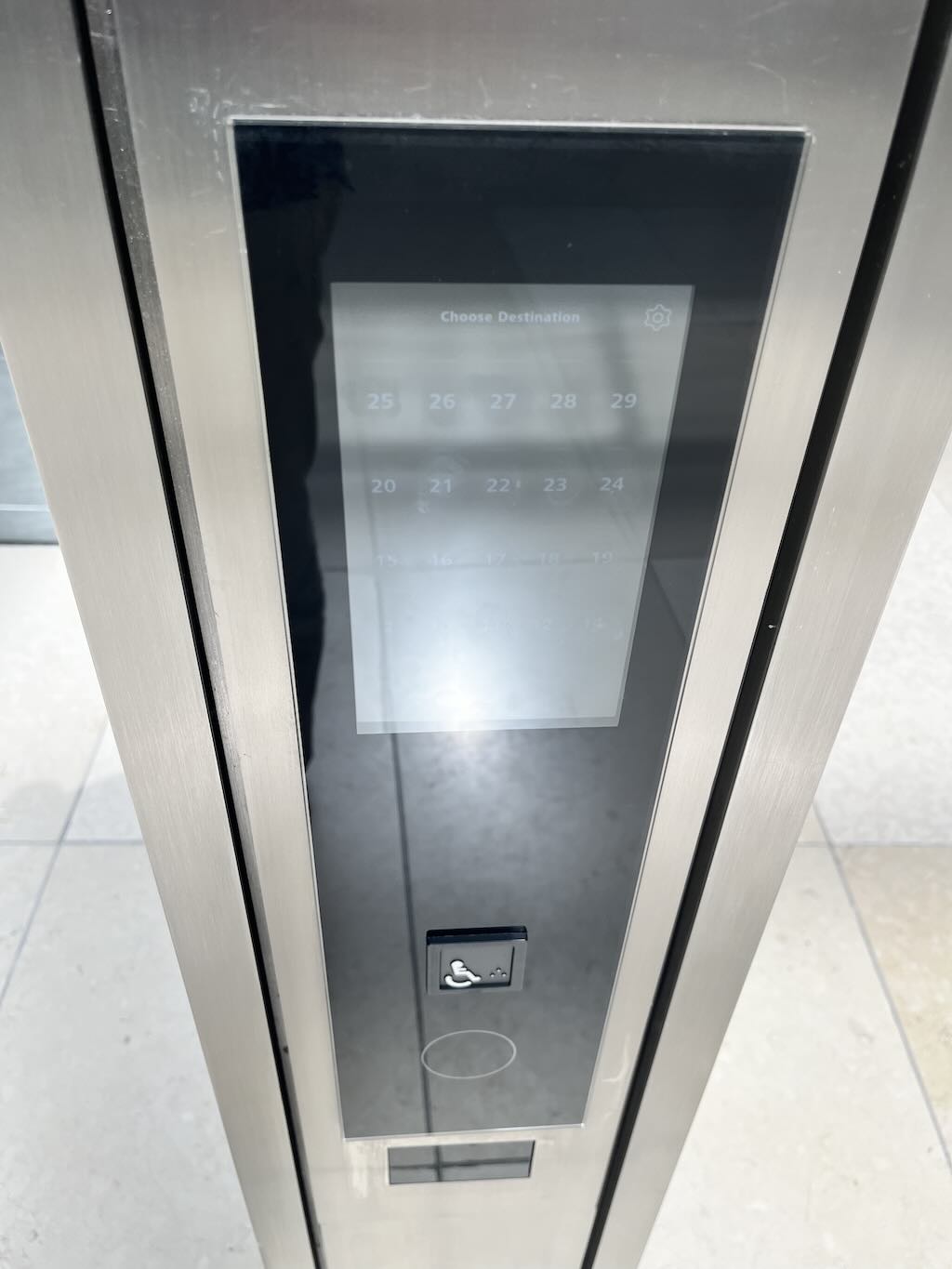
Sometime during Covid, the metal buttons were replaced with glass touch screens – which are totally unreadable on sunny days, because in our stunning glass-ceilinged atrium mezzanine they sit directly in sunbeams[0]. So now you have to walk up to the kiosk, shade it with your body, and squint at the screen to make out where to touch it.
Comment by namibj 2 days ago
Comment by JoshTriplett 2 days ago
But yes, this seems like a case of "unfortunately, people".
Comment by hypercube33 2 days ago
Comment by dperfect 2 days ago
Comment by joshjob42 2 days ago
Comment by taftster 2 days ago
Efficient elevator algorithms will often suggest moving an elevator into a preempted positioning strategy, based on time of day or peer elevator positions. The scheduler might move an elevator up to offset one coming down, for example. The demand-signal algorithms at least minimize movement in this way.
I think minimizing maintenance at the cost of increasing wait times is probably an important balance to get right. No doubt, the cost owners for maintenance are not going to perceive the wait time of passengers to be as important.
Comment by jasonlarue 2 days ago
Comment by brewdad 2 days ago
Comment by taftster 2 days ago
Comment by sorz 2 days ago
- rooms are all booked
- young furries usually share one room with 4 or even up to 6 friends
- more guest room-lobby-ballroom traffic
- far more inter-guest-floor traffic than their usual tourists
- one full-suit furry take 1.5-2 human's space
Their elevators are not designed for this scenario and got overloaded all the day. Queueing for tens of minutes is not uncommon.
Comment by dguest 2 days ago
Also, any spiritual successors to Sim Tower needs to include furry-con as a disaster scenario.
Comment by kneel25 1 day ago
Comment by Waterluvian 2 days ago
There’s something so satisfying about watching a machine just dutifully work through queued tasks like this.
Comment by wlesieutre 2 days ago
> After my lecture, a Maxis employee who shall remain nameless buttonholed me. "You guessed right," she said. "Sim Tower was built around a real elevator simulation program we bought from a Japanese guy."
https://web.archive.org/web/20090916193335/http://www.gamasu...
Comment by Waterluvian 2 days ago
Comment by Sohcahtoa82 2 days ago
Comment by stackskipton 2 days ago
Comment by jcranmer 2 days ago
Comment by Sohcahtoa82 2 days ago
Tbh, while I bring up Project Highrise whenever someone mentions SimTower, I did always feel like it was missing something. Something always felt slightly soulless about Project Highrise.
Comment by Waterluvian 2 days ago
Comment by b3lvedere 2 days ago
Comment by duderific 2 days ago
Even at that relatively reduced level of complexity, it's quite tricky to figure out how to prioritize who gets served when.
Comment by kccqzy 2 days ago
Comment by pseudosudoer 2 days ago
Comment by crabbone 2 days ago
So, for instance, I didn't measure the elevator's efficiency in the wait time. I included (weighted) travel time. I assumed LOOK algorithm was used. And then when I tried to calculate various outcomes for different trips I suddenly realized that elevator's efficiency and fairness seem to go different ways.
Without trying to reproduce my evaluation system, here's my finding in fewer details: if you have two passengers, one going from the ground floor to the top floor and other joining for the shorter ride down in the middle, then the elevator that makes a "detour" is more efficient, but it hardly seems fair that the passenger traveling ground floor to the top should go even a single floor in the opposite direction.
Somehow, until that point, I lived with an illusion that the most efficient solution to a problem must be the most fair to every participant. Discovering this counterexample sent me on the "tour of discovery" of ethics and different philosophers who contributed to it... and while in the end it made me none the wiser, I'm happy to have discovered this field.
Comment by pwython 2 days ago
I swear no matter if it was busy or not, it seemed like everyone was assigned to the same one or two elevators. The wait was always so long too, I used the stairs most of the time if just going <6 flights.
Someone besides RCCL needs to study that algorithm.
Comment by skullone 2 days ago
Comment by sp0rk 2 days ago
Comment by pavlov 2 days ago
It might be fun to revisit. The game was actually of Japanese origin.
The Digital Antiquarian just wrote about it the other week:
https://www.filfre.net/2026/07/the-life-and-times-of-maxis-p...
(Part of an ongoing multi-part Maxis article, SimTower is halfway down in this part 2.)
The origin story:
”As Yoot Saito would be the first to tell you, the rest of the game was really born out of his odd fascination with elevator systems.
> ’Late one night, I was waiting in my building’s lobby for an elevator. There are two cars in my building’s shaft. I pushed the button, but instead of the closest car coming to my floor, the farthest car arrived first. In my usual questioning way, I asked myself, “What happened here? How are these cars logically synchronized?” That was the beginning of SimTower.’
Comment by heironimus 2 days ago
I can see how that could be challenging when people get off on intermediate floors, making a full car available again, changing status. And, if 3 people are waiting and there is room for 1, should it stop or not? Etc.
My favorite takeaway from this is how simplicity often beats complexity.
Comment by barrkel 2 days ago
Comment by vova_hn2 2 days ago
I wonder how do elevators find out if the car is full or not.
I once been to an office building where it obviously didn't work properly.
I needed to get down from a pretty high (15+) floor to the bottom during the evening rush.
The elevator got full immediately but still stopped almost on every floor on the way down.
Each time an awkward scene ensued: a huge crowd of people outside elevator just standing and looking at the crowd in the elevator. Everyone has to just wait pointlessly.
Comment by hahahaa 2 days ago
Comment by oxag3n 2 days ago
I visit a building sometimes with destination dispatch elevators, and with low exposure across multiple years I'm confused every time the elevator I need to take is open behind me.
I once used the paternoster lift in Germany, beats any elevator algorithm efficiency because it's a non-stop "conveyor" with no doors. I still get nightmares about that elevator.
Comment by danfunk 2 days ago
Comment by effseven 2 days ago
Comment by teepo 2 days ago
Comment by why_at 2 days ago
I work in a building with Destination Dispatch elevators so I'm used to them. I have the opposite problem where I'll get into a normal elevator and just stand there without pushing anything.
Comment by quietsegfault 2 days ago
Comment by avidiax 2 days ago
Comment by quietsegfault 2 days ago
Comment by Bossie 2 days ago
Comment by userbinator 2 days ago
Comment by besil 2 days ago
I would have never thought there were so many challenges behind a car moving up & down.
This industry is so niche and peculiar.
Elevator trip scheduling is one of the many challenges. Really a great experience so far
Comment by hahahaa 2 days ago
> The state of the world 30sec after you called your elevator might be very different but the system is unable to adapt. Turns out the loss in flexibility is not worth the extra information for the optimizer.
Very interesting. I am on a 30 flr 8 car today so guess it made sense for Destination Dispatch. It does mean there is rarely a full elevator and usually 3 stops max allowing it to go fast to high floors.
Other things I thought could factor in elevators is shopping trolleys: both customers and trolley collectors. One level will have people coming in with full trolleys and almost always the other levels will not. I don't think elevators really care they just fill up and you need to call another one.
Also prams but they are 2-way.
Comment by ericmcer 2 days ago
Just ride to the floor I have access too, stay in while the doors close, and it would take me to a random floor. Push open door and voila I was on some random corporations private floor.
Comment by altairprime 2 days ago
I figure something like a simple weighted ratio of car color = { 1.0: car fg color, max(1,speed^0.1)-1: shaft bg color } would do, so that 2x only shifts the color 7% towards the background color, but 500x shifts the color 86% towards the background color — and a stationary elevator can fade in from 86% bgcolor to 0% bgcolor over a few ticks as it sits there.
I recognize that for most of us, the flashing elevators blur into motion blur, but I can see individual frames at 120fps and while I am not seizure-sensitive to high-contrast flashing, I imagine those folks would appreciate you going the extra mile to reduce contrast at higher velocities, too.
Comment by gregorvand 2 days ago
As someone often using destination dispatch, I am inclined to think after the elevator arrives, you get to the destination more quickly than RSR or LOOK because it’s optimised everyone to the same floor (less stopping)
So it may be a case of more waiting in the lobby but less in a claustrophobic box, which I’ll happily take
Comment by jamies 2 days ago
I want something similar for advanced sensor stop lights...
I've long toyed with creating an elevator simulator game, but every time I build a prototype I realize it's not that fun to manually dispatch elevators, and playing with algos only goes so far! Elevator Saga is great for the programming side: https://play.elevatorsaga.com/
Comment by NikxDa 2 days ago
They have three elevators, but pressing one button only calls that specific elevator. So everyone presses all three buttons, meaning the three elevators basically turn into one.
I don‘t understand how this was ever signed off, but I‘ve seen it multiple times now...
Comment by Ekaros 2 days ago
In general my understanding is that every single cab is unit that can operate alone separate from any others. Then these are grouped together to operate more efficiently. But this is feature you need to buy. Going too cheap someone might choose not to.
Comment by coop57 2 days ago
Comment by jp191919 2 days ago
Comment by dillutedfixer 2 days ago
Comment by npodbielski 2 days ago
Comment by Tomis02 2 days ago
Comment by Aunche 2 days ago
Comment by vachina 2 days ago
Comment by esikich 2 days ago
Comment by clarkmoody 2 days ago
[1]: https://clarkmoody.com/Moody_AgentBasedElevatorControl.pdf
Comment by SoftTalker 2 days ago
Comment by reader9274 2 days ago
Comment by Sohcahtoa82 2 days ago
Unless you're a hotel. Then the timing is flipped: Wait in a distributed manner in the morning/mid-day, gather on the floor in the evening.
Comment by cruffle_duffle 2 days ago
It could also be that you and I simply aren’t privy to what is actually happening “the instant” you are waiting for the elevator.
…which makes me wonder how often the firmware in these get updated. Assuming it’s not just a pile of ancient relays and stuff. And if, when they do get updated, the algorithms get improved. Or if the algorithm is something that gets sold to the building and “upgrading” is an actual purchase.
Anyway, I could get a little LLM buddy to look it all up but where is the fun in that?
Comment by dbcurtis 2 days ago
Comment by rubslopes 2 days ago
Comment by efavdb 2 days ago
Comment by ladberg 2 days ago
I.e. in a bank of 2 elevators where one is resting on ground and the other is resting on a different floor, as soon as someone calls the ground elevator (which is already there and immediately opens) the other elevator (if idle) will move to the ground floor so that there's no delay the next time someone calls one from the ground floor.
Comment by worldthruword 2 days ago
Comment by worldthruword 2 days ago
Comment by paxys 2 days ago
Comment by mapmeld 2 days ago
Comment by cruffle_duffle 2 days ago
My guess is whoever hinted at that didn’t fully understand what they were taking about.
Comment by pkstn 2 days ago
Comment by abhaynayar 2 days ago
What I find annoying though is you clunkily go click a floor then clunkily wait then clunkily walk over to the elevator assigned which may or may not be on the other end of the space. Also another interesting thing I've seen is that it seems in my case the distance from destination selection and elevator assigned seems to reduce at times when the office is emptier so that too seems to def be accounted into the algorithm.
Comment by cush 2 days ago
Comment by hypercube33 2 days ago
Comment by tegling 2 days ago
Comment by socalgal2 2 days ago
Very form over function.
Comment by tomduncalf 2 days ago
Comment by tamimio 2 days ago
Comment by sambaumann 2 days ago
Comment by larrydag 2 days ago
Comment by MostlyStable 1 day ago
Comment by rrvsh 2 days ago
Comment by ChuckMcM 2 days ago
Comment by JoshTriplett 2 days ago
Sounds like destination dispatch would work better if it didn't tell you which elevator to get into until the elevator arrived.
EDIT: already being discussed in the thread at https://news.ycombinator.com/item?id=49125423
Comment by perilunar 2 days ago
On a related note, could someone please design continuous spiral escalators with horizontal sections at each floor?
Comment by Anamon 2 days ago
Comment by jihadjihad 2 days ago
0: https://news.ycombinator.com/item?id=35152341
1: https://computer.rip/2023-03-13-the-door-close-button.html
Comment by urbnspacecowboy 2 days ago
Comment by josefrichter 1 day ago
Comment by bob1029 2 days ago
Comment by gwbas1c 2 days ago
I stayed in a hotel with these. It was horrible. Most people didn't figure it out, would get in the wrong elevator, and just get lost in the building.
Comment by ryukoposting 2 days ago
Using such a primitive elevator gave me a newfound appreciation for the complexity of modern designs. The queueing algorithms are subtle but clever, and the difference in efficiency is instantly obvious once you've dealt with the alternative.
Comment by mr_wiglaf 2 days ago
Comment by iancarroll 2 days ago
Comment by stkni 2 days ago
Comment by jabroni_salad 2 days ago
The simulator seems to have passengers spawning on a random floor and then transiting to a different random floor. But for where I work, the trips are pretty much always from the lobby to a floor, or from a floor to the lobby. Nobody goes inbetween floors except maybe the cleaners.
Comment by niklasrde 2 days ago
That will need planning and assignment I guess? But at what load figures does it become more efficient?
Comment by hoten 2 days ago
Comment by airbreather 2 days ago
Where I live, on the taller buildings it is common to have banks of elevators which only service certain floors, eg floors 2:25 and 26-50 are two different banks of elevators.
Some modern elevators have two cars per shaft, imagine scheduling that.
Comment by agentultra 2 days ago
https://github.com/tlaplus/Examples/blob/master/specificatio...
Another interesting, and underrated one: hotel keys.
Comment by duncangh 2 days ago
Didn’t anticipate that my day would be bookended by relating to and empathizing with the plight of the elevators while I wait for one in a tall corporate building.
Pressed the kiosk some time ago but watching the sun begin to arc towards setting it does appear the world can change a lot in 30 seconds.
Comment by nubg 2 days ago
Patents, everybody...
Comment by krishna180 2 days ago
Comment by jhaile 2 days ago
Comment by danso 2 days ago
Comment by ivanjermakov 2 days ago
Comment by efields 2 days ago
Comment by nhhvhy 2 days ago
Comment by newswangerd 2 days ago
Comment by tgsovlerkhgsel 2 days ago
For example, some elevators allow adjusting the door closing/opening speeds etc., I'd be curious what other things can be adjusted.
Comment by jgrahamc 2 days ago
Comment by ed_mercer 2 days ago
Comment by tuetuopay 2 days ago
Comment by randallsquared 2 days ago
Comment by sltkr 2 days ago
Comment by the_cosmos 2 days ago
Now maybe I can beat that game!
Comment by arm32 2 days ago
Comment by frizlab 2 days ago
Them elevators are able to see into the future to be there even before we call them. Come on!
Comment by jhallenworld 2 days ago
Comment by dbcurtis 2 days ago
Comment by toplinesoftsys 1 day ago
Comment by salberts 2 days ago
Comment by zatkin 2 days ago
Comment by soupspaces 2 days ago
Comment by ncr100 2 days ago
I love this by the way.
Comment by hagen8 2 days ago
Comment by elisbce 2 days ago
Comment by mallory854 2 days ago
Comment by hasteg 2 days ago
Comment by pbrum 2 days ago
Missed opportunity to entitle it "Elevator Action"
Comment by Himanshu_942 2 days ago
Comment by FabHK 2 days ago
Comment by brudgers 2 days ago
Deviant Ollam on Elevator Hacking https://youtu.be/ZUvGfuLlZus
Comment by cyberrock 2 days ago
Comment by kccqzy 2 days ago
Comment by andrewseanryan 2 days ago
Comment by m463 2 days ago
They have to be built a certain way, and need super fancy dispatch algorithms.
Comment by realaccfromPL 2 days ago
Comment by nuker 2 days ago
Comment by proee 2 days ago
Comment by mekdoonggi 2 days ago
Comment by baxtr 2 days ago
Comment by appplication 2 days ago
Comment by socalgal2 2 days ago
Comment by yread 2 days ago
Comment by prometheus1992 2 days ago
Comment by gosub100 2 days ago
Comment by shadeslayer_ 2 days ago
Comment by DoneWithAllThat 2 days ago
(In the example above we gave up and decided it was cardio time, five laps up and down 14 flights to escape with all our luggage.)
Comment by vivzkestrel 2 days ago
- john.fun vs neal.funnnnnnnnnnn
- who woooon? you decide!!!!!!
Comment by cyanregiment 2 days ago
Level 2: Traffic lights, graphics (2D arrays)
Level 3: Flight control, simulations (3D arrays)
Level 4: Satellite tracking, virtual worlds (4D arrays)
...
So many problems can be cast to arrays to be solved with various linear algebra.
Considering LLMs are "Level 1000+" puzzles in this analogy, I wonder if every problem could be represented by an n-dimensional vector and solvable with algebra.
They at least make great interview questions - Tic-Tac-Toe is commonly given, but is obvious. The board already "looks" like arrays. The less obvious ones, like elevators (or load balancing), are always interesting.
Comment by senthilnayagam 2 days ago
claude could recreate it in unity in about 10 minutes. now ticked it off my "want to code" bucket list.
Comment by sghiassy 2 days ago
Comment by Quantumhunk 2 days ago
Comment by tintor 2 days ago
Comment by rconti 2 days ago
However, I think you might be correct about transit systems, where the blocked doors might re-open a small amount before quickly attempting to re-close, to keep the train on schedule and prevent this behavior.
Comment by slater 2 days ago
Comment by yossi_peti 2 days ago
Comment by pavinjoseph 2 days ago
Comment by itunpredictable 2 days ago
Comment by supportm 2 days ago
Comment by thenoblesunfish 2 days ago
Comment by oeitho 2 days ago
I was recently at a Radisson hotel in Germany where I was tried to summon an car, but none would appear for a long time. I believe that someone was keeping the doors open on their floor to wait for someone. The fact that all the other elevators were passing by in both directions was actually a bit infuriating as well.
At that moment I really wished for an algorithm that would recognize when an car spent a significant amount of time on one floor and then reassign the other floors to a new elevator.
Comment by kazinator 2 days ago
- Two elevators ascending and descending in near lock step, in a two-elevator building, effectively reduced to one elevator.
- When going in a different direction from the requested one (e.g. called elevator to go up, but actually going down), the doors wastefully close, open and close again. Seen this in many elevators.
- At 3 a.m. you take the elevator to a parkade, like to get something from a car. When you return to the elevator a minute later, it is gone; it spontaneously moved away even though nobody is using it but you.
Comment by moralestapia 2 days ago
My takeaway is that the benefit of using a much more complex algorithm is marginal.
Comment by alightsoul 2 days ago
Comment by quietsegfault 2 days ago
Comment by cubefox 2 days ago
Really? Maybe I'm lucky I never had to deal a lot with elevators.
Comment by KomoD 2 days ago
Comment by mallory854 2 days ago
Comment by rrr_oh_man 2 days ago
AAAAAAAAAAAH. WHY.
Comment by danielvaughn 2 days ago
Comment by jmyeet 2 days ago
At a previous employer we had heteregenous elevators. In one bank, some went to the lower half of floors only while others went to all and the company installed a "smart" elevator system. I kind of became known because I was constantly yelling about this system in the feedback group because I hate "smart" elevators and and (IMHO) they just don't work. What actually works is express elevators and sky lobbies.
This article covers one of the deficiencies this system had: full elevators. For example, you'd want to go down and an elevator would skip your floor because another had already been assigned. That one would show up full and you couldn't go down. Down wasn't so bad because the stairs weren't a bad option but up was terrible. Going up a few floors was fine. Going up 20 was... a bigger issue.
Back in the day we had elevator operators and people in the lobby during the morning rush who would shepherd people into particular elevators. I actually think this system works way better than anything technology has come up with. Even if you nail the implementation (and I've never experienced elevators that have), people don't read and will just get into elevators anyway.
Anyway the article says that generally speaking on smaller banks simple up and down buttons work best. I absolutely agree.
There's a deeper issue here though and that is solutions looking for a problem. Nobody is making money from up and down buttons. They are fromn selling smart elevator solutions. And you see this everywhere in life. It basically devolves into rent-seeking behavior. Salespeople wine and dine a couple of people responsible for making decisions and then make bank on selling something nobody wants or needs as well as the constant maintenance and updates.
Comment by marcosdumay 2 days ago
That's what the no-button elevators with the kiosk does.
Comment by socalgal2 2 days ago
Comment by TeMPOraL 2 days ago
The core problem: elevators are frustrating for many reasons, and that frustration often manifests as hidden blame and hate towards other fellow passengers. Like, IDK, I'm sitting there with a stroller and a kid on floor -1, trying to get to the train platform at floor 0, but the elevator isn't coming because it's going back and forth between 0 and 2 and 3, as people who came by cars shuttle their luggage to and from the parking lot. As a city dweller and non-car person, I can feel my hatred towards cars and drivers bubbling up right there.
I imagine the same is felt by them if I manage to snatch the lift and go from 0 to -1, when they'd really love to already be on +2.
There's many other cases. Mall problems are different than train station problem, different than tall residential building problems, different than office building problems. Destination Dispatch is its own special thing, with its own special psychological twists. But two things I observed in general are:
- If there is a control element available, you will blame people for using it (even internally). Like, "I'd be there a minute ago if not for this damn XYZ who just had to press the button at exactly this time, and they weren't even going in this direction!"
- If there is an indicator element available, people will optimize around whatever it shows.
Like, someone gets at floor N, sees most of the buttons between there and their destination M lit up, immediately presses N+1 to get off there and call another elevator. But if the buttons are visible enough from outside the lift, they may just not get in in the first place, saving themselves and the others time and trouble, etc.
The more I think about it, the more I see that placement of buttons and indicators in the lift is in itself an UX engineering problem with unusually high impact of every decision on well-being of the users.
EDIT: Also ironically, and in line with my feeling that Star Trek got more things right than people give it credit for, a lot of elevator problems - both scheduling and social/psychological ones - would be solved if elevators just moved faster, like 2-4x faster than now, and also in some cases, also moved sideways. I.e. turbolifts.
(That, and if it didn't immediately led to the building owners putting less of them. So put another way: frustrating lifts is the sign of building owners/designers cheapening out.)
Comment by deton3991 2 days ago
Comment by yucongchen 2 days ago
Comment by nc55g3g 2 days ago
Comment by hn3ufz62f7 2 days ago
Comment by hnrprtlpdb 2 days ago
Comment by mito88 2 days ago
Comment by cpuguy83 2 days ago
Beyond the content, the font, style, etc made it a pleasant experience for me.
Comment by OJFord 2 days ago