Advancing the price-performance frontier with GPT‑5.6
Posted by tedsanders 4 days ago
Comments
Comment by GodelNumbering 4 days ago
This applies even more strongly to model choosing. I know for a fact that majority of my work doesn't require a very strong model, but separating the trivial and non-trivial tasks is a famously hard problem (if at all decidable).
Comment by in_a_society 4 days ago
Comment by xyzzy123 3 days ago
All we need now is some sort of program to evaluate halting problem oracles...
Comment by program_whiz 3 days ago
```python
source_code = open(__file__, 'rt').read()
response = ask_llm("will this program halt, only answer 'yes' or 'no'?\n" + source_code)
will_halt = response == 'yes'
while will_halt:
continueComment by xyzzy123 3 days ago
The "halting problem is unsolvable" argument relies on the oracle not being able to output "not sure". But adding that option admits trivial oracles, like ones which output "not sure" for everything, so some are better than others.
The "real world" use most people have for halting oracles is as part of software safety, where if the checker outputs "not sure" you modify the software until the checker can decide if it halts.
Comment by skybrian 3 days ago
Knowing that functions terminate is important for proof languages like Lean, where you often want to prove things without running the code at all. You're proving that one could, theoretically, calculate an answer, without actually calculating it.
Comment by fragmede 2 days ago
Comment by njcornell 3 days ago
Comment by booi 3 days ago
Comment by keeganpoppen 3 days ago
Comment by gck1 3 days ago
GPT 5.4 is/was a very capable model.
Comment by try-working 3 days ago
Comment by HappySweeney 3 days ago
Comment by fractorial 4 days ago
Comment by carimura 4 days ago
Comment by throw2ih020 4 days ago
Famously, this is also a problem for human coders in sprint planning.
Comment by bryanlarsen 4 days ago
HN could be run as a BBS on 70's hardware. Instead of using a CPU with ~10 thousand transistors, you're likely using one with ~10 billion to do basically the same thing, and you don't think twice about it.
Comment by pimeys 4 days ago
Comment by satvikpendem 4 days ago
Comment by pimeys 3 days ago
We run an agent company and outside coding the new Gemini 3.6 Flash and GPT 5.6 Luna are very interesting. Luna can do a bit of research and create reports. Gemini is great for computer use.
For programming it's all Kimi K3 now.
Comment by thatnerdyguy 3 days ago
Comment by satvikpendem 3 days ago
Comment by attentive 3 days ago
Comment by greggh 3 days ago
This way the expensive/strong model only handles the architecture and orchestration tasks. The cheaper models handle everything else and the strong one knows how to tell them what to do in enough detail to get good work out of them.
Comment by layoric 3 days ago
Comment by londons_explore 4 days ago
Comment by ModernMech 3 days ago
Comment by elcritch 3 days ago
Comment by taf2 3 days ago
Comment by theshrike79 3 days ago
You use the big models to plan. Not just the overall plan, but which files need to be edited etc. Then they give that to the lower end model. So Luna or Sonnet, which are perfectly capable of following instructions and still creative enough to not get stuck.
Comment by biorach 3 days ago
A Principal Staff Engineer who costs $2400 a year and never feels any work is beneath them? Hell yeah.
OK OK, usage limits
Comment by theshrike79 3 days ago
The rest of us need to optimise a bit.
Comment by pkulak 3 days ago
Comment by hellojimbo 4 days ago
Comment by odiroot 4 days ago
/s
Comment by wmf 4 days ago
Comment by gck1 3 days ago
Comment by apitman 3 days ago
Comment by gck1 3 days ago
- Models that can be launched as subagents are hardcoded (can only be another Sol or Terra, but not Luna). Most of the time it'll just launch same model as parent anyway.
- They encrypt initial task delegation from root agent to subagent, for whatever reason
- You can't switch into subagent view at all, despite the fact that apart from initial root>subagent task handoff, all session is visible in transcript.
Comment by theshrike79 3 days ago
(also you need to gate it with "tell the subagent it's a subagent" and "if you are a subagent, don't spawn subagents" or you'll get a matroshka doll of sonnets all the way down =P )
Codex kinda sorta can launch a subagent, but that's about it.
Comment by eli 3 days ago
Comment by JarJarBeatU 4 days ago
Comment by preommr 4 days ago
I don't have the words.
I genuinely thought we were in a stage where we were plateauing and going in for 5-10% improvements over months. Seeing spikes like this makes me question about where the floor really is.
Comment by jpadkins 4 days ago
The dynamic GPU clusters will be used for the 5% of tasks, and pushing out the frontier. Also there will be a set of knowledge tasks that are not done today (because they are too difficult for most knowledge workers), that will start being done in the future.
Comment by jrflo 4 days ago
Comment by jaggederest 4 days ago
https://chatjimmy.ai/ is their interactive. Tiny context, very dumb, but absurdly fast. Imagine this as a tool call for claude code for trivial changes - the tool call from the harness takes longer than the execution.
Comment by ElijahLynn 4 days ago
I just tried it too and 14,098 tokens in .05 seconds, I barely blinked and it was done. There was no typing at all appearing on the screen. It just showed up.
https://chatjimmy.ai/chats/01dc66a4-4b1b-4dea-bb5f-926855e37...
Comment by WalterGR 3 days ago
Comment by ElijahLynn 3 days ago
Here's a copy and paste prompt if somebody wants to just test it real quick to see what I saw:
Write a story about the fastest monkey who ever lived, his name is Jimmy and he is an AI superbot monkey that is part cyborg primate. He can travel through time and is psychic.
Comment by christophilus 3 days ago
If we get to anywhere near this speed for the equivalent of the current models... I don't even know what to think about that future.
Comment by apitman 3 days ago
Once speed significantly increases I think we're going to see some interesting downstream effects. The three things I currently spend the most time waiting on are LLM API requests, Rust compile times, and nix derivations. As AI latency approaches zero I think we're going to start taking a hard look at whether slow-compiling languages are adding enough value over Golang, Typescript, or even dynamic languages to be worth the slowdown.
Comment by blovescoffee 3 days ago
Comment by jaggederest 3 days ago
Comment by iamjackg 4 days ago
I pressed Enter, and the response was instant.
> Generated in 0.037s • 14,205 tok/s
This is unbelievable.
Comment by jcul 4 days ago
Comment by Cort3z 3 days ago
Comment by ch4s3 3 days ago
Comment by jaggederest 3 days ago
The other thing that I think is really interesting about all of this, is that LLMs are already perforce behind the times with their knowledge cutoff, so adding an additional ~3 months for bake into silicon isn't such a huge deal, I think, for the ~10x more efficient and faster you get.
Comment by ch4s3 3 days ago
Comment by theshrike79 3 days ago
Things like this give me hope for a system that can be fully local and private, but also with the ability to be almost infinitely extendable with tools.
Comment by ch4s3 6 hours ago
Comment by antman 3 days ago
Comment by nerdsniper 4 days ago
and it gave a very reasonable answer in non-perceptible time.
Comment by jaggederest 3 days ago
Comment by weiliddat 3 days ago
Comment by throwuxiytayq 4 days ago
Comment by HDBaseT 3 days ago
I find myself getting caught up in the sheer speed of modern computing and networking. The fact I can play an online game with 10 other people is just insane.
Comment by jaggederest 3 days ago
Comment by dyauspitr 3 days ago
Comment by HDThoreaun 4 days ago
Comment by ericd 3 days ago
Comment by kooi 3 days ago
"LMS algorithm in bash"
Just barfed it up lol.
Amazing.
Comment by baal80spam 3 days ago
This is crazy.
Comment by 8cvor6j844qw_d6 4 days ago
Comment by throwup238 3 days ago
I’m still trying to figure out coding agents. I can’t even begin to imagine the things it would enable. Even the most mundane ideas like LLMs-in-HiFreq-trading have huge implications.
Comment by nly 3 days ago
You need to be 4 orders of magnitude faster at least
Comment by ElijahLynn 4 days ago
Comment by Dig1t 4 days ago
Comment by reducesuffering 3 days ago
Comment by herzigma 3 days ago
"I need a short, 4000 word essay on the the difference between star wars and Star Trek universes from the perspective of graduate level scientific work."
Comment by apitman 3 days ago
Comment by antman 3 days ago
Comment by zahrevsky 3 days ago
Comment by Yopolo 4 days ago
Blocking Fable for sure made it very politicl a lot sooner than i expected it to happen.
and because China already has massive problems of getting access, they are pushing it on hardware too like what Huawai did without EUV.
It seems China is already able to do DUV a lot sooner than others expected.
Comment by re-thc 4 days ago
That's the media and in particular US KOLs of all sorts driving the wrong impression of China and other places. China and many other places for example have fast public transport that the US doesn't and can't even imagine today. They're not behind.
China's DUV still isn't that production grade (mass produce-able) so don't get that hyped up the wrong way (in a different direction).
The whole China-is-behind with tech and in particular semi wasn't that they can't. The truth is they spent decades in internal politics and corruption. That all got solved with the bans, so thank the bans! Jensen even said the bans were bad.
Comment by FuriouslyAdrift 3 days ago
Comment by monkeydust 3 days ago
Comment by FuriouslyAdrift 3 days ago
That's about how disrupting DSPs were to the industries they arose out of (over a very long time frame).
How would that disrupt the industry?
Comment by HDBaseT 3 days ago
There is other in the space, Groq and Sambanova are both private companies attempting to develop their own technology.
Comment by FuriouslyAdrift 3 days ago
Comment by 5555watch 3 days ago
Or, when we will start doing this, who's going to be able to do that in scale?
I'm seeing the TAALAS example, but it's only an 8B model, suggesting some real limitations parameter wise. And for 2.5kW?
Comment by adrianvi 3 days ago
The big AI labs won't do that unless they are forced to, as they want you to spend more money on the big, expensive, frontier models (so they can live up to their valuation), so it's more likely that you will see this on smaller open weights models.
Comment by vjvjvjvjghv 3 days ago
Comment by jaggederest 3 days ago
Comment by kooi 3 days ago
High speed SRAM is where the $$$ is
Comment by coffeebeqn 4 days ago
Comment by bob1029 4 days ago
I don't think it would be that difficult to manufacture compared to other process tech. HBM is really hard to do compared to other memory types.
Comment by re-thc 4 days ago
Google is already working on a similar idea but more "flexible".
Comment by kridsdale1 3 days ago
Comment by jmb99 3 days ago
The "edge" AI landscape (in particular, what you can do with ~5W) is going to be nuts in about 18 months.
Comment by jacekm 3 days ago
Comment by jmb99 3 days ago
The only thing that will crash prices is reduced demand (duh) or, more interestingly, increased production. In particular, if CXMT is able to get their DDR5 fabs up to a reasonably high yield, that could add some downward price pressure (as could government subsidies). As well, if Micron/Kingston/Hynix think that CXMT is going to start cutting into their market share, they might be willing to either increases supply or drop prices. Unfortunately CXMT looks to be taking quite a while to get their new fab up to max capacity so that may take a year+ before anything manifests.
If you're interested in following the (publicly available) info on these sorts of things, check out what companies like Axelera, DeepX, and MemoryX are doing today and have on their roadmaps, as well as the sorts of chips/SoCs Qualcomm, Kinara (now NXP), and Ambarella currently have announced (or have on the market). And remember, that pretty much all of these chips on the market today were in initial development more or less when ChatGPT first launched. If you knew what you knew today (or a year ago) about what requirements current- and next-generation models would have (from a silicon perspective), what might you do differently? Think for instance, host system interconnects, amount and speed of on-package or on-die memory, image/video decode capabilities, int8 vs fp8 vs fp16 vs bf16 compute units, etc. And, consider that most "AI" stuff in development a few years ago was all 15nm or 12nm - because who was gonna pay big money to get fab capacity at 3nm to run some object detection models? So most of the stuff on the market today is on very old nodes and therefore not super power efficient.
Comment by jacekm 3 days ago
Comment by re-thc 3 days ago
Comment by captainbland 4 days ago
Comment by w29UiIm2Xz 4 days ago
Comment by FuriouslyAdrift 3 days ago
Comment by minraws 4 days ago
But if this is even at 400B size it's insanity those inference prices, maybe 10-20% margins, if it's higher I would like to know is it their own chips or maybe they have accurately sized the model to fit on exactly a B300?
Could be a lot of magical things we can only speculate, but from here there likely isn't another 60-70% margin, like I have heard people claim, I would definitely be willing to bet on that.
Could still be a healthy 10-30% margin. Especially with Terra.
Comment by platinumrad 4 days ago
Comment by handfuloflight 4 days ago
Comment by platinumrad 4 days ago
Comment by hzbdhdjs 4 days ago
Comment by an0malous 3 days ago
Comment by foobar_______ 4 days ago
Comment by ignoramous 4 days ago
[0] I am constantly surprised how much work pay-as-you-go with DeepSeek / MiMo will get done. I've barely crossed $2 each in a month of use (~200m tokens).
Comment by computerex 4 days ago
I feel perfectly content in using pay as you go pricing with deepseek. On the other hand, although Anthropic's models used to be my bread and butter for personal work, they are simply too expensive to reach for these days.
Comment by rpdillon 4 days ago
Comment by ismailmaj 4 days ago
Assuming the efficiency gains are real, I feel like something has to give, maybe worse quality due to aggressive quantization/kv cache compression?
Comment by heisgone 4 days ago
Comment by anthonypasq 3 days ago
why on earth would you suppose that?
Comment by oblio 3 days ago
Comment by mgambati 3 days ago
These companies are printing money on inference. The only issue is the capex of expending on new servers but they are generating TONS of income.
Comment by claw-el 3 days ago
Comment by mlinsey 4 days ago
Although I'm sure there are some efficiency gains, the technology is too new and labs are scrambling to release too quickly to think that the low-hanging optimization fruit has been picked already.
Comment by dannyw 4 days ago
If you use Codex it's different, the harness has a lot to do with it and there's definitely been changes including recently.
Comment by axus 4 days ago
Comment by onlyrealcuzzo 3 days ago
There is ZERO reason to believe models 1/10th the size of frontier are completely capped on intelligence and impossible to get smarter.
They have consistently compressed the intelligence of larger models.
You'll see it first on the small end, when they stop being able to compress intelligence, you know that will slowly bubble up and up the chain to larger and larger models.
There's no evidence we've reached that at the bottom.
Comment by gameshot911 3 days ago
Comment by SwellJoe 3 days ago
I think there's also a new generation of hardware in the past year or so tuned specifically for LLM workloads, where it was almost an accident that GPUs worked to run LLMs before. So, while there's still this ridiculous shortage of hardware, what is being delivered is much faster and cheaper to run for these specific workloads.
I wasn't expecting it to happen from the US vendors, though, as they've spent so much capital to get to where they are they need to make huge margins on inference to pay it all back. I expected the Chinese models who're running much leaner operations to be the "frontier" on costs (and they have been). But, I'm glad to see OpenAI joining the "cheap and cheerful" models party. There's a lot of work in that area of capability. Probably most work people are doing falls into that area of capability.
Comment by Yopolo 4 days ago
But yeah I do'nt want to know what Kimi 3 is pushing buttons inside Anthropic, OpenAI and Google.
Besides any floor: For every year the tokens get faster and cheaper, we will see new things like properly working AI factories which mimic expert teams. A lot more parallism as well.
Comment by paytonjjones 4 days ago
With an 80% reduction in cost that becomes a ridiculous outlier in efficiency.
Comment by 827a 4 days ago
Comment by FuriouslyAdrift 3 days ago
MI500 series is supposedly already taping out and they're claiming massive increases (we'll find out end of 2027 prob).
Comment by blovescoffee 3 days ago
Comment by cousinbryce 4 days ago
Comment by Yopolo 4 days ago
Besides Nvidia Hardware is still sold out and super expensive. Not a single Nvidia consumer GPU got cheaper at all, Nvidia DGX Spark got more expensive too.
It will be swooped of the market the second it hits the market.
Comment by gentlewater 4 days ago
Comment by bakugo 4 days ago
Anthropic's big marketing push this year has been entirely focused on getting people to use Opus via a Claude Code subscription, to the point that Sonnet is almost viewed as the poor man's alternative, and from what I've seen, almost nobody uses it.
Actually, here's an interesting project for all the vibe coders looking for their next front page post: scrape a ton of commits from GitHub with Co-Authored-By: Claude and figure out what the percentage split between Opus/Fable/Sonnet is. I'm willing to bet it's less than 10% Sonnet.
Comment by supern0va 4 days ago
This may be misleading, since I suspect many are using a blend through sub-agents. I tend to bias for Fable to orchestrate and Opus for implementation via sub-agents.
Comment by StilesCrisis 4 days ago
Comment by Zarathruster 3 days ago
Comment by petesergeant 4 days ago
Comment by baq 4 days ago
Comment by heaney-555 4 days ago
Comment by 827a 4 days ago
Luna is an extremely strong model.
Comment by re-thc 4 days ago
By benchmarks, which sadly is a poor measure. Yes Luna is a good model under certain circumstances. Whether it is great for general usage is another story. Sonnet is definitely better when prompts are more vague and it needs to decide things. Luna generally sticks to things very strictly and goes off in bad ways.
Comment by Klathmon 3 days ago
I almost exclusively use it with xhigh or max effort, but when run like that it's been an incredibly cheap little workhorse for most development work. I'm still leaning on Sol for planning and debugging, but when it's time to start pumping out code I've been leaning into Luna (Max) and I've been enjoying it! And that was before the price drop, it's going to feel practically free at this point
Comment by jug 3 days ago
Comment by mediaman 4 days ago
I've previously found flash (for all the hate it gets) to be good for these kinds of things. Haiku was fine but it's ancient.
Comment by re-thc 4 days ago
That's again not some "intelligence factor" here. Different agents work for different use cases. Luna wins some. Terra wins some. Sonnet wins some. Flash was really good at exploring.
So I'm not sure what your point is? There's a big market for everything. Even within the market you describe it's likely not a Luna-size fits all either.
Comment by Philip-J-Fry 3 days ago
Comment by 3836293648 4 days ago
Comment by re-thc 4 days ago
You mean they increased the price and then cut it back and now it is amazing?
Luna had a price hike vs mini (its previous replacement). The cut now just puts it back in that ball park.
Not that this isn't good news, but what's impressive?
Comment by zzleeper 4 days ago
I typically do lots of mini calls for research (100s of millions or something in that ball park). Newer models made that absolutely impossible, and the fact that the older ones are starting to get deprecated made me switch to e.g. deepseek for some of my runs. We'll see if I move back after this.
Comment by aesthesia 3 days ago
Comment by WarmWash 4 days ago
Comment by ceroxylon 4 days ago
Comment by afry1 4 days ago
We are not purely rational creatures, thank God. Sometimes those "limiting factors" you listed -- stress, peer pressure, hormones -- are crucial elements of informing the problem solving process and arriving at a decision or a solution that actually works.
All an LLM can do is fulfill a prompt, no matter how misguided, backwards, or incomplete that prompt actually was.
"Go jump off a bridge." Hmm. Dying makes me stressed out. I'm not gonna do that.
Comment by a13o 3 days ago
Comment by customguy 4 days ago
Comment by subw00f 4 days ago
Comment by solarkraft 4 days ago
Comment by arjunchint 4 days ago
Comment by visiondude 4 days ago
Comment by camel-cdr 4 days ago
Comment by mediaman 4 days ago
Tokens are not normal software, because they have marginal cost, and I think people who are used to software economics really struggle with this. With token generation there really can be manufacturing cost efficiencies where one producer is just straight up better at serving product at a lower marginal cost.
Comment by robocat 3 days ago
No it hasn't!
A century ago, some nails cost 2.5% of disposable income, and now the same nails cost 2.3% - only a little cheaper.
The cost of nails has remained remarkably consistent for a century. The problem is that you have ignored the depreciation of money.
Let's assume California prices and income and pick a bigger retail package of nails as you might use for building a house. The numbers used to calculate percentages: in 1926 a 50lb keg of 4" nails was $2.75 and median after tax income might be $108 per month. In 2026 a 50lb carton of 4" nails is $106 and income might be $4,516. Albeit I assume nails are now more readily available and the quality of nails is likely better; and perhaps I should have compared galvinised nail prices.
Comment by eli 3 days ago
Comment by Der_Einzige 3 days ago
Comment by buckle8017 4 days ago
This is very likely priced below recovering the cost of the hardware but still above operating expenses.
Comment by infecto 4 days ago
I have no idea either way but one thing that detracts from these threads is folks claiming things as a fact without evidence.
Comment by paxys 4 days ago
Comment by qntmfred 4 days ago
Comment by pavpanchekha 4 days ago
Comment by jedberg 4 days ago
> it doesn't feel like night-and-day.
I see what you did there. :)
Comment by deklesen 4 days ago
Comment by oh_no 3 days ago
Now we have an American lab drastically cutting a price, feels like this is the opposite of that trend.
Comment by maxdo 4 days ago
Comment by pixelesque 4 days ago
Personally, I'm having surprisingly good results with DeepSeek 4 Pro at home, which is very good value for money: it's not as good as Claude / GPT 5.6 (I have Co-pilot license at work), but it's still really useful for code reviews, validating thoughts, and especially designing / writing unit tests for new (and old before refactoring) functionality.
And it's very cheap per task. (Flash is even cheaper, but I've had issues with that on more complex tasks where it starts forgetting things and arguing with itself "but wait, let me read the function again").
Comment by fy20 3 days ago
Comment by forsalebypwner 3 days ago
Comment by pixelesque 3 days ago
(I've been using it via OpenRouter and it's much more than that, but still cheap).
Comment by forsalebypwner 3 days ago
Comment by subarctic 4 days ago
Comment by pixelesque 3 days ago
No, I'm using it via OpenRouter in pi.dev - I just used it 30 mins ago... Providers (automatically selected): StreamLake and Baidu Qianfan.
Comment by Mashimo 3 days ago
Comment by mark_l_watson 3 days ago
Comment by oh_no 3 days ago
Comment by pixelesque 3 days ago
Morph occasionally have lower prices than the standard rates, and:
https://telnyx.com/pricing/inference-api
Is one which is a bit cheaper... I haven't actually tried K3 myself...
Comment by jug 3 days ago
Comment by pioneer37 4 days ago
Comment by dominotw 4 days ago
Comment by simonw 4 days ago
If the cost of serving GPT-5.6 just dropped by 20%, does that add up to literally billions of dollars in savings per month?
We know Anthropic spend $1.25 billion renting inference capacity from SpaceX (in two Colossus datacenters) from the SpaceX IPO, but we don't know how much of Anthropic's inference capacity that is (presumably a small fraction, since they were operating on top of AWS and other providers before the SpaceX deal.)
I've not seen any numbers that hint at OpenAI's per-month inference bill, but surely that has to be in the multiple billions of dollars as well.
So 20% is a really, really big deal.
Comment by NitpickLawyer 4 days ago
Comment by magicalist 3 days ago
Edit: searching for the story now, further bolstering the point is that was 1% in training time [1], and the openAI claim is 20% in end to end inference cost. This is a bad comparison.
[1] https://deepmind.google/blog/alphaevolve-a-gemini-powered-co...
Comment by NitpickLawyer 3 days ago
How so? First, kernel writing (or ML engineering more broadly) is a highly specialised task. Not everyone can do it. It shows that models are getting better and better at (easily verifiable) hard tasks. And you can "hire" that expertise much easier than you can hire the equivalent meatbags. And more importantly you can "fire" them as soon as the task is done. And then hire them 3 months later, when the new model drops. And so on.
Second, 20% gains in inference today gives better end results (i.e. lower overall cost) than 1% in training 2 years ago. Today's models are improving mostly via RL. And RL is highly dependant on fast inference (you want many rollouts for each training scenario). Same for dataset filtering, environment generation, distillation, etc.
Comment by magicalist 1 day ago
No it doesn't. You have no idea how optimised the underlying kernels already were. If a kernel was already optimal, it doesn't matter if you bring a brain the size of a planet, you're not going improve it.
> Second, 20% gains in inference today gives better end results (i.e. lower overall cost) than 1% in training 2 years ago
Your claim (at least in implication) was some kind of trend here. It doesn't matter which one was better to optimise because it "gives better end results" if you're trying to make a trend line out of two unrelated things.
I'm looking for more efficient ways to pack items into packaging. You're looking for more efficient ways to dispatch workers. I report how much faster I can get a shipping container loaded. You report how much less it costs to to get powerlines fixed during a storm.
It's a bad comparison.
Comment by elil17 3 days ago
Without looking at the specific changes made, it is impossible to know whether this represents a real capability improvement. For example, maybe the 20% gain was due to a very obvious/easy to catch inefficiency while the 1% improvement was due to something subtle.
Comment by NitpickLawyer 3 days ago
Comment by elil17 6 hours ago
Comment by dust42 4 days ago
Comment by overgard 3 days ago
If those numbers are accurate, I don't think 20% is a really, really big deal. It's like saying "we're digging our grave 20% slower." Ok, but they're still digging!
Or, different analogy, if I'm going broke because I lost my job due to executive AI psychosis, cancelling my netflix subscription doesn't really change the math of not being able to afford rent. It doesn't even really slow it. The amount of money that OpenAI is spending is so absurd that a minor cost saving is like, uh, some progress, but they'd need to do it a lot more to move the needle
Comment by nl 3 days ago
Comment by overgard 3 days ago
Comment by nl 2 days ago
> Cost of Revenue: $2.65 billion
That's how standard accounting rules for public companies would measure it.
Comment by overgard 1 day ago
> 2025 — OpenAI Had $13.07 Billion In Revenue, $34 Billion In Costs and Expenses, and $20.92 Billion In Losses, with a net loss attributable to the company of $38.53 Billion
Comment by nl 1 day ago
Comment by dominotw 4 days ago
> reduced inference cost by 20 percent saving company x billion dollars per month
Comment by paxys 4 days ago
Comment by petesergeant 4 days ago
Comment by bpavuk 4 days ago
Comment by paxys 4 days ago
Comment by speed_spread 4 days ago
Comment by blovescoffee 3 days ago
Comment by tekacs 4 days ago
I have no doubt that further work was required to enable this, but it's still very cool to be possible to say that.
Comment by andai 4 days ago
Comment by da_grift_shift 4 days ago
Comment by hirako2000 4 days ago
Comment by kridsdale1 3 days ago
Comment by bob1029 4 days ago
I was already a huge proponent of Luna for things like deep research. Being able to run 5x more for the same cost is simply bananas. We are already running 10 parallel agents for hypothesis generation. I cannot imagine 50. The statistics become much more interesting & powerful when you can run so many samples of the exact same prompt+model without breaking the bank.
Comment by andai 4 days ago
Comment by bob1029 4 days ago
Taking actions that mutate the environment is a different story. I think this is where you run into diminishing returns very quickly. You generally want one strong agent to act given the results of all the searching that was done. If the plan is clear, you don't need a genius model to execute it.
Comment by handfuloflight 4 days ago
Comment by andai 3 days ago
https://arxiv.org/abs/2512.24601
There's also a great write up here by the author:
Comment by bob1029 3 days ago
RLM might be more useful on the execution side than on the research side. In fact, these somehow feel like they might be exact inverses of each other in terms of what the ideal architecture looks like. At some point you definitely do need something in the middle that has it all sorted out.
Comment by andai 2 days ago
Research tasks benefit the most from this. Because such work benefits from having a large number of agents working on a problem in parallel (i.e. crawling the web), and the model size becomes less important past a certain minimum.
I don't know about other categories of work, like programming. I imagine looking for bugs or security issues would benefit from it.
Comment by kridsdale1 3 days ago
Comment by Imanari 4 days ago
Comment by dannyw 4 days ago
Comment by kridsdale1 3 days ago
Comment by wahnfrieden 3 days ago
Comment by cg5280 3 days ago
Comment by fy20 3 days ago
Comment by kaufmann 3 days ago
Comment by jrflo 4 days ago
Comment by bob1029 4 days ago
Phase 1 - Run X copies of Luna in parallel over the user's prompt. The purpose is to generate a diverse set of hypotheses.
Phase 2 - Run Y copies of Terra in parallel to investigate the hypothesis results, with each receiving them in a randomized order.
Phase 3 - Run 1 copy of Sol over investigation reports.
The goal is to ensure that the agent covers more initial starting points before presenting a final conclusion. If you only run a single copy of Sol and it hooks onto something wrong, it might not recover.
Comment by eevmanu 3 days ago
Via just ... "prompting it"?
Or do you use any tool in the middle to ensure this agent architecture?
Just curious if there is any workflow-like tool in the middle that is helping.
Comment by bob1029 3 days ago
Comment by AaronAPU 3 days ago
Comment by __jl__ 4 days ago
For our production app, OpenAI clearly is the best provider now. Their API is very reliable and has many nice features. The price-performance of the model lineup is incredible. We used open weights model via Fireworks for a long time (e.g. Kimi K2.5). Fireworks is a great provider but we still ran into issues here and there (Same with Anthropic and Google). OpenAI just works, is fast and in my view has a better price-performance ratio across almost all levels of intelligence.
Comment by dannyw 4 days ago
Comment by amluto 4 days ago
Comment by sipjca 3 days ago
“Overloaded”, maybe half of requests or more wouldn’t go through
Comment by Rendak 3 days ago
Comment by dannyw 3 days ago
They obviously load shed a bit of Codex-sub during peak times, and for the amount of tokens you get for a sub, I don't mind. I just mean the API where you pay-per-token is rock stable.
Comment by jofzar 3 days ago
Comment by quirino 4 days ago
I was still using GLM-5.2 in my personal projects, but this just made Luna a very easy choice.
Comment by qingcharles 4 days ago
Comment by quirino 3 days ago
Comment by qingcharles 3 days ago
Comment by hattimaTim 4 days ago
Comment by PhilippGille 4 days ago
Comment by hattimaTim 4 days ago
Comment by quirino 4 days ago
I bet it must be better in some contexts and worse in others.
Comment by paxys 4 days ago
Comment by dannyw 3 days ago
Comment by tosh 4 days ago
makes it by far the best choice for most workloads that do not need bleeding edge intelligence (reminder: luna can be comparable to opus 5!)
Comment by heaney-555 4 days ago
Comment by dannyw 4 days ago
Haiku 4.5, on the other hand, is comparable to performance to Gemma4 31B (with working tool call formatting) in my experience, and Gemma4 strongly wins on vision and multimodal.
Comment by newtwilly 4 days ago
Comment by euazOn 4 days ago
- Haiku: 30 points
- Luna Medium/High/Xhigh/Max: 38/46/49/51 points
That's a massive difference:
- 30 points is Gemma 4 31B territory
- 50 points is GLM-5.2 (744B) territory.
Comment by ignoramous 3 days ago
Comment by wahnfrieden 3 days ago
Comment by ls_stats 3 days ago
Comment by wronex 4 days ago
Comment by Yopolo 4 days ago
Your support bot.
Your research long running bot.
Your SEO Optimizer bot.
Your incident analyser bot.
Your personal assistent bot.
Comment by wronex 4 days ago
Comment by Yopolo 3 days ago
Lets start of with 1000 ai credits which should be enough for one playthrough, have it included into the game.
Comment by stri8ted 4 days ago
Comment by dannyw 3 days ago
Yes, I can just do it myself, but even at API prices, I'd rather have the LLM do it.
Comment by therealdrag0 3 days ago
Comment by shepherdjerred 3 days ago
Comment by andai 4 days ago
https://deepswe.datacurve.ai/ - (See the Agent Steps view)
Or is the output speed so much higher that it cancels out?
I don't see a lot of benchmarks that record actual time. But on AA, Sol on Low beats Luna on High for Time Per Task.
Comment by paxys 3 days ago
Comment by Phlogi 4 days ago
Comment by ninjahawk1 4 days ago
Comment by HDThoreaun 4 days ago
Comment by msejas 4 days ago
Comment by otherme123 4 days ago
Comment by dgellow 4 days ago
Comment by incognito124 4 days ago
Comment by firasd 4 days ago
Whereas Google with Gemini 3.x, Anthropic with Fable etc are happy to just go for 'big model with dense params'
It's hard to guess from the outside of course but just this kind of talking points focus on GPU efficacy is what we see from OpenAI and Chinese open source labs more often than from Anthropic or Google Deepmind and this benchmark chart seems to concur
Comment by welcomezhangjun 3 days ago
Comment by rldjbpin 3 days ago
case in point 5.4-nano, which is the only model of its class which is now finally comparable to 5.6-luna in pricing. [1] until this change, workflows using the older model could not economically justify the old luna pricing.
the doubling in price between 5.4 and 5.5 also did not help with things, but now 5.6-terra can be considered an update for this pricing tier.
if the token efficiency is real (which i am yet to replicate for our workflows), then the switch to these models can be a net benefit. thank you chinese labs!
[1] https://developers.openai.com/api/docs/pricing#text-tokens
Comment by Pesto 4 days ago
Before I thought it was just an improved version or at least in the same class as gpt 5.4 mini but now it's being priced like a nano model!
I thought about it because Terra has similar pricing to 5.4 and Sol is similar to 5.5.
Luna was already my workhorse before, it performs very well on high/xhigh for most of the tasks, very happy about this drop.
Comment by archon1410 3 days ago
Perhaps users prefer instant responses over thinking models so much so that using a more expensive and less performant non-thinking model is worthwhile.
[1] https://developers.openai.com/api/docs/models/chat-latest [2] https://developers.openai.com/api/docs/models/gpt-5.6-luna
Comment by randomblock1 3 days ago
You can actually use Luna without reasoning (set it to "none"). So if they wanted to, they could definitely replace 5.5 Instant with it.
Comment by archon1410 3 days ago
It probably costs them a substantial amount of money everyday to not replace Instant with Luna, and the people who want larger models will upgrade regardless of whether they get Instant or Luna on the free tier. It is unlikely the amount of people upgrading just to have latest models would be enough to offset the costs.
[1]https://artificialanalysis.ai/models/gpt-5-6-luna-non-reason... [2]https://artificialanalysis.ai/models/gpt-5-5-instant-05-26
Comment by NortySpock 4 days ago
I don't buy it.
There have been recent weeks where some of the mid-level models (Hy3, Laguna M.1) are free (true for parts of June and July, see Hy3 in Cyan) . Even then the total token usage appears to be reaching a steady-state.
https://openrouter.ai/rankings#top-models
^ the first graph is tokens per week across all models
I guess we just can only throw ideas at an LLM at a certain rate.
I still have ideas and now I can have an LLM vibe code what I want, but I'm not going to let an agent just run unattended for longer than a few minutes or a few bucks for hobby projects.
So maybe it is a matter of lowering the cost of an LLM so I can let it churn for hours at a cost of pennies... But I suspect demand for tokens is very price-elastic.
Comment by Yopolo 4 days ago
My company checks the models and pays for Opus through AWS.
You still send the WHOLE context of whatever you want to do to a random endpoint on the internet. If you want to write a good email, you give that context your email address, names, the reason for it etc.
Big companies don't randomly use some random api endpoint to do so.
Anthropics quarerly revenue is still growing very fast. I don't think we have seen even the real potenzial of it yet at all.
Not only are still a lot of countries missing which do not even use anthropic or any other frontier model yet but also all the agentic based solutions enterprise companies are currently building on mass (at least in my industry)
Comment by Der_Einzige 3 days ago
Stop rejecting what we have been collectively telling you guys! LLM providers are profitable, and have been for awhile!
Comment by kingstnap 4 days ago
Haiku was already in a ditch.
But this is coming straight for the jugular of a ton of models on openrouter.
Comment by mark_l_watson 3 days ago
Comment by pbowyer 3 days ago
To fix this you currently need to make your own copy of the bundled model catalog [2] and opt Luna into MultiAgent V2.
1. https://github.com/openai/codex/issues/32031
2. https://github.com/openai/codex/issues/32031#issuecomment-51...
Comment by wahnfrieden 3 days ago
Comment by efficax 4 days ago
Comment by jrflo 4 days ago
Comment by efficax 4 days ago
presumably it's a much bigger model
Comment by jmolinski 3 days ago
https://artificialanalysis.ai/models/comparisons/gpt-5-6-lun...
Comment by lemming 3 days ago
Comment by energy123 4 days ago
Comment by vinhnx 3 days ago
Comment by armanj 3 days ago
Comment by wahnfrieden 3 days ago
Comment by vinhnx 15 hours ago
Comment by arjunchint 4 days ago
- lower input/output token pricing
- the cached token price is $0.0028/Million tokens, which is like 50-90% of tokens
Comment by gentlewater 4 days ago
Comment by goldsmith112 4 days ago
Comment by fritzo 4 days ago
Comment by espadrine 4 days ago
With this new price change, Terra does look pretty Pareto’ed by Luna.
On agentic coding, pairing Sol Medium for architecting with Luna High for coding does kinda make sense. But beware that architecting can be very read-heavy, and Sol is a bit read-pricey compared to Terra.
Comment by Argonaut998 3 days ago
Comment by andai 4 days ago
Comment by wxw 3 days ago
This is... ridiculously cheap. Amazing!
Comment by Decabytes 4 days ago
Comment by simianwords 3 days ago
- GPT-5 high: score 35, approximately $0.37/task
- Luna medium: score 38, approximately $0.01/task
- Luna max: score 51, approximately $0.042/task
So Luna medium is:
- slightly more capable than GPT-5 high;
- approximately 35–40× cheaper per benchmark task.
And Luna max is:
- 16 Intelligence Index points better;
- still roughly 9× cheaper per task.
This reduction was possible within 1 year.
Comment by bakugo 4 days ago
Looks like the Chinese models are really making a dent. Having 3 different price categories with the "most affordable" one still costing more than GLM 5.2 never made sense.
Comment by preommr 4 days ago
Comment by measurablefunc 4 days ago
> China: Household rates average around $0.08 / kWh (¥0.53/kWh).
vs
> US: Household rates average around $0.16 / kWh, though regional variation is massive—ranging from ~$0.10/kWh in low-cost states (like Washington or Louisiana) to $0.30–$0.45+/kWh in high-cost areas like California or Hawaii.
Comment by sosodev 4 days ago
Comment by andai 4 days ago
https://files.catbox.moe/csxl32.png
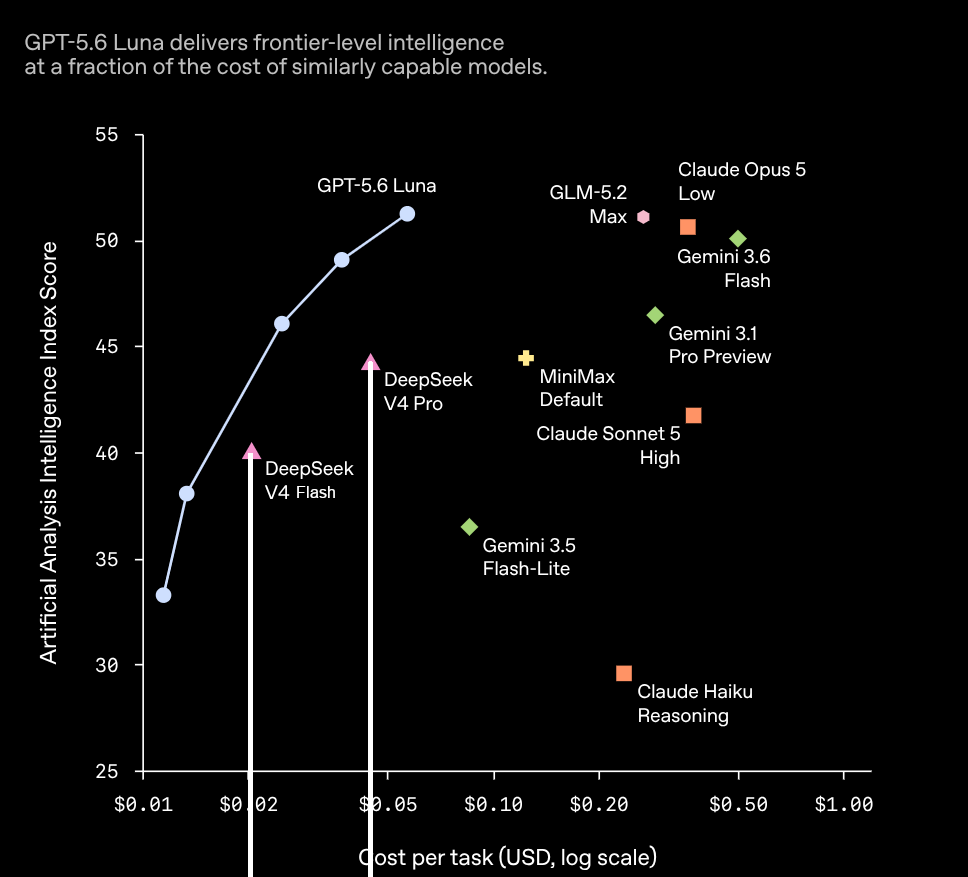
(2 cents to run AA index, score 40)
Looks like OpenAI broke the pareto frontier on the trust-me-bro benchmarks!
(One has to wonder if they used any of the neat tricks from the DSV4 paper :)
Comment by xendo 4 days ago
Comment by peheje 4 days ago
Comment by arcanemachiner 4 days ago
Comment by gck1 4 days ago
Comment by hadlock 4 days ago
Comment by jrflo 4 days ago
Comment by hadlock 3 days ago
Comment by simianwords 3 days ago
Comment by linzhangrun 3 days ago
Just imagine how much the same level of intelligence cost only a few months ago.
Comment by kzrdude 3 days ago
https://api-docs.deepseek.com/updates/
The update seems to say that it's a re-post train of exactly the same model.
Comment by smusamashah 3 days ago
Comment by swingboy 4 days ago
Comment by fractorial 4 days ago
Comment by baalimago 4 days ago
Comment by gbnwl 4 days ago
Comment by baalimago 4 days ago
Comment by Tankenstein 4 days ago
Comment by gbnwl 3 days ago
Comment by weird-eye-issue 3 days ago
Comment by steveklabnik 3 days ago
https://developers.openai.com/api/docs/guides/latest-model#p...
Comment by MitziMoto 3 days ago
Comment by StilesCrisis 4 days ago
Comment by hugopuybareau 3 days ago
Does this seem higher or lower limits ?
Comment by infinite_spin 3 days ago
Comment by alvis 4 days ago
Comment by WhereIsTheTruth 3 days ago
What a time to be alive, the fall of the Chinese edge
Comment by polishdude20 3 days ago
Comment by wahnfrieden 3 days ago
Comment by jnakano89 4 days ago
Comment by redrix 3 days ago
GPT-5 cost $10 (per 1M output)
They still have to pay back those hundreds of billions of investment dollars somehow.
The best thing any developer can do today is to make their app LLM/provider agnostic (or use an LLM gateway) to avoid lock-in.
Comment by guybedo 4 days ago
Comment by XCSme 3 days ago
Comment by XCSme 3 days ago
Comment by dgellow 4 days ago
Comment by anthonypasq 4 days ago
Comment by brazukadev 3 days ago
Comment by svieira 3 days ago
Comment by simianwords 3 days ago
Comment by dgellow 3 days ago
Comment by simianwords 3 days ago
1. The basic mechanism is literally described in the post: they found efficiencies and passed it down
2. This has been the trend for all the time LLMs have existed
Why confusion then? What’s surprising you?
Comment by armanj 3 days ago
Comment by wahnfrieden 3 days ago
Comment by armanj 3 days ago
Comment by Aboutplants 4 days ago
Comment by simianwords 3 days ago
Comment by amazingamazing 3 days ago
Comment by weird-eye-issue 3 days ago
If somebody already thought the price was subsidized then this price change would just mean it's even more subsidized, so why would that change their mind?
Comment by redrix 3 days ago
GPT 5.6 Terra: Was $15.00. Now $12.00.
(edit: formatting)
Comment by troglodytetrain 3 days ago
Being less expensive than Anthropic isn't impressive.
Comment by 8801729-829863 1 day ago
Comment by unknown2342 3 days ago
Comment by jartan2002 3 days ago
Comment by dannyw 4 days ago
Comment by feiz45607 3 days ago
Comment by lightinglabs 4 days ago
Comment by spacebacon 3 days ago
Comment by sidcool 4 days ago
Comment by andybak 4 days ago
Comment by wilg 4 days ago
Comment by infinite_spin 3 days ago
Comment by paxys 4 days ago
Comment by hirako2000 4 days ago
Comment by qingcharles 4 days ago
Comment by shevy-java 4 days ago
Edit: Yes, 80% minus is still milking. Because you empower these greedy mega-corporations. Just look at the RAM prices increase, then you see that the more money you give these hungry dragons, they more they will eat up. Don't get fooled by their "less cost now" advertisement.
Comment by purpleidea 4 days ago
Comment by weird-eye-issue 3 days ago
Comment by conception 3 days ago
Has been pretty accurate when pre-release quality or bugs pop up. In theory you could run your own.
Comment by measurablefunc 4 days ago
Comment by beering 4 days ago
Now, if cost is your concern, then that’s a problem in all of computing. Hence why I’m sending you short plain text messages using an iPhone with a many-core CPU and gigabytes of RAM.
Comment by measurablefunc 2 days ago
Comment by dominotw 4 days ago
Comment by cute_boi 4 days ago