Launch HN: Drafted (YC P26) – Models for residential architecture
Posted by PrimalNick 1 day ago
I’m Nick, founder of Drafted (https://www.drafted.ai). We’re training models that generate residential architecture from structured design constraints.
Product demo: https://www.youtube.com/watch?v=8QkJ7jNU9y4
Residential architecture is still one of the most expensive, slow, and inaccessible creative processes in the world. Designing a custom home typically costs $10,000–$50,000 or more, takes months, and requires making major decisions before most people can even visualize the outcome. As a result, the vast majority of homes are built without direct architectural involvement.
Our goal is to teach computers how the built environment works so anyone can imagine, explore, and eventually create physical spaces tailored to them.
Today, users can design homes using simple inputs such as: - Square footage targets - Footprint shapes - Lot boundaries - Room placement preferences - Spatial relationships and constraints.
Our models generate complete floor plans and matching exterior elevations in seconds. Users can explore designs in both 2D and 3D, iterate instantly, furnish interiors, experiment with materials, and export CAD, PDF, and other files for the rest of the pre-construction process.
One of our newest capabilities allows users to draw any footprint shape and generate a complete home layout inside it: https://www.youtube.com/watch?v=wZJhBm7-OHI.
Over the past month, more than 120,000 people have used Drafted, generating over 325,000 home designs.
If you're building a home, developing property, working in architecture, construction, or AI, we'd love to hear your feedback!
Comments
Comment by hyperberry 1 day ago
Do you have a background in homebuilding? Or have you ever built anything before?
Visualizing the design is one thing, but the feasibility must be considered -- and often vetted through engineer(s) -- from the initial design phase. And even then, despite the best planning attempts, inevitably there will be some issues that need to be addressed 'on-the-ground' during construction.
I think you may be onto something, and I believe LLM models could be capable of accounting for e.g. code restrictions, structural considerations, MEP conflicts, etc. Most of the 'knowledge' homebuilders accumulate is trainable and repeatable. And- at least in the US- most of it has been codified/standardized in the IRC. But still there are tons of little caveats & gotchas to consider. Maybe those details could be addressed directly in your system prompts?
Also curious: what kind of "other files" does Drafted export "for the rest of the pre-construction process"? IDK to what extent you've used any existing home design software, but Home Designer/Chief Architect are capable of creating a (detailed) BOM for the entire build, down to every member of framing lumber. If the user chooses to enter price information, they can also provide cost estimates. A seemingly obvious AI-assisted improvement would be gathering price data automatically- say from the Lowe's or similar Big Box Hardware nearest to the user's location. And ideally keeping it updated as lumber & other materials fluctuate in cost.
To me a really capable AI design software could also be capable of: - Basic electrical load calculations - HVAC/ Schedule D [ductwork] design - Structural considerations- e.g., recommending a joist plan: type/size/direction/spacing of floor joists + validating against IRC and/or joist manufacturer load tables - and a whole lot more
I have a number of other ideas in case you're interested. Feel free to send an email (in profile).
PS- are you familiar with BIM software (like AutoDesk Revvit)? There a lot of 3D modeling capabilities you could borrow that go way beyond floor plans and aesthetic architectural considerations.
Comment by PrimalNick 1 day ago
I started and ran a tech-enabled pre-construction service for ~6 years and grew up in a homebuilding family.
Codes, structural, MEP, and pricing are definitely huge pieces of the buildability puzzle. These are layers we plan to train into the model. Right now we are focused on the schematic level ideation process. So figuring out the flow and shape that can often a take a while to stabilize in the architectural design process.
Once we have this tooling built out, we will add more layers of context that helps make better buildability and cost decisions.
Super familiar with other BIM software. Chief Architect is a more residentially opinionated one. We are hoping to bridge the gap between these high-skill bar softwares and anyone wanting to design. Their capabilities and data structures are helpful robust usability. Just a bit complicated for most people. We are working on more interopability, so people can continue in whatever workflow while we are focused on the schematic level design phase (currently have DXF, IFC, GLB, and PDF exporting).
I'll shoot you an email :)
Comment by PrimalNick 1 day ago
Comment by ____tom____ 1 day ago
How many of us have made house plans at some point?
Comment by irjustin 1 day ago
The SIMs ran my life for a while and today if there was a "build this plan into a real house" as a lead gen...
My gut says the crossover/cross-sale is just too hard and niche, but if it works, it sounds like one of those genius ideas.
Comment by PrimalNick 1 day ago
Comment by podlp 21 hours ago
That said, I think this is neat because I’m buying a condo and knowing what’s even possible (physically, allowed by code, etc) seems more art than science. Getting answers usually involves bringing someone on-site, and almost nothing can be DIY’d anymore (either due to permits, HOA, complexity, etc)
Comment by tralarpa 1 day ago
Comment by PrimalNick 1 day ago
Try creating a design and let me know how that goes!
Comment by N_Lens 1 day ago
Comment by cgillett 1 day ago
I've thrown some weird setups at it like a high bedroom:bathroom ratio and it's doing a great job at distributing bathroom access between the bedrooms, and arranging the bedrooms around shared spaces.
Thanks for sharing.
Comment by PrimalNick 1 day ago
There's an insanely big probability space and everyone has very unique desires/preferences when designing.
I'm really excited to see what people come up with.
Comment by summermusic 1 day ago
- A car parked in the garage perpendicular to the door and the other differently-sized car
- A bedroom missing a closet
- Attached bathrooms with multiple sinks
- An office with a weird entrance from a dead space from the garage
- External doors that open the wrong way (against fire code in most places)
- Closet doors opening inward
- Both doors of the top-left bathroom opens into the sinks (why two sinks?)
- The top-left bathroom has a weird dead space between the shower and bathtub (why both?)
- the random little floating feature in the middle of the open floorplan space doesn't make any structural or aesthetic sense
- The two bedrooms in the lower left with the weird bump-out for the windows that make no sense
- The window placement for many windows don't make sense and don't even line up with the 3D view of the house
- The hallway on the left that turns and goes to nowhere for no reason
- The additional random inaccessible dead spaces next to the bottom right bathroom
It took me just a few minutes to see this. I hope nobody ever builds a home based on these plans.
[1] https://cdn.drafted.ai/thumb/drafts/23025/generations/94729/...
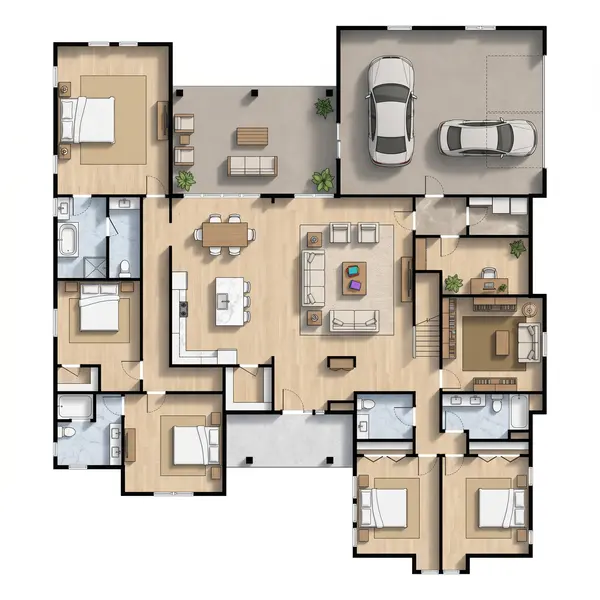
Edited for formatting, to add a few points I missed, and to add a link to the image
Comment by PrimalNick 1 day ago
If you're someone looking for a schematic design level tool that can allow you to explore design for free then this will allow you to develop ideas and figure out a starting point to work off of.
We will continue to improve the model and build out more tooling for guiding it.
Comment by pbreit 1 day ago
Comment by prawn 1 day ago
We had both in our last house which was a mid-range build and not overly expensive at the time (very cheap in hindsight).
Not commenting on the placements though. Looking at the floorplan, it’s a pretty silly layout that could at least be used as a starting point then tweaked, but at that point you might as well start with an off the shelf plan first. Reminds me of a procedurally generated dungeon game.
Comment by tadfisher 1 day ago
Comment by stonogo 1 day ago
https://cdn.drafted.ai/thumb/drafts/27019/generations/98723/...
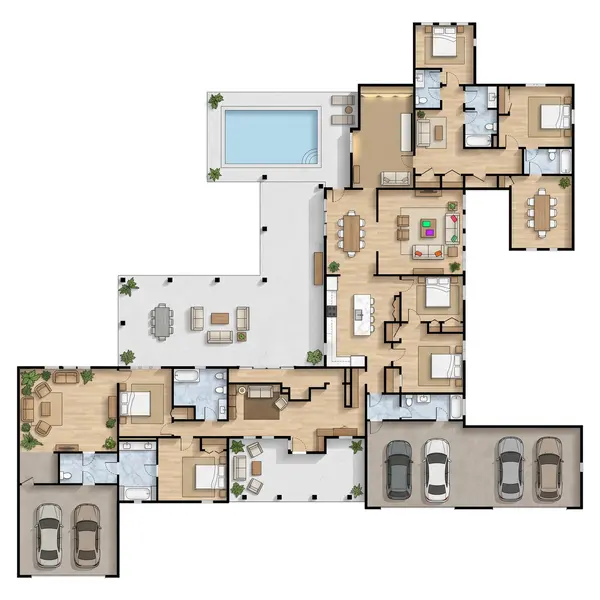
- off-bathroom conference room!
- side-by-side toilets
- garage inaccessible except via bathroom
it's engrossing!
Also most (but not all!) of the designs seem to omit laundry facilities. I wonder whether there's a pattern there.
Comment by PrimalNick 1 day ago
Comment by pbreit 1 day ago
Comment by PrimalNick 1 day ago
Comment by nibab 1 day ago
looks great btw. congrats
Comment by PrimalNick 1 day ago
Comment by pottertheotter 1 day ago
Comment by PrimalNick 1 day ago
It is more of that data. Most people can't afford an architect and almost everyone who buys a templated plan from one of those sites ends up changing it for another $5k-$15k with a drafter (lower cost) or architect (higher cost).
For a lot of people, they like a house, but they want to fit it to their needs and don't know how.
We are hoping to bridge the gap through lowering the cost to ideate and iterate on home designs.
Comment by nshotton 21 hours ago
Comment by whymsicalburito 1 day ago
We're building an ADU right now and the floorplan design was a very small part of what our architect did. So much more of the value came from the relationships he has with the structural and geotechnical engineers we used as well as the relationship with our city building department.
This really strikes me as a product in search of a problem.
Maybe a homeowner could use this for initial planning before finding an architect to use, but at that point you're competing with pencil and paper.
Comment by richardw 1 day ago
This is just one aspect but it’s still useful. Many people want to see a house and say “please help me make that”. In Australia there’s a set of house patterns that reduce the overhead of just landing a design and pushing it through the admin hurdles.
Comment by conductr 1 day ago
From there, I kicked the PDF to a completely unrelated structural engineer that gave engineering specs, a few extra drawings that are standard copy pastes from his previous efforts, and his stamp (cost $600.)
From there, I had everything I needed to get accurate bids from general contractors and permits. Nobody needs to have any special city level connections in my major US city if you follow general code standards along the way they have to approve it. The GC knows what the on site inspectors will pass/fail as sometimes they play by different rules. At the end of the day, GC can always pull out the code book and prove an inspector wrong. Doing so tactfully is part of their jobs as inspectors are a revolving door and not always as knowledgeable as you’d think they should be.
Note. I don’t live in an area where seismic is an issue.
Comment by PrimalNick 1 day ago
Majority of homes being constructed in the US are done in areas where as long as you follow the general code standards, you'll be able to get approval. This is why template house plan websites exist.
A very standard process for a builder is buy or use a template -> make tweaks with a drafter -> structural engineer for additional structural documents and stamping (liability) -> submit for permitting.
This opens the market for a tool like ours. In the short term, it won't be as helfpul in strict markets, just pure ideation, but over time that'll change with the model learning how to ingest local codes standards for designing within.
Comment by conductr 1 day ago
Features like detailed framing plans, siding/wall/roof/insulation/etc all the detail cross-section drawings would be welcome additions. Especially if I could then tag the product type for each layer and it produced an inventory/shopping list. I think this is closer to what BIM software does but would be great to have even as a DIYer/GC.
Comment by pbreit 1 day ago
Comment by mrhottakes 1 day ago
Comment by twostorytower 1 day ago
Comment by PrimalNick 1 day ago
We plan to make the model better for ADU's after we get through multi-story houses :)
Comment by pablogancharov 1 day ago
Comment by PrimalNick 1 day ago
Comment by pnagre05 1 day ago
Comment by PrimalNick 1 day ago
Comment by pnagre05 1 day ago
Comment by filup 1 day ago
Comment by PrimalNick 1 day ago
Comment by filup 1 day ago
I noticed it can only draw hip roofs.
You need more alot more training data of good looking houses. I'm sure it's taken a lot of effort to get these things working, but these houses are lacking some character to me.
I think this is a great idea. Have you thought about trying to hire architects or builders?
Comment by ingend88 17 hours ago
Comment by realty_geek 1 day ago
Comment by PrimalNick 1 day ago
We are working on being able to upload a floor plan to start editing, which hopefully opens this door a bit.
Comment by gallamine 22 hours ago
Comment by roamerz 1 day ago
Comment by PrimalNick 1 day ago
Engineering would be awesome! We want to get to training the model on structural constraints. We will start with basic foundation drawing, but will get deeper as we have the bandwidth to do it.
Comment by w10-1 1 day ago
But if you're considering a pivot, interior design would be a great direction!
Given the space and furniture I have or could buy, what are my alternatives for flow and light and usability? What if energy or allergens are an issue?
This could engage users and has natural add-on's for buying things that would help monetize with price discrimination. End-users could be happy to explore, but you might have more features for designers.
You could fine-tune based on all the home-decorating videos and materials, add MCP for physical models (layout/positioning, environment), and use video models for ingesting current and visualizing results.
Comment by neya 1 day ago
Comment by PrimalNick 1 day ago
You should try creating a house and let me know what you think.
Comment by glerk 1 day ago
First thing that came to mind is that I would use this for a sim city style video game
Comment by PrimalNick 1 day ago
Comment by upcoming-sesame 1 day ago
Comment by PrimalNick 1 day ago
Comment by LoganDark 1 day ago
Comment by PrimalNick 1 day ago
Comment by J7jKW2AAsgXhWm 1 day ago
Comment by amir_karbasi 1 day ago
I'd love to see a two storey use case in the future! I have a few designs for a small plot of land in Toronto (2500 sqft lot) and would love to try and make alterations based on my zoning constraints.
Comment by PrimalNick 1 day ago
I'd love to have you try it :D
Zoning constraints will likely be another few months beyond multi-story.
Comment by svemyh 1 day ago
Comment by PrimalNick 1 day ago