A dumpster arrived behind my university's library
Posted by mooreds 5 days ago
Comments
Comment by bastawhiz 5 days ago
I used to work in a library, and this was often the case. Our basement was stuffed to the gills with romance novels that nobody was reading anymore, mysteries published decades ago, and kids books that probably related to kids from a previous generation more. A yearly sale would see the collection trimmed. Almost across the board, you could still get those books through interlibrary loan. If not from the county network, from another library in the state. In my time, I never heard of anyone missing a book that had been disposed of.
Comment by fhdkweig 5 days ago
I ended up with a nice selection of books on nuclear energy and radioactivity including a nice non-fiction Asimov book on the neutrino and particle physics.
Libraries are always filled to the rafters. The only way to fit new books in is to take old books out. If they didn't, they would only ever have books from the 1940s when they first built that library.
Comment by kzrdude 5 days ago
(Taylor, Lunar Science: A post-Apollo view)
Comment by kelnos 5 days ago
> a state university’s property, even if it’s been deemed trash, cannot be transferred to private individuals.
What a waste! Sure, allowing something like this could (and probably would) be abused, but I think the waste is worse.
I'm glad your middle school was able to do what they did!
Comment by eutropia 5 days ago
Comment by e15ctr0n 4 days ago
The Friends are a separate nonprofit from the library, usually run by volunteers. They can also accept donations from the public, keeping books out of dumpsters. They organize regular book sales which are generally popular with the reading public. https://action.everylibrary.org/from_book_sales_to_big_impac...
If you think that books should be kept out of the landfill or the shredder, please consider starting a Friends group for your local library. https://www.ala.org/united/friends
National Friends of Libraries Week is usually the third week of October every year. https://www.ala.org/united/events_conferences/folweek
Comment by cwmoore 4 days ago
Comment by ghaff 5 days ago
Comment by themaninthedark 4 days ago
I know the universe I went to did. Price it all at a penny each.
Comment by etempleton 4 days ago
Comment by pfdietz 4 days ago
Comment by fhn 4 days ago
Comment by pfdietz 4 days ago
It's quite an event with long lines to get in and is loved by all. The money raised is used to buy more books for the library.
Comment by WillAdams 5 days ago
A last copy policy will ensure that when one wants to compare a first edition of _The Fellowship of the Ring_ against a second, one can get the full weight of Aragorn's snark:
>What did you fear that I should say? That I have here a rascal of a rebel dwarf that I would gladly exchange for a serviceable orc?'
Comment by fhdkweig 5 days ago
If there is enough space to have a room full of books, it would be better used as a publicly accessible set of stacks. The only real reason to have a librarian-only room is for books that are rare and valuable.
Comment by WillAdams 5 days ago
Someone needs to take up Carnegie's mantle and finish the job which he began.
Comment by jerf 5 days ago
What's the limiting principle you propose? It has to be something real libraries and library funding sources can take action on, because they have to take real-world actions on them. So this is not a time for aspirational speeches or vague exhortations to "do more", which is the exact opposite of a limiting principle anyhow. What is "enough"?
Comment by WillAdams 5 days ago
As I noted, it's a pain for me to have to drive down to DC to get access to a book which _used_ to be in the local library system, but isn't anymore, or to purchase my own copy (which wasn't previously necessary).
Comment by throwaway173738 4 days ago
This is a REALLY bold assumption you’re making here, and frankly until we’ve tried it I don’t think you can argue that it has no positive effect to put tons of books in every small town everywhere.
Comment by bluGill 5 days ago
Comment by S_Bear 5 days ago
My current library is around 2000 square feet and I acquire around 1000 books a year, so I have to toss around 1000 books a year, because they're made of matter and take up space.
Comment by duskwuff 4 days ago
Also along these lines: test prep and study guide books. Same deal really.
Comment by bombcar 4 days ago
Comment by kelnos 5 days ago
Comment by gowld 5 days ago
https://www.abebooks.com/servlet/SearchResults?ref_=search_f...
Comment by webnrrd2k 5 days ago
Comment by AtlasBarfed 4 days ago
Comment by WalterBright 4 days ago
That's what scanned books are for. Didn't google already scan them all? And then the book publishers shut that down?
Comment by Ekaros 5 days ago
Comment by ForOldHack 5 days ago
In the first edition, he was depicted as a large creature, and Tolkien was upset about it, and in the second edition, changed the description to small.
This information was gathered by a rare book seller who's videos I find immensely interesting.
Comment by crote 5 days ago
I rarely go to a library to loan a specific work - I go there to find a work. This means going through dozens of potentially-relevant titles, taking them off the shelf, quickly browsing through them, and taking the one or two best ones home. This entire workflow becomes impossible if the book isn't readily available.
A book hidden in a box in the basement, or which arrives after only a few days, might as well not exist at all. I'm simply not going to scroll through a list, order several dozen books solely by their title alone, and come back a few days later (if this is even allowed at all): it's just not worth my time.
The whole "we keep a copy in a central archive" approach only works for historical purposes, not for actually making it available for reading. If you do that you have to also make digital scans trivially available for browsing - and in practice that rarely happens!
Comment by Tangurena2 4 days ago
Comment by Cycl0ps 5 days ago
Comment by sapphicsnail 4 days ago
Comment by elictronic 5 days ago
If you are a software dev, go volunteer at a library and offer up your time to do this. Do something for your community, do something for yourself.
Comment by bigbadfeline 5 days ago
You misunderstand the environment, "offering" doesn't work if the library haven't asked for help, in that case you're just ignored. You see, whatever you do for them would require participation and at least some effort on their side.
Some other organization could help here, but going to the library and begging them to let you help them is a non starter.
Comment by Blackthorn 4 days ago
Comment by anigbrowl 5 days ago
This is hardly comparable to difficult philosophy books as mentioned in the article, though. To my mind, the poin of libraries is to house and make accessible difficult or challenging books that might not necessarily be popular. I was shocked when I first visited an American library and found large numbers of mass-market paperbacks and magazines. When I say 'large numbers' I mean 10 or 20 copies of books by Oprah or other celebrity authors. Librarians would have it that they're serving the community by making these books available in the library around the same time they're available in bookstores, ignoring the fact that once the publisher's marketing drive is over all those extra copies are going to be surplus. I do not understand why you would buy 20 copies of one book when you could have it and 19 other books.
Comment by bastawhiz 4 days ago
> I do not understand why you would buy 20 copies of one book when you could have it and 19 other books.
Easy answer. Libraries know what their clients will check out. Often, because books are requested. If fifty people wait-listed the last big Dan Brown book, the library buys enough so that those people aren't waiting months to get their turn.
And yes, it's frustrating for librarians. Nobody likes buying lots of books that are not especially good. But that's literally the whole point of the library. Providing access to books that people actually want to read.
Comment by Amezarak 4 days ago
If we needed public entertainment centers, then let's be clear what they are and advertise them as such. Personally I have no interest in the public funding of entertainment.
Comment by bombcar 4 days ago
Comment by Ekaros 5 days ago
Comment by anigbrowl 5 days ago
My local Half-Price Books (a second-hand bookstore chain) has a vastly better selection than my local library.
Comment by phil21 5 days ago
University libraries of course might be a good exception to this rule. But your local public library should be a way to make reading accessible to the average middle to lower class family. And that means providing the materials they want to read - not what you think they should.
It's always going to be a balance for librarians. They don't get to operate in ivory towers disconnected from those local taxpayers whom fund them.
Comment by anigbrowl 4 days ago
As a library-funding taxpayer myself, I find it very depressing that the selection in my local libraries is so lacking. Hence my remark about the vast superiority of second-hand bookstores for just about any topic.
Comment by sapphicsnail 4 days ago
It's pretty classicist to assume that only rich people are reading those kinds of books. I have plenty of friends who struggle to pay rent who read dense stuff like philosophy, lit. theory, etc. This whole David Brooks style paternalism drives me crazy.
Comment by Amezarak 4 days ago
Why should I support a public entertainment center? The original American libraries were created to make valuable and educational works accessible to the public, not pulp. Library systems all over the country have discarded most of this stuff in favor of political, romance, mysteries and kids books. Abandoning their original mission is exactly why their public support has collapsed. Nobody cares about a place for homeless people to browse the Internet or to check out video games and movies.
> But your local public library should be a way to make reading accessible to the average middle to lower class family.
"Reading" is already maximally accessible, nobody needs a library to do this. Kids are reading reams and reams of web fiction. If anything, the increasingly low quality of library fare is related to the poor reading level of Americans generally - children's books have become especially atrocious, but even pulp mystery fiction is written on a very low reading level. “We have to get them to READ” is a completely pointless and meaningless goal if the public benefit is to keep up romance fiction publisher profits.
Comment by anigbrowl 4 days ago
https://www.reddit.com/r/antiai/comments/1rnjx1e/i_found_thi...
https://www.governing.com/artificial-intelligence/how-local-...
Comment by dredmorbius 4 days ago
I'm also reminded by an observation of the late Robert K. Merton, on latent vs. manifest functions. Originally coined in the context of sociology, but far more broadly applicable. In discussing these, Merton makes the perceptive observation that because latent functions are not immediately apparent, obvious, or significant, they represent a greater increment of knowledge and understanding than manifest functions, which are obvious, evident, easily understood and communicated, etc.
Popular works, or opinions, tend to be more accessible, yes. But they are also frequently a lower increment of knowledge or utility.
I too am pained by book and other information collections which pander to easy accessibility at a cost to insight and significance. That isn't to say that libraries should discount popularity at all, but I cringe when it seems to be the primary consideration.
By extension, other mass-context systems (markets, mass media, etc.) also tend toward minimum viable standards (often mis-stated as "least common denominator", problematic in several ways), and discount both long-term (non-obvious, non-apparent) benefits and costs.
Comment by jubilanti 5 days ago
How dare librarians... give the people the books they want to read???
Comment by anigbrowl 4 days ago
That said, I would still prioritize variety over pure popularity. For example, I can see a library having 2 or 3 copies of all the Harry Potter books because people keep checking them out, but I don't think they need 10 copies.
Comment by jubilanti 4 days ago
Your idea of what makes a book good or bad is as much influenced by the marketing you are exposed to. You're just subjected to a different kind of marketing than the general public.
Comment by wat10000 5 days ago
Comment by bashmelek 5 days ago
They do serve a lot of people with this method, but am a different cohort. If a library is to serve a diverse group of people it should also remember book snobs like me. When I visit my local library it is as if anything remotely classic is hidden in a secret area, you can’t find hardly any of them.
Comment by wat10000 5 days ago
Comment by ghaff 5 days ago
Comment by bombcar 4 days ago
They just provide cover with the DVDs and the pulp.
Comment by anigbrowl 4 days ago
Comment by ungreased0675 4 days ago
Comment by toomuchtodo 5 days ago
Resources:
https://archive.org/want/?mode=donation_book
https://help.archive.org/help/does-the-internet-archive-have...
https://help.archive.org/help/donate-books-app-for-ios-and-a...
https://help.archive.org/help/how-do-i-make-a-physical-donat...
Comment by ForOldHack 5 days ago
When I got it, I read through it, solid for three days. Wow. Stunning look at a technology in its infancy.
The name of the Bookseller was Luma Kunda. Thank you Mr Kunda. I later learned from someone at the nearby bus stop, that Mr Kunda possessed an eidetic memory.
I would have loved to hear him tell stories about what he saw in the tarot cards.
Comment by toomuchtodo 5 days ago
Comment by asdff 4 days ago
Comment by WillAdams 5 days ago
Given the number of books I've been unable to find when I wanted them save in the Library of Congress (which won't loan, necessitating a trip to DC, or finding and purchasing my own copy), and the number of times my ILL requests have been turned down, a last copy per system mechanism seems the best for preserving access.
Comment by rdmond 5 days ago
Yale, Columbia, Harvard, Princeton, and NYPL coordinate on exactly this https://recap.princeton.edu/
Comment by bastawhiz 4 days ago
This is actually a mostly-solved problem in many cases. Many librarians have great SQL skills (or at least the ones I've met) and can query this easily. Most regional library systems have a centralized catalog. And the cost of moving books on demand is fixed: a van with one book and a van with fifty books costs the same to drive between branches.
Most colleges and universities have agreements with each other for exactly these systems and they're actively used. My partner considered completing his U Chicago PhD from San Francisco by way of the Stanford library.
Comment by WillAdams 4 days ago
There have been numerous cases where I checked out a book, and later went to refer to it again and it was not just no longer in the stacks, but not available in the system.
Comment by KittenInABox 3 days ago
Comment by WillAdams 3 days ago
It's not that I can't find them, it's that a couple were available locally, but aren't currently (due to being discarded) and the nearest copies are in the Library of Congress (which does not lend), requiring a drive. Mostly I've been buying them.
Comment by gumboshoes 1 day ago
Comment by reaperducer 5 days ago
I've done ILL in three major cities. The shortest time it took to get the books requested was 14 days. Some have taken over 60.
Comment by bombcar 4 days ago
Comment by bastawhiz 4 days ago
Comment by ghaff 5 days ago
Comment by dredmorbius 4 days ago
The annual Librarian's letter details the results: an unannounced test of five arbitrarily-selected works was made via pneumatic tube (later supplemented with a telephone), and the requested works arrived within 10m5s, 8m11s, 10m, and with the longest delay, 12 minutes from receipt of the request.
See p. 7 of the annual Librarian's Report: <https://babel.hathitrust.org/cgi/pt?id=mdp.39015036735044&vi...>.
One would hope that 2026 technolgies would be capable of results within at least the same order of magnitude, even at a greater physical separation.
One of my tremendous disappointments of today's Internet is the haste with which it delivers drek, but the reluctance with which it provides useful information, often for utterly outdated concerns with copyright. I'll note that HathiTrust itself, here the source of what was originally a public-domain US government publication, well outside any possible extant of copyright, still only permits one-page-at-a-time downloading of the original document.
Comment by lgvld 4 days ago
Comment by kzrdude 5 days ago
Comment by asdff 4 days ago
The library had probably 30 copies of this edition, most all sitting on shelves, while maybe 1 or 2 each of all other older editions. I'm guessing solely because this edition is "new" therefore they ordered a case of these books from the publisher when they came out whether there was demand for it or not, and the quantities of the older editions are much more likely to be matched to true demand of this book.
And eventually, they will have to destroy what probably 29 copies of this book in some years time.
Seems kind of stupid right? Why order such an excess of books?
Then I also wonder if they could sunset these quantities better. Rather than destroy the excess copy after I return it, maybe just let me keep it?
Comment by throwaway173738 4 days ago
This is pretty much what they do with children’s board books. Toddlers pretty much wreck any book you give them. But the library wants kids to learn to read. So they check them out and then they accept them back in whatever condition, no fees.
Comment by asdff 3 days ago
Comment by phendrenad2 4 days ago
But that's completely the wrong attitude. Books are NOT all created equal. A schlocky romance novel is not equivalent to a book by Kierkegaard, or Vonnegut, or Plath, despite the fact that they are just a bunch of leaves between bindings with an ISBN stamped on the back.
So it's telling when the top comment on a story about professors fighting to save books from being carelessly thrown away is that there exists a basement full of romance novels. The narrator is faulty in this story.
Comment by rahimnathwani 4 days ago
That means two trips to the library. And it means you can't use the book that same day. This is fine for fiction, but not if you want a book because you're going to study it to aid your learning or your work.
If it's fine for a book to arrive in a few days why have a library with publicly browsable shelves at all?
Comment by com2kid 4 days ago
They have none of the fraggle rock books. A once huge series, now gone.
Same for the Mr Men series. Just may as well not exist.
My son very much enjoys my old fraggle rock books, but my library system apparently threw all of their copies away years ago.
Comment by goldfishgold 4 days ago
Comment by calvinmorrison 5 days ago
Comment by NoMoreNicksLeft 5 days ago
These libraries do not coordinate the deaccessioning. If it ever gets down to 2 copies, there's a non-zero chance that they will deaccession their copies simultaneously, and then there are none.
You worked for a library. Did they ever check first to make sure some other library had a copy? Did they warn that other library "we're getting rid of ours, please don't get rid of yours"?
Comment by ciscoriordan 5 days ago
‘“I think some faculty worry that everyone is going to discard willy nilly and then before you know it there won’t be anything left,” Walker said. “No, libraries have gotten together, research libraries and others, and joined a consortium called LOCKSS – Lots of Copies Keep Stuff Safe – and people have agreements like Harvard is the place that will always keep a print copy of x. And there’s multiple ones of all of it. So there’s backup in case Harvard gets blown away by a nor’easter or something.”’
https://dakotastudent.com/wp-content/uploads/2019/07/Apr-10....
Comment by bastawhiz 4 days ago
Yes. They have a shared catalog. All of this is coordinated. It's literally the whole point of being a librarian.
Comment by NoMoreNicksLeft 4 days ago
Yes. I have my nose in it constantly. It's a fallacy to ascribe more coordination to this than actually exists. What mechanism is it that you think exists that would sound the red alert when the last library (or even the second to last) is about to get rid of the very last copy?
Comment by jubilanti 4 days ago
Doesn't need much coordination. Before getting rid of a book, search for it in that shared catalog you allegedly have your nose in constantly. If you're the last or second to last copy, then you know. Unless two libraries are independently doing this at the exact same time.
Comment by timcobb 5 days ago
Comment by gammalost 5 days ago
People see some value in the physical books themselves. They are sacred, discarding them becomes a crime against knowledge. Sure I get it, the nazis burned books; but these libraries are in no way comparable to that
Comment by ciscoriordan 5 days ago
Comment by varun_ch 5 days ago
Comment by tecleandor 5 days ago
Comment by ungreased0675 4 days ago
Comment by asdff 4 days ago
Comment by aaronharnly 5 days ago
A stout, middle-aged man, with enormous owl-eyed spectacles, was sitting somewhat drunk on the edge of a great table, staring with unsteady concentration at the shelves of books. As we entered he wheeled excitedly around and examined Jordan from head to foot.
“What do you think?” he demanded impetuously.
“About what?” He waved his hand toward the book-shelves.
“About that. As a matter of fact you needn’t bother to ascertain. I ascertained. They’re real.”
“The books?”
He nodded.
“Absolutely real — have pages and everything. I thought they’d be a nice durable cardboard. Matter of fact, they’re absolutely real. Pages and — Here! Lemme show you.”
Taking our scepticism for granted, he rushed to the bookcases and returned with Volume One of the “Stoddard Lectures.”
“See!” he cried triumphantly. “It’s a bona-fide piece of printed matter. It fooled me. This fella’s a regular Belasco. It’s a triumph. What thoroughness! What realism! Knew when to stop, too — didn’t cut the pages. But what do you want? What do you expect?”
He snatched the book from me and replaced it hastily on its shelf, muttering that if one brick was removed the whole library was liable to collapse.
Comment by el_io 5 days ago
Comment by tecleandor 5 days ago
Comment by littlekey 5 days ago
Comment by ciscoriordan 5 days ago
Comment by mjmsmith 4 days ago
Comment by the_af 5 days ago
But I do love physical books. Even unimposing books, I like reading them but also touching them, their smell, their covers. And for art books, I think it goes without saying that the experience of the digital version is markedly different to the physical version.
I love going to a used books store and simply perusing their shelves, occasionally buying something, and a digital library simply cannot replicate this.
Comment by joshstrange 5 days ago
For me, books are closer to art than functional objects. I have a wall of bookshelves in my house that I love and I’m slowly filling them with my favorite books. I will probably never reread any of them (I’ll read the ebook version instead) but I like looking at them and I like being able to loan them out or for them to be a conversation starter.
It took me a while to be ok with that (treating books as art) but I’ve made my peace with it. I’m buy 99% used books from places like AbeBooks online or Half Price Books locally and I have no interest in “books by the foot” or similar. It’s more like my bookshelves are mini-shrines to authors or series that have been impactful to me.
Comment by clickety_clack 4 days ago
Comment by NoMoreNicksLeft 5 days ago
Books are, I think, in some small way, sacred. And I don't want to associate with people who think otherwise. I don't think you get it at all.
Comment by jubilanti 4 days ago
Some books are sacred. But if they all are, then none of them really are.
Comment by SMV279438 5 days ago
Decades ago there were rows and rows of bookshelves, with these bound magazines, going back to the 1880's. It was so interesting to look through them.
But now there was nothing, zippo, left of that. Just huge areas with completely empty shelves. Apparently it happened fairly recently, and the bookshelves hadn't been removed yet.
I asked the reference librarian where you could look through these, online. But she came up empty, unless you're actually a student and have access to their special subscriptions that may have these old magazines.
Comment by andrewla 5 days ago
Many of my fondest memories growing up was browsing the bookshelves in my childhood home, discovering books that I remember to this day. Now I read almost exclusively on my kindle and the browsing experience is just so terrible. I feel I have failed my children in a real way by not giving them access to this.
Comment by asdff 4 days ago
Comment by dredmorbius 4 days ago
So I headed to the campus library, serials room, which had bound volumes of Time along with many other publications, and shelf-scanned the appropriate date ranges around 1934 until I found the edition with the story. Read that, which was insightful (a question I'd had was whether or not Puyi was seen at the time as a puppet, and yes, he very much was).
I am fearful that this experience could not be replicated today, and that those stacks may well have been cleared.
Comment by Walf 5 days ago
I could not count the number of books I picked up and enjoyed, even if only for a short while, whilst I was studying at uni.
Comment by ghaff 5 days ago
Comment by mncharity 5 days ago
Comment by goldfishgold 4 days ago
Comment by kristjansson 5 days ago
Despite the frenzy of building at most American universities, the library is forced to serve dual purpose as space for study and collaboration as well as repository of printed material. The collection is not managed on merely its own merits, but subordinated to the other, competing demands even on its 'home' turf.
Comment by ghaff 5 days ago
Comment by kristjansson 4 days ago
Comment by nitwit005 4 days ago
Comment by ciscoriordan 5 days ago
Here's another article about the same library, the Chester Fritz Library, acquiring one of the 11 remaining copies of a 444-year-old book: https://blogs.und.edu/und-today/2026/02/chester-fritz-librar...
Comment by TFNA 5 days ago
Also, disposing of books when there are not actually space limitations, in order to create the supposed library of the future that has few books, is so new a phenomenon that it shouldn’t yet be called routine. Objecting to this trend is still very much appropriate.
Comment by ciscoriordan 5 days ago
Comment by canjobear 5 days ago
Comment by michaelt 5 days ago
20 years ago when I was in university, this trend was already picking up steam.
First they removed the historical newspaper microfilms (replaced with an online archive which could be searched)
Then the academic journals went online, allowing desk-bound academics to access them online.
Then the paper journals they had on the shelves got older and older, and the library became less and less a place of research, more and more a collection of textbooks for undergraduates and a place for quiet study.
And once the library decided to focus on being a study space, whiteboards and areas for study groups and laptop users became the order of the day. Smart whiteboards and projectors too, this being 20 years ago.
Comment by jswelker 4 days ago
1) the space is needed for other purposes (even though funding for said purpose might not be secured) 2) having shelves of useless junk makes discovering useful good stuff much harder 3) the university library has a mandate to support the curriculum of courses being taught, not being a repository of all human writing
Yes interlibrary loan UX sucks (although at my library I made it quite good!) and yes interlibrary loan needs to be pushed much harder.
Comment by andrewla 5 days ago
My particular experience with book dumpster diving was when they were cleaning out the office of a former professor at my college, who had been a student of Dijkstra, and had nine binders with photocopies of the EWD archive [1]. I and two other students split up the books, and to this day I have three volumes of faded yellow copies of these papers. Despite the fact that these are all digitized now in some form it's still a chunk of history that I feel privileged to own.
Comment by ForOldHack 5 days ago
You are indeed privileged. What you have gained by reading them, is more than an education: It would be a journey, to read them, and your commentary.
I picked up a science fiction book, in a recycle bin, that for the most part belonged there, except for one chapter... one short chapter-and after I read it, the world started to swirl... "Human language had by this time, become mostly telepathic." Thank you, Joe Haldeman.
And Thank you Edsger W. Dijkstra.
Comment by andrewla 5 days ago
There was one where he describes a problem that he had seen in an elementary school -- find a fraction between a/b and c/d. Everyone he talked to had the same basic answer; find a common denominator, find the midpoint, and if necessary, double the denominator. So 2/3 and 3/4 -> 8/12 and 9/12 -> 16/24 & 18/24 -> 17/24. And to him it was immediately obvious that a better answer is just (a+c)/(b+d), which he immediately intuited but then set out to make a better proof for.
Comment by andrewla 4 days ago
Comment by jjkaczor 5 days ago
OTOH - I personally don't have enough room for real books, so everything I have is digital on a NAS. It's there, but "not the same".
Digitization reminds me of part of the plot of "Rainbow's End" (Vinge), where physical books get digitized, through a destructive process...
Comment by NoMoreNicksLeft 5 days ago
Really, we need a gigantic bibliography project of some sort. These 2648 titles are the core computer science bibliography would be a big help. Or these 17,852 titles are the core 1970s harlequin romance novels.
>Digitization reminds me of part of the plot of "Rainbow's End" (Vinge), where physical books get digitized, t
He wasn't able to predict that they'd just shred the books without bothering to digitize them though.
Comment by jjkaczor 5 days ago
Comment by buildsjets 5 days ago
https://www.washingtonpost.com/technology/2026/01/27/anthrop...
Comment by arjie 5 days ago
I’ve fantasized (like other datahoarders) of personal archives - and I do have a few hundreds of gigabytes of textual content archived for myself and to LORA my machines into. Copyright law does make it hard to have a co-op of book scanners but I can scan all of mine for myself.
Perhaps the future will be universal access but in the event it is not, perhaps my children will benefit from the family archive - though a future Primer must necessarily sort out the vast quantities of it that are inexplicably fan fiction erotica.
Comment by Amezarak 3 days ago
Comment by arjie 3 days ago
Comment by hcayless 5 days ago
Comment by roughly 5 days ago
> When Wharton died in 1937, without any children, her will bequeathed her library to the sons of two friends of hers. The first, William Royall Tyler, Jr., stored his half in a warehouse on the outskirts of London. The other half went to Colin Clark, who let the books molder for decades at his family castle in Kent until financial troubles prompted his brother to begin selling off chunks of it to various dealers in rare books. Clark’s half was painstakingly recovered and brought back to the Mount, but the other half was destroyed in 1941, during the London Blitz.
Man plans, and God laughs, as they say.
Comment by FiatLuxDave 4 days ago
The second event refers to what happened to the librarians who had been responsible for this decision, when the full effects of it became evident.
- A legendarium of the Confusion Era, by Franklin Duane, 192 PCE Edition
Comment by tokai 4 days ago
No library will ever just throw books out randomly. Most works are available from many dozen of other libraries and not even close to lost if thrown out. Inter library loan insures that they can always be gotten should a user need them. Shelve space is not infinite, and books not being used out blocks space for works that are in use.
Tools like worldcat and familiarity with the fields the library's collection cover, helps avoid weeding rare and unique works. Librarians are well aware of their library's forte. A single library isn't the world repository of knowledge. The network of collaboration between all national and academic libraries is.
Comment by rmason 4 days ago
This doesn't happen everywhere. I have an old friend who like me is a fan of Michigan history. Every time he bought a book on his rural county or its towns he'd give a copy to his local library. Twenty years in he found out they were just selling them to brokers for ten to twenty percent of the cover price. Now he gives the list price of the book to the library with the understanding they use it for books of history.
Comment by CalChris 5 days ago
Comment by TFNA 5 days ago
As an academic, the vast majority of my reading is on my Kobo, and I don’t think this particular medium encourages this. Sure, an e-reader is inferior to print books in terms of random access and keeping multiple pages open at once, but I don’t find myself skimming the way I might on a laptop screen or smartphone.
Comment by beej71 5 days ago
If it's some online article, though, I definitely skim. And I'd skim if it were printed, too.
Comment by crtasm 5 days ago
Comment by sailfast 5 days ago
Comment by ceayo 5 days ago
- It's fun to collect, to look at what you have.
- You can remember the books, by looking at your shelves.
- You /actually/ own something, instead of some random variable in Jeff Bezos' database saying you are /allowed to/ read it.
Comment by gowld 5 days ago
Comment by TFNA 4 days ago
This article is about academic libraries. Research in many fields requires keeping multiple books open in front of you at the same time, because new research typically starts by synthesizing disparate previous research. That’s a workflow that most people find much less efficient with ebooks. Your segue into personal book ownership and impressing people is also not very relevant to the article.
Comment by sailfast 6 hours ago
Comment by pibaker 4 days ago
From experience, when a college library offers access to an ebook, what they do is just providing an access token so you can log into some publisher's website and read it there. The publisher can theoretically withdraw a book or raise the price and the library will have no recourse because it doesn't own them.
Comment by sailfast 6 hours ago
Comment by toomuchtodo 5 days ago
If everything is locked up in ebooks with DRM (Amazon recently nuked old Kindles to close a DRM loophole), culture is locked behind corporate paywalls.
Comment by bentley 4 days ago
Comment by NoMoreNicksLeft 5 days ago
>DRM
You're downloading them wrong.
Comment by gowld 5 days ago
Yes, that's what funds the creation of culture. If intellectual property is unprotected, then creators of that property are not supported.
Comment by toomuchtodo 5 days ago
Comment by etempleton 4 days ago
Comment by hedora 5 days ago
Maybe publishers could have the right to purchase the books back at current list price or something if they want to block the shredding.
Comment by zamadatix 5 days ago
Comment by warumdarum 5 days ago
Comment by ck2 5 days ago
* https://i.abcnewsfe.com/a/d4018abd-6789-46ea-83bc-092fddc313...
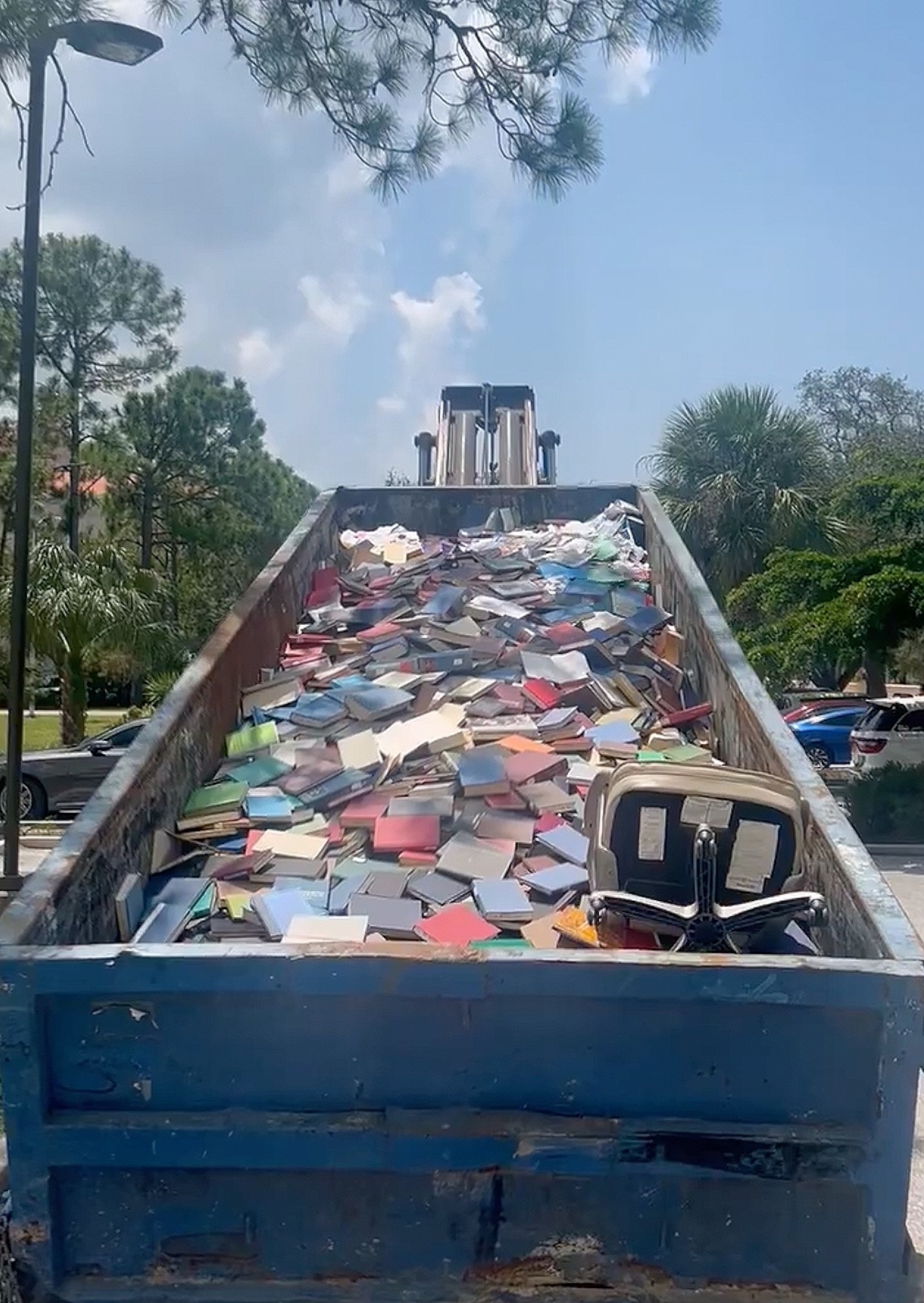
* https://abcnews.com/US/books-dumped-en-masse-floridas-new-co...
Comment by deaux 5 days ago
Gotta love how as hundreds of billions of tax dollars are being misappropriated through corruption, state university books about to be trashed can't be taken home supposedly to prevent corruption. Nothing wrong with throwing away books, but let common sense prevail and people take them home.
Down with the oligarchy.
Comment by j_w 5 days ago
Comment by giardini 4 days ago
Comment by apitman 5 days ago
Comment by anigbrowl 5 days ago
Comment by k310 3 days ago
I can't give them away.
It's enough for hundreds of "Little Free Libraries" and suppose that I built the enclosures in my shop, nobody would put up a base.
I would love to see some young person or immigrant learn some useful skills. Prison libraries wouldn't take them, unless I DELIVER them to their doorstep (or gate, I suppose). Nobody cares. That's the state our society is in now.
I am reminded of a PhD I worked with who wanted the world on a platter, but DELIVERED to him. I find this syndrome among a lot of people.
1. I want it ALL
2. I want it FREE
3. I want it NOW, and
4. I want it DELIVERED on a SILVER PLATTER.
People are just comatose. They talk about doing good, and leave it at the "listen to me" stage. I am reminded of a story by the Venerable Sangharakshita.
> From Lecture 095 "The Universal Perspective of Mahayana Buddhism" by Sangharakshita:
> Let's suppose that there is a great famine somewhere - the sort of terrible famine that you still get even now sometimes in India. There's no food. Everybody is starving. Everybody is gaunt, famished, skeleton-like. And there's terrible suffering. Now in a certain town in the country where this famine has occurred there happen to be two men who have an enormous quantity of grain, quite enough to feed all of the people. One of the men is old, the other is young. Now, what does the old man do? He puts up a notice outside his front door. And the notice reads: 'Whoever comes will be given food.'
> Now what about the young man - what does he do? The young man takes a great sack of grain on his back, and he goes from door to door distributing the grain, and when one sack becomes empty, he rushes back home and gets another one. And in this way distributes a great deal of grain all over the town. He gives the grain away to whoever asks. And he's so keen on getting the grain to the people that he doesn't mind going into the poorest and the dirtiest and the darkest of hovels. He doesn't even mind going into places where respectable people don't usually venture. Because there's only one idea in his mind, and the idea is that everybody must be fed, nobody should be allowed to starve.
Not one book should go to the landfill, and I have seen the local library do it, if there is a single person who wants to read and can't afford books.
Reminder to everyone. Get off your overused asses and share a little of your "too much and never enough" with others, with emphasis on getting separating fanny from couch.
I'll just keep trying.
WHY DO I LOVE BOOKS?
My Dad used to read books to my brother and me. I learned to read from those books. I gave them to my young daughter. In 1999, I lost both parents, and while I was paying my last respects to Mom, my wife (now ex-wife) asked my daughter if she was reading those "old" books (First editions, mostly, by Thornton Burgess, of "Mother West Wind" fame.) My daughter, being very young, said no, so off they all went to the Goodwill, behind my back, not thinking at all that a young kid had absolutely no way of buying such books, and NOT asking if her Dad gave them to her. But Tiger Moms are like that. That was around Christmas time. Come Eastertime, I wondered where the books went, and found out. Family heirlooms gone.
In a form of compensation, I did manage to buy similar, if not identical, books at Moe's Bookstore over time, just so there wouldn't be this big hole in my life. They're on my shelves now. It's my daughter's choice whether to have kids, but at least I closed that loop.
Just because you don't value something doesn't mean that it has no value to someone else. Some people think that the world revolves around them, and don't consider what anyone else thinks, wants, needs or values.
I will find a way.
Comment by roysting 5 days ago
Comment by roysting 4 days ago
Comment by LaGrange 5 days ago
Comment by ceayo 5 days ago
Comment by LaGrange 4 days ago
Comment by SauntSolaire 5 days ago
Comment by bentley 4 days ago
Comment by WillAdams 5 days ago
>Libraries will get you through times of no money better than money will get you through times of no libraries. --- Anne Herbert
When I was very young, my father retired to a rural county in Virginia where the county library was a carrel of used paperbacks in the basement library --- for each Scholastic book order, the teacher would remove a couple of books (as well as the promotional poster which my purchases made eligible), then hand me the box and the balance of its contents.
Like the furrow's length which I grew to feel in my bones by helping a neighbor plow his garden w/ a horse, I feel that quote in my soul.
>A home without books is a body without soul. (or words to that effect) --- Marcus Tullius Cicero/G.K. Chesterton
c.f.,
>No ornament of a house can compare with books; they are constant company in a room, even when you are not reading them. --- Harriet Beecher Stowe