No leap second will be introduced at the end of June 2026
Posted by speckx 1 day ago
Comments
Comment by imglorp 1 day ago
> ... the "invisible infrastructure" of the web; balancing historical accuracy with the technical need to minimize zone fragmentation is a much more complex trade-off than it appears on the surface ...
The complexity goes up tremendously if some condition is rarely encountered: eg leap second. This means it gets pushed to a "corner case" and tested more lightly and more rarely.
At $work around 2014 we had three different hardware GPS types which we used for precision timekeeping; some chips, daughterboards, and firmware. One day a leap second arrived -- it gets broadcast to aGPS hardware a day ahead of time -- and all three implementations handled it differently. One handled it, one did something else like ignore it, and I think one even bricked itself. That situation was less than bueno.
Comment by throw0101d 1 day ago
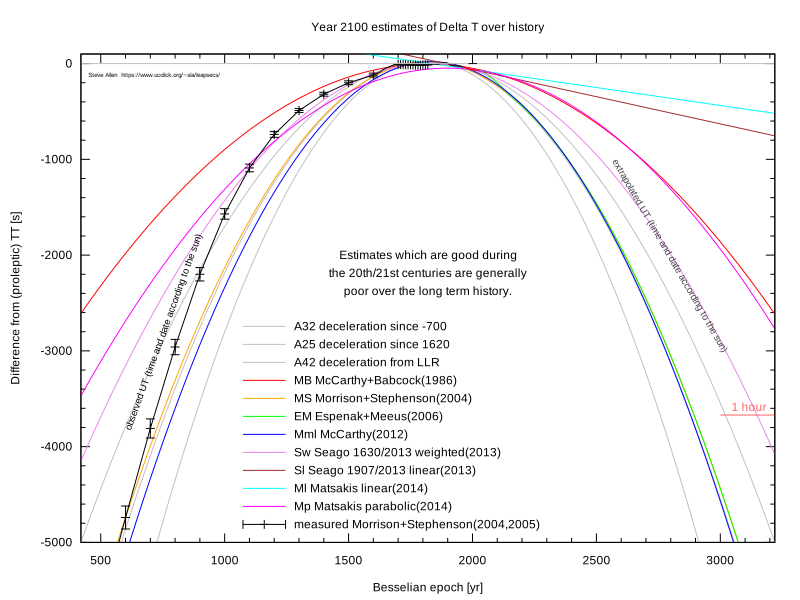
There is some talk of eliminating the leap second, which would over time have the Earth and sun diverge with regards to noon and such. One 'answer' to this concern is to have a 'leap hour' or something in the future (some future generation's problem, not ours): but given that people can't even get February 29th correct now, and it happens regularly, I don't see how a one-off event would be made to work. It'd be a huge coördination problem.
Just look at the introduction of the Gregorian calendar: it was slightly off since the time of Julius Caesar, but that minor error added up over time, to the point that to get the equinoxes/solstices back to where they 'should' be 10 days had to be removed with the Gregorian calendar. And because of politics (or a religious flavour) it took a long while for everyone to get on the same page.
Comment by michaelt 1 day ago
We've had 27 leapseconds in the last 54 years [1] - an average of 0.5 seconds per year.
At that rate, solar time will drift by 60 seconds over the course of 120 years. Drifting by 10 minutes will take 1200 years.
The leap hour will be in 7200 years, around year 9226.
Comment by throwup238 1 day ago
7200 years ago the Neolithic revolution was still in full swing and many of the most famous megaliths like Stonehenge hadn’t even been built yet. The first real state, the Sumerian civilization, hadn’t formed yet in Mesopotamia.
Personally, I’m very comfortable making this someone else’s problems 7200 years from now. If they’re still having basic coordination issues then it’s their own damn problem.
Comment by heresie-dabord 19 hours ago
Older folks at Göbekli Tepe grumbled that climate change wasn't real. As far as they were concerned, the Sumer and Indus Valley kids were playing with fire and didn't know squat. The older generation just couldn't understand the crazy architecture over in Egypt and the slangy "new wave" movement at Salisbury Plain. It always seemed that the shiftless youth there just loitered and smoked and invented new expressions to frustrate communication. And everyone could agree that no one liked their so-called music!
https://en.wikipedia.org/wiki/G%C3%B6bekli_Tepe
https://en.wikipedia.org/wiki/8.2-kiloyear_event
https://en.wikipedia.org/wiki/Sumer
https://en.wikipedia.org/wiki/Indus_Valley_Civilisation
Comment by vmilner 1 day ago
Comment by caymanjim 1 day ago
Comment by IKnowComputer 1 day ago
Comment by tadfisher 1 day ago
Comment by refulgentis 1 day ago
Comment by layer8 1 day ago
Comment by fanf2 1 day ago
Comment by Asmod4n 23 hours ago
Comment by hollerith 23 hours ago
Comment by adrian_b 20 hours ago
The dinosaurs had days with fewer hours than us.
Comment by Ekaros 20 hours ago
Now we have locked in second extremely hard underpinning all of our measurements. But you could consider that you have same number of hours in a day and length of those hours has changed...
Comment by phantom784 19 hours ago
Comment by galangalalgol 18 hours ago
Comment by WorldMaker 12 hours ago
Comment by darkwater 22 hours ago
You mean 09226, I believe. [1]
[1] https://hn.algolia.com/?dateRange=all&page=0&prefix=false&qu...
Comment by zamadatix 1 day ago
Leap hour replaces all of that with what is more or less equivalent to a change in DST rules (except for more time zones at once). DST changes don't go perfect either by any means... but we do them regularly enough without the world crashing down that doing an additional shift change of an extra hour every 5000 years is almost certainly less hassle and breakage than the leap second approach breaking things every ~2 years.
Comment by phicoh 1 day ago
Comment by throw0101d 1 day ago
Comment by recursivecaveat 1 day ago
Comment by amenghra 1 day ago
Comment by Palomides 1 day ago
I'm a fan but it's rare for anyone else to agree!
Comment by phicoh 21 hours ago
Comment by adrian_b 20 hours ago
As you say, what the computer should maintain internally and for communication with other computers, not with humans, is only true time and not other quantities, like the angles between Earth, Sun and stars.
Only TAI is true time, while "universal time" is an angle and "universal time coordinated" (UTC) and its derivatives are some weird hybrid quantities that can be computed from times and angles.
The conversions between true time and various kinds of official times used by humans are very complex and they should be handled in a single place, not in various places that may handle time zones and discrepancies between UTC and TAI and various other "times", e.g. UT2, UT1 etc.
Comment by Gibbon1 19 hours ago
Comment by Polizeiposaune 1 day ago
Comment by tialaramex 1 day ago
The leap seconds were an attempt to have wall clock time map to the planet's rotational angle consistently despite the problem that the planet's spin varies unpredictably.
Yes the "leap hour" is a legal fiction of course. In reality in the event anybody cares about this in the distant future they will make the kind of "drastic" changes you've probably experienced twice a year for your whole life and barely noticed... More likely because the drift is so incredibly slow they won't change anything.
Comment by throw0101c 1 day ago
* https://www.scientificamerican.com/article/leap-seconds-may-...
* https://scripps.ucsd.edu/news/global-warming-influencing-glo...
The general trend is slowing down. Apparently (?) once the day gets to be 24h+0.001sec (+1 millisecond), a leap second would occur about every 1000 days; then when it becomes 24h+0.002sec, a leap second would occur about every 500 days; when it reaches 24h+0.003sec, a leap second would occur about every year; etc.
Comment by clickety_clack 1 day ago
Comment by WorldMaker 11 hours ago
Comment by cesarb 1 day ago
A simpler solution: we already have an offset between local time and coordinated time, just change that offset. So, for instance, Brasília Time, which is currently UTC-03, would become UTC-02 or UTC-04, depending on which way the change went.
Comment by adrian_b 20 hours ago
For the time of Julius Caesar, about 3 more days would have been needed, which would have made the Christmas coincident with the Winter Solstice, and which would have made much more sense.
Comment by TurdF3rguson 1 day ago
The concern, of course, is that some universes eliminating them while others don't can puts us out of sync. This creates a wobble that could potentially throw us out of Hilbert space.
Comment by nstents 1 day ago
Comment by b112 1 day ago
Comment by wmf 1 day ago
Comment by throw0101d 1 day ago
Prescheduled.
Now tell everyone we're having one June 30, 2029, and see how things go.
Comment by wmf 1 day ago
Comment by throw0101c 1 day ago
Which is about how long it took for folks to switch from the Julian to the Gregorian calendar.
Comment by tmp10423288442 1 day ago
Comment by wmf 1 day ago
Comment by thaumasiotes 20 hours ago
Note that the equinoxes and solstices are officially supposed to be on the 25th. By the time of Julius Caesar, that had diverged, but the divergence in reality made no impact on the date of the official solstice. The Gregorian calendar could easily have put the solstices back on the 25th, but chose not to.
Comment by adrian_b 20 hours ago
The Gregorian calendar has not restored the time of Julius Caesar, but the time of the First Council of Nicaea (325 AD), when the rule about how to compute the date of the Easter was established.
From the time of Julius Caesar to 325 AD, more than 3 days of drift had accumulated, so the Gregorian calendar would have required 13 or 14 days of correction.
When many countries transitioned to the Gregorian calendar much later, they had to add additional correction days to the initial 10-day difference, about 1 day per century.
Comment by thaumasiotes 10 hours ago
That is false. See https://kiwihellenist.blogspot.com/2022/05/julian-calendar.h... , or "Digression #2: why do Roman writers report the date of the solstice as 25 December?" at https://kiwihellenist.blogspot.com/2015/12/christmas-and-its... .
Solstices were on the 25th a few hundred years before the time of Julius Caesar. He did not even attempt to put them back there.
Comment by euroderf 1 day ago
<rant> It won't happen on a human scale. So why oh why do we screw around with this moronic leap-second nonsense ? Oh dear, in the year 4000 noon will arrive three minutes earlier compared to now. So? </rant>
Comment by philwelch 1 day ago
“Over time” really glosses over how much time it would take. In 500 years there might be half as much divergence between solar noon and 12:00pm as we intentionally inflict on ourselves with DST, or that France and Spain inflicted on themselves in the 1940’s so they could share a time zone with Germany. By the time anyone will even notice we will probably change time systems for other reasons anyway. It’s not even remotely comparable to the Julian/Gregorian issue, which dealt with leap days. Each day has 86400 seconds.
Comment by dijit 1 day ago
The last leap-second I encountered (also the 2014 one) crashed my MySQL databases.
you wouldn't assume that it depends on time like that, because honestly why would it? "surely it's fine, NTP corrects drift of a second fairly frequently"- but a leap second is not a drift, it's something quite insane unless your primitives are solid. Nobody would test for this.
Comment by imglorp 1 day ago
I wonder if all NTP implementations don't follow those guarantees?
Oh and another app that hates clock jumps used to be sshd; it would just bail out and drop all connections. We found that out while chasing ANOTHER bug in SunOS on a T4: they didn't have it mutexed right so it possible to read its RTC register while it was in the middle of getting updated so the client would read a garbage time. We chased NTP for a week before realizing it was the kernel.
Comment by leni536 1 day ago
It's not like we wound back by 24 hours on leap days, that would be insanity. So in addition of leapseconds being a rare problem, it's also handled in a uniquely bad way.
Comment by 5-0 1 day ago
This makes sense for timestamps in traditional logs. You don't have to second guess the order of things, especially across multiple systems or services.
Comment by leni536 22 hours ago
I know we just get a 60th second in a minute. What unix and NTP timestamps do (or originally did) was repeating a second. Then we got other hacks to keep monotonicity, like smearing. Not without tradeoffs.
Comment by nineteen999 7 hours ago
Comment by zombot 23 hours ago
Comment by Ozzie_osman 23 hours ago
A restart fixed everything.
It wasn't just our site that went down. If I recall correctly, many other large sites (like Reddit, LinkedIn, etc) also had the same issue. Guess no one thought of the "did you try restarting it?"
Comment by darkwater 22 hours ago
Comment by rwky 20 hours ago
Comment by rausr 23 hours ago
Comment by fuoqi 1 day ago
[0]: https://en.wikipedia.org/wiki/International_Atomic_Time
Comment by theamk 1 day ago
We convert timestamps to and from date+times all the time. Having each day be exactly 86400 seconds simplifies this a lot, and practically every app benefits from that. Leap second smearing will ensure smooth and continious time.
Taking leap seconds into account is only needed in a very, very few contexts - maybe astronomy, or certain kinds of high-speed physics? Those rare users should be able to figure stuff out.
Go with UTC, don't optimize for rare usecases at the expense of everyone else.
Comment by deepsun 23 hours ago
Comment by theamk 18 hours ago
How is this achieved - no leap seconds, smeared leap seconds, hard time jump every few thousands years - does not really matter.
Comment by bloppe 14 hours ago
This is never going to happen. If handling 1 leap second every year or two is so hard and destructive, imagine the anxiety of introducing 30 all at once after 100 years of complacent software development with very few people alive who even remember the last adjustment. Of course our children will just say "screw that".
TAI always has 86400-second days. UTC can have 86401 (or 86399 theoretically, but that's never happened in practice). Eliminating leap seconds from UTC is so dumb because TAI already exists and is basically just UTC but without leap seconds. But, for some reason, the BIPM would rather allow UTC to drift from UT1, but it will always have the ~40 historical historical leap seconds that have already occurred. It will become a strictly weirder version of TAI.
I predict that in hundreds of years, as UTC-UT1 reaches several minutes, people will start talking about inventing a "new" time keeping standard with leap seconds to stay in sync with the Earth, and shift to using that for civil time keeping instead of drifty UTC. Then we'll finally be where we should have been the whole time: effectively using TAI as the source of truth, and converting to civil time by introducing leap seconds (but the new "TAI" will be weirder than the old TAI, which we should've just been using the whole time).
Comment by klausa 1 day ago
Making an assumption that a day 86400 seconds breaks at least twice a year in many parts of the world, and that's before we introduce leap seconds or possibility of your code running on hardware that itself travels across timezones.
Comment by deepsun 23 hours ago
Comment by klausa 22 hours ago
So you have to do the conversion at some point _anyway_.
If your app presents me data making the assumption that _my_ day is always 86400s, it will be _wrong_.
Comment by bloppe 13 hours ago
Technically, nobody lives in "UTC". You might say people live in UTC+0, which is a standard time zone around the prime meridian. UTC refers to the system of standard time zones, not a single time zone, but in common speech "UTC" is often understood to mean UTC+0.
Let's say you live in California. During the winter, you observe PST ("standard time"), which is UTC-8. During the summer, you probably observe PDT ("daylight time"), which is UTC-7. Switching between the two is sort of outside the scope of the UTC system. It happens locally and is subject to local social and political preferences. Digital clocks mostly just keep track of standard time and possibly adjust their output if presenting a human-readable timestamp string.
Leap seconds are very much inside the scope of UTC. A leap second occurs globally for every standard time zone at the exact same global instant. It's determined by an objective criterion based on UT1.
Comment by johnisgood 21 hours ago
Comment by klausa 19 hours ago
Because you need TZ awareness to implement that in a way that most humans expect.
Comment by bloppe 13 hours ago
There are 2 common ways to represent time: something akin to Unix time, which is just a scalar number representing the offset from some global reference instant (the epoch), or as "clock-calendar parameters" i.e. year-month-day-hour-minute-second. It's much more natural for software to operate entirely on the former representation right up to the point that the timestamps need to be either displayed as an output string for a human to read, or parsed from an input string from a human. Then you crack open tzdata [1] to do the conversion.
Comment by klausa 13 hours ago
Comment by fuoqi 1 day ago
>We convert timestamps to and from date+times all the time.
If you do not account for time zones during this conversion, then you are not qualified to implement such conversions.
It's fine to use 86400 seconds for durations (e.g. "this computation will finish in 1d 8h 20m 34s"), but it's absolutely not fine to use it while dealing with datetimes.
[0]: https://en.wikipedia.org/wiki/Leap_second#Phase-out_and_futu...
Comment by bloppe 13 hours ago
Comment by krick 20 hours ago
Now, if I cannot really add a month anymore (and I cannot in TAI, because months don't even really exist in TAI, since TAI isn't a solar year) in my internal time format, all that convenience goes away. I now must always worry about leap seconds and timezones and all the stuff I don't really need to think about in the vast majority of cases.
…Yeah, well, I'm really not sure. I am not convinced, and am honestly kinda relieved by the fact I won't have to find out. But it's an interesting point nevertheless. And, no, UTC w/o leap seconds is not the same thing. In fact, UTC w/o leap seconds is kinda the polar opposite: it's clearly the wrong abstraction, because it ignores the (not even so hard) problem somebody doesn't want to deal with, which doesn't really go away, but is very practical.
Comment by bloppe 13 hours ago
Unless there's a leap second in that month. Then it would be 13:59. Maybe you don't care, but some people do. It could have legal or technical ramifications.
> Now, if I cannot really add a month anymore (and I cannot in TAI, because months don't even really exist in TAI, since TAI isn't a solar year).
What do you mean by month? Calendar months are obviously irregular (thanks February). "30 days" makes perfect sense in TAI. Indeed, 14:00 today + 30 days would always be 14:00 in TAI.
Comment by rappatic 1 day ago
Comment by MarsIronPI 1 day ago
Comment by wanhandle 1 day ago
Turns out the JVM simply lost its mind when leap seconds were introduced. So, for the next several years, we watched that French society's website that announced when leap seconds would be introduced and scheduled application restarts accordingly.
Comment by wlkr 1 day ago
Comment by anotherpaulg 1 day ago
I have read numerous explanations, but haven't found a really authoritative discussion.
Comment by pinkmuffinere 1 day ago
> In 2021, it was reported that Earth was spinning faster in 2020 and experienced the 28 shortest days since 1960, each of which lasted less than 86399.999 seconds.[24] This caused engineers worldwide to discuss a negative leap second and other possible timekeeping measures, some of which could eliminate leap seconds.[25] The shortest day ever recorded was 29 June 2022, at 1.59 milliseconds less than 24 hours.[26] In a 2024 paper published in Nature, Duncan Agnew of the Scripps Institution of Oceanography projects that the water from increasing ice cap melting will migrate to the equator and thus cause the rate of rotation to slow down again.[26]
Comment by butILoveLife 1 day ago
That said, no one wants to admit it, so contemporary science follows Falsification, where we find ways to not actually make claims about reality. (Which as an Instrumentalist/pragmatist, I love Karl Popper, its just not metaphysical truth. And that would break Popper's heart)
Comment by riskassessment 1 day ago
I'd argue the opposite is true for anyone who has studied statistics which is largely built on Instrumentalism (think George Box: 'All models are wrong, but some are useful') and Popperian falsification (Null Hypothesis testing). We are absolutely taught to treat models as predictive tools rather than metaphysical truths.
Comment by butILoveLife 1 day ago
And taking fluid dynamics, we used renyolds number, which is a made up ratio that helps for decision making... Its not like when we answered questions, we could answer the grey area we are discussing.
If I had to guess, I think its due to western civilization being built of Platonism (and even Aristotle was infected). Our science and morality is later built by platonic realism. Only in the last 100-ish years are we starting to get over it.
Comment by exac 1 day ago
I can see how someone could misunderstand or forget what they're taught though.
Comment by butILoveLife 1 day ago
Comment by voxl 1 day ago
Comment by butILoveLife 1 day ago
I think it matters. No the planets are not doing circles around the sun. Circles don't actually exist, they are doing elipses.
Also 'real' has quite a few meanings. If I ask the question 'Are you closer to a keyboard or the gym?' does that question exist?
This kind of stuff does end up mattering. It becomes much more noticeable in psychology (and biology). If you read Freud, Adler, or Jung, you will say 'Oh extrovert! I've seen that before!' But then you realize its vague and almost always true. Its like a horoscope.
So if we think there is a truth to reality, we look for perfect relations. If we think its impossible for humans to figure out, we look for best fits.
Comment by arwineap 1 day ago
Comment by Vvector 1 day ago
Where I live, high noon today occurs at 1:03 PM. No one is complaining that it is 3 minutes (or 63 minutes) off. It's a non-issue for 99.9% of the population.
Comment by coldpie 1 day ago
But I do think there is a valid argument that the infrequency of these events cause more issues than maybe one large adjustment 500 years from now would cause. Not sure where I land on this one.
Comment by 8fingerlouie 1 day ago
Thanks for making me a decade younger :)
Comment by Vvector 1 day ago
For 99% of the world today, high noon =/= 12:00:00. Nothing breaks because of this. The world continues to run.
Comment by al_borland 23 hours ago
I was told the sun would show up on the calendar in the floor at noon. As noon approached, I saw nothing. Then I figured it probably needed to be solar noon, so had to look that up and wait around until that time. Today, that will be 12:20pm.
Nothing would have broken had I missed this, and nothing of critical importance is running on a solar clock (I don’t think), but it still led to a discrepancy in what was expected and where I needed to be when, based on drift from solar noon.
Comment by ralferoo 1 day ago
Comment by coldpie 1 day ago
Is that true? Per Wikipedia:
> Since [1972], 27 leap seconds have been added to UTC, with the most recent occurring on December 31, 2016. All have so far been positive leap seconds, adding a second to a UTC day; while a negative leap second is theoretically possible, it has not yet occurred.
Either way, it's due in part to Earth's rotation slowing down, so the average drift would still be non-zero.
Comment by ralferoo 1 day ago
The time period of the Earth fluctuates a lot [0] and actually in 2020 it was less than 24 hours, but not a large enough change to warrant a negative leap second. If you go back to the 1940s, we would had needed negative leap seconds if we had leap seconds at all then, and going back 150 years we would have needed multiple negative leap seconds every year for several consecutive years.
What we can say is that on average, it is close enough to 24 hours and the average over hundreds of years is even closer to 24 hours that it's not worth adding these extra seconds as you'd then need to remove them again later on.
[0] https://c.tadst.com/gfx/900x506/graphlength-of-day.png from https://www.timeanddate.com/time/negative-leap-second.html

Comment by zarzavat 1 day ago
Comment by philwelch 1 day ago
Comment by adrian_b 20 hours ago
Astronomers need either true time, which is TAI, to be used in computing the positions of celestial bodies, and they need for observations the so-called Sidereal Time, which is not a time but the angle between a coordinate system attached to the Earth and an inertial system of coordinates attached to distant celestial objects that have negligible angular movement (in the past those were distant stars, now they are distant galaxies or quasars).
The Sidereal Time can be computed in a complex way from TAI, because it is determined by the periodic rotation and precession of the Earth and by various superposed periodic or random movements.
The UTC is not adjusted to match the current true rotation angle of the Earth, which you can measure by looking up to the stars, but it is adjusted to match within 1 second a fictitious angle that would be the rotation angle of the Earth-Sun direction corresponding to an Earth that would rotate uniformly both around itself and around the Sun, so that the duration of a day would have been constant.
In reality, the duration of a Solar day, i.e. the time between 2 consecutive noons, varies a lot during the year, by a large fraction of an hour (by about a half of hour peak-to-peak), so using UTC directly for estimating the position of the Sun gives a very big error, of many minutes of hour.
So what you need for astronomy is to know the current TAI and you need a Sidereal Time calculator, which you need for knowing in what direction to point your telescope, to find a given celestial object.
UTC cannot be used directly in astronomy, but only after passing either explicitly or implicitly through TAI. The fact that astronomical almanacs are published using UTC in their tables is obfuscating this, because the values in the tables have not been computed using UTC, but everything has been converted to UTC to match the time that is presumably shown by the watch or clock that the almanac user may have.
Comment by edgsousa 19 hours ago
https://rin.org.uk/news/624222/Leap-Seconds-To-Be-Phased-Out...
Comment by r2vcap 18 hours ago
Before modern standardization, maintaining calendars and clocks was typically the responsibility of states or similar authorities, often guided by astronomers. Now it seems that international organizations are effectively following the early UNIX/POSIX model, and astronomers no longer have the same authority over timekeeping.
Comment by xorcist 1 day ago
Comment by delecti 1 day ago
Compare that to removing the leap day, where the start of seasons would be noticeably affected within just a few decades. Hundreds of years ago, a pretty insignificant headache was invented which is providing constant payoffs.
Comment by vilhelm_s 1 day ago
Comment by bloak 1 day ago
Comment by paulddraper 1 day ago
And anyone that cares about the relationship of the time of day and the position of the Sun.
Granted, it's not a lot, only a minute per century.
Comment by phicoh 1 day ago
Statistically, nobody on Earth knows what UTC is. People know about their local time zone and how it related to time zones in other countries. Where the position of the sun is relative to UTC, almost nobody knows.
Comment by Vvector 1 day ago
How can people manage with noon off by minutes, yet want leap-second accuracy every 6 months?
Comment by paulddraper 1 day ago
But yes, point taken.
The counterpoint is that it costs little.
Comment by euroderf 1 day ago
Radical changes to time-related software cost little ? Stop press !
Comment by paulddraper 1 day ago
I haven't once done a single software upgrade related to leap seconds.
Comment by 8fingerlouie 1 day ago
Comment by sarchertech 1 day ago
Really the idea that there will enough civilizational continuity that our current timekeeping infrastructure and systems will continue unbroken for that long is insane.
Comment by al_borland 23 hours ago
We’re still using a calendar developed over 400 years ago and just making minor tweaks. Without some central global authority, change is unlikely. And even with that, it would be extraordinary disruptive.
The middle for the day, on our time keeping devices, being light outside goes all the way back to the first sundials over 3,000 years ago.
Small and regular maintenance is more realistic than expecting a complete overhaul of timekeeping at some point when are lack of maintenance becomes so problematic that the whole system needs to be thrown away.
Comment by fuoqi 19 hours ago
Most of the world is perfectly fine with 12:00 not being synchronized with high noon [0]. And some jurisdictions still semiannually f*k with it further using DST. Generously assuming the current time keeping system will survive for ~6k years (looking at the leap seconds accumulation rate for the last 50 years) we can just shift timezones by one hour.
[0]: https://64.media.tumblr.com/4a9a4613f057d3b5f17ec548e6ac06d1...

Comment by sarchertech 17 hours ago
Do you know how long that is on a civilizational scale? When we try to develop warnings for nuclear waste storage that will last that long it’s mostly impossible because we assume there will be absolutely no civilizational continuity/shared context.
Doing 20k years of regular maintenance just in case we somehow keep using the same timekeeping system is completely unhinged. Better to jump an hour in 6k years if people in 6k years decide they care.
Comment by bloppe 13 hours ago
Comment by sarchertech 11 hours ago
6,000 years ago is 1,000 years before Stonehenge.
And this isn’t about whether we use the same calendar, we’re talking about whether we have time keeping continuity down to the second. This requires infrastructure continuity and essentially no adjustments whatsoever over that time.
Comment by throw0101d 1 day ago
* https://www.npr.org/2024/03/30/1241674216/climate-change-tim...
† T23:59:58Z would have skipped/suppressed :59 and gone to T00:00:00Z.
Comment by netsharc 1 day ago
I had to look it up: https://www.timeanddate.com/time/negative-leap-second.html . In proper words, the clock ("the one humanity agrees to use) would skip 23:59:59Z.
I wonder how much chaos a minute that only has 59 seconds would cause. Measurements would be off by that missing second (e.g. a pipeline delivering fuel at 60 liters/minute would surprisingly only have 59 liters in that minute..).
Comment by wahern 1 day ago
On unix this is what CLOCK_MONOTONIC is for; for one thing, the real-time clock can be reset at any time. Technically even CLOCK_MONOTONIC could jump forward. Real-time embedded systems either provide other timing APIs, or make additional guarantees about CLOCK_MONOTONIC's behavior.
Comment by treis 1 day ago
Comment by throw0101c 1 day ago
The FreeBSD folks test(ed?) their code for these things and it works:
* https://lists.freebsd.org/pipermail/freebsd-stable/2020-Nove...
Of course third-party userland code understanding what happens is another thing.
Comment by NooneAtAll3 23 hours ago
Comment by himata4113 1 day ago
Comment by layer8 1 day ago
There was a resolution in 2022 to make a decision in or before 2035, to increase the allowable deviation from one second to a longer interval, like one minute. But that would become more frequent in the long run as well, and likely would still cause disruptions whenever it happens. Though on the other hand there would likely be a longer advance notice for it as well.
Comment by himata4113 1 day ago
Comment by alentred 1 day ago
Comment by wmf 1 day ago
Comment by himata4113 1 day ago
Comment by SeanDav 1 day ago
Comment by toast0 1 day ago
At the beginning of january and july, observe the difference between UT1 and UTC. If the difference is >= 0.6s, a leap second will be inserted at the end of june/december. Publish the results here: https://hpiers.obspm.fr/eoppc/bul/bulc
Comment by pocksuppet 1 day ago
Comment by xg15 1 day ago
Comment by treis 1 day ago
Comment by jmusall 1 day ago
Comment by idiotsecant 1 day ago
Comment by SchemaLoad 1 day ago
Comment by shablulman 1 day ago
Comment by OhNoNotAgain_99 1 day ago
Comment by unit149 1 day ago
Comment by sltr 1 day ago