When employees feel slighted, they work less
Posted by consumer451 4 days ago
Comments
Comment by pinnochio 6 hours ago
When you train a dog, you have to give a reward very soon after the desired behavior, otherwise the dog won't associate the reward with the behavior. Likewise, a manager is not going to associate a slight towards an employee with an increase in absenteeism or lower productivity that happens days and weeks later.
Comment by mejutoco 6 hours ago
Regarding dog training, one can use a placeholder for the reward. This is useful, for example, if you want to reward a dolphin jumping through a hula, because you will not be able to give the reward at that moment, but for example, you can say "yes!" or use a clicker at that moment, and give the reward later, and it will be clear what caused it.
For anyone training any animal, I recommend the book: Don't Shoot the Dog! The New Art of Teaching and Training by Karen Pryor (not affiliated in any way)
Comment by tarkin2 6 hours ago
Comment by catlifeonmars 3 hours ago
Note that GP is comparing the _managers_ motivation to a dog’s motivation, not the worker. It’s about a delayed feedback loop to the manager, who won’t connect the punishment (lower productivity) with the bad behavior (slighting the employee).
Comment by NoMoreNicksLeft 13 minutes ago
It's delayed because the employee fears further retribution still. You need some distance between yourself and the bloodthirsty dog before you can even hope to reduce your productivity, or you'll be mauled quite enthusiastically. By delaying it for days or weeks, by being out of sight when it happens, there is plausible deniability that can let them survive the attacks.
Managers do this to themselves, they punish people who would give them the quick feedback loop.
Comment by tarkin2 2 hours ago
Comment by csallen 59 minutes ago
If you ignore the specific similarities being pointed out (learning and training work similar in different mammals), and you instead focus on the most offensive differences you can think of (dogs are lesser intelligent creatures than man), then of course you can find a way to be offended.
But doing so is optional, FYI. And counterproductive to an interesting conversation as well.
Comment by catlifeonmars 1 hour ago
Comment by pinnochio 6 hours ago
Btw, the comparison was between the dog and manager, and about the association of cause and effect. Maybe you should try to read more carefully and charitably in the future.
Comment by tarkin2 5 hours ago
Yet when of the top comments used dog training to explain manager-worker relations--something that empathy and introspection could tell you was a bit off (would you feel slighted if I make our interactions analogous to an owner and dog?)--it may show, yes, such does need to be spelt out these days.
I recall the University of Manchester was teaching university students empathy.
Comment by pinnochio 5 hours ago
That aside, I completely agree with you that managers should engage in empathy and introspection. I still think it's helpful, even for those that do, to have some empirical confirmation of how strongly employees can be affected by what might seem a simple oversight to an otherwise empathetic and introspective manager. But unfortunately, callous people tend to be chosen for management, and this research is also potentially helpful in aligning their own self-interest with their employees.
Comment by njhnjhnjh 2 hours ago
Comment by t-3 4 hours ago
Comment by sudonem 3 hours ago
Comment by SkyeCA 3 hours ago
Comment by yunwal 4 hours ago
Comment by kibwen 36 minutes ago
Never met a manager in your life, I take it?
Comment by 4er_transform 4 hours ago
Comment by anonymars 3 hours ago
Comment by mejutoco 5 hours ago
Comment by realo 5 hours ago
Comment by patrickk 1 hour ago
Sociopaths often make up an unusually large percentage of the upper layers of management. They won't hesitate to step on people to get ahead, and use the typical conflict aversion of regular people to their advantage- causing drama and fights, wearing others down, and eventually getting their way because most people just want their pay cheque, not to go into battle constantly.
https://www.ribbonfarm.com/2009/10/07/the-gervais-principle-...
Comment by grayhatter 4 hours ago
American culture is unfortunately permeated with examples, and habits, and expectations around punishing the behaviors you'd want to see. I see subtle things like that all the time. So while I doubt anyone who stopped to actually think about the concrete implications of their behavior, more specifically their unconscious habits; wouldn't be able to describe how insulting people, or really, how discouraging people is likely to have a negative outcome. The catch being, most people don't stop to consider anything. Thoes who do, are exceptionally rare.
As an example, someone posted a comment providing context, and encouraging people to be curious and grow their skill set with techniques that will help them with dogs, (and yes, these do translate to humans as well.)
Which invited a negative comment from you attacking people who aren't perfect every single moment of every single day, who might benefit from a reminder that how they treat others matters. Also indirectly attacking the person you replied to.
(See what I mean about the culture of punishing the behavior, you want to see? Or did you intend to discourage curiosity?)
> Perhaps the answer is yes when we also compare a worker's motivation to a dog's motivation seemingly without irony.
You can train a human using the exact same skills you use to train a dog. Just because humans are also, in addition to those able to do a lot more, and learn in an astronomically larger set of ways, doesn't exclude the techniques that work best with dogs. You forget this at your own peril. I.e. if the way you behave wouldn't encourage the behavior you want from a dog well, it sure as hell wont encourage the behavior from a human. All humans, including you, are not that special, get over yourself. rhetorically speaking
Comment by gorgabal 4 hours ago
Depending on the context, this can traumatize a human though. This idea has been the basis for both gay conversion therapy and applied behavior analysis. The latter I have had the misfortune to directly experience myself.
Comment by grayhatter 3 hours ago
Comment by alemanek 3 hours ago
Comment by benj111 4 hours ago
The length of time between behaviour and reward/punishment is too great. So to train your manager you need to go home straight away.
Comment by 9rx 5 hours ago
Comment by dsabanin 3 hours ago
Comment by pinnochio 6 hours ago
Comment by gwbas1c 1 hour ago
I turned heel and ran in those cases. It's a bad analogy for managing people and should not be perpetuated.
Comment by amarant 1 hour ago
On a related note, I wouldn't mind being treated like a dog by someone who is up to date with modern dog training practices: instant rewards for success, no negative feedback(unless I'm being aggressive, but I think I can manage that much), and tons of belly and/or back rubs! Where do I sign?
Comment by pastel8739 1 hour ago
Comment by 9rx 24 minutes ago
Although it seems unlikely to me that anyone who is taking time off after feeling slighted is doing so as some kind of silent protest in hopes that the manager will change. I expect it is done to nurse the wound.
Comment by kingofmen 1 hour ago
Comment by kibwen 35 minutes ago
Comment by lo_zamoyski 1 hour ago
Human beings can with varying degrees of success reflect on their behavior. They can recognize how certain behaviors on their part might encourage certain responses among employees. More importantly, however, they can recognize which behaviors on their part are simply not good in the first place and learn to behave as they should. It's not a question of aligning domino tiles so they fall over a certain way. First and foremost, it's a question of justice and benevolence. Be just and be benevolent, not a domino-aligning psychopath.
Comment by andsoitis 4 hours ago
if someone is going to feel slighted and similar things add up to them working less, they probably are not a great colleague to begin with.
What matters more are: assignment to rewarding work, get paid top dollar, not be bored, get recognition for success, coaching on career growth, given leeway to make mistakes, not overlooked for promotion, etc.
Now, as a people manager, if you're not steering those kinds of things, you are not a great manager and you should be replaced with someone who does those things.
Comment by dghlsakjg 2 hours ago
People don’t care about the birthday card. They care when the manager does something nice for everyone but them.
Nobody cares about a pizza party, they care that the manager didn’t think to save any pizza for the team that had to do an emergency call out to a client site during lunch.
Comment by SkyeCA 3 hours ago
A late birthday recognition might not feel important, but if one already feels like management doesn't care about them? I can easily seeing that as a confirmation of it that causes resentment. I can also see it doing the same for any number of management related issues.
I can tell you personally that the action which most seriously affected my performance at a workplace was being denied a bereavement day because the official policy was to only allow one. I felt more than slighted and every single negative action taken afterwards by HR/management, no matter how small, caused me to resent them more.
Comment by anon7725 1 hour ago
One of the things I remember most from my career was a manager "rules lawyering" about bereavement leave when my aunt passed away. Ironically, HR was very sympathetic and accommodating, and it was a non-issue with them.
I've been treated "worse" by jackass execs and managers, but always in the context of work. Someone acting in the way this manager did about a personal situation sticks with me much more than those.
Comment by hinkley 43 minutes ago
I told her to go and we’d sort out her work situation when she or we got back.
It kinda came out of the blue so we didn’t have time to hypothetically it out so we could just operate on autopilot.
Since then I’ve had bosses who heard of a death/critical illness in the family just say, “Go.” No discussion or details needed. Just go. Because being petty or precious about the whole thing just makes you public enemy. And when clever people work for you they don’t always come at you straight on. They come at you sideways and you don’t even know it’s revenge. They just passive aggressively let something slide that made your life miserable.
Comment by andsoitis 2 hours ago
I think when setting up policy like this you have two choices:
a) have a fixed number of days --> fair, objective
b) allow it to the manager to use their judgement --> variance across company
The former has the tradeoff that you experienced.
Comment by nasmorn 2 hours ago
Comment by em-bee 3 hours ago
Comment by ok123456 58 minutes ago
If your actual friends or family want to do something, that's fine. But mandatory birthday card signings and having your workplace surprise "decorated" with stuff for a children's birthday party (that gets taken down and reused for the next office birthday) is grim, impersonal, and infantilizing. Nothing at all would be better.
Comment by Sharlin 3 hours ago
Comment by darth_avocado 2 hours ago
Comment by zemvpferreira 1 hour ago
Comment by vohk 48 minutes ago
If you've spent time struggling to make ends meet, even median income can feel like previously unimaginable wealth and security, and workplace satisfaction is rarely something that you had a great deal of choice around. If you've spent most of a decade making six figures with benefits, it's easier to decide an extra 10k or even 50k isn't worth the added stress.
Cost of living and personal situation (dual incomes, dependents) can shift that needle around quite a lot too.
Comment by hirvi74 48 minutes ago
How likely is one to find all of the above in a job? My current job is essentially the opposite of all of those items. Though, believe it or not, it's not a bad place to work. Just very old school and non-tech focused.
Comment by alephnerd 4 hours ago
If I find out that management is being adversarial to ICs (eg. not offering to pay 75th percentile salaries, giving crap equity offers) I've put pressure to let heads roll. Similarly, if I've seen ICs become adversarial (eg. quiet quitting, overemployed, ignoring brutally honest conversations to upskill, constantly undermining product roadmaps) I've often allowed heads to roll as well.
At least in the Bay Area, the "Netflix Model" has become the norm post-COVID - pay top dollar, but also be open to fire if interests do not align.
What I've noticed in my career as an IC and management is a lot of lower-mid level management are people who were promoted well beyond where their capabilities. To be brutally honest, the stereotypical snarky HNer who is promoted to Staff Eng with an option to become an EM is the worst hire in any organization.
Comment by Aurornis 4 hours ago
I find this funny because it suggests an equilibrium point where 75% of management must be adversarial by definition.
Adversarial is a loaded word. In my experience, the management I’d call most adversarial occurred at companies paying 80th to 90th percentile or higher. The attitude is that they’re paying employees enough that they need to shut up and put up with anything that comes their way. If you don’t like it, we have a list of qualified applicants who will gladly take your place in a heartbeat and won’t complain as much because those paychecks are larger than what they made at their last company.
> To be brutally honest, the stereotypical snarky HNer who is promoted to Staff Eng with an option to become an EM is the worst hire in any organization.
I think the trend where companies made Staff Eng into a pseudo-management role without reports was a mistake. It gets defended heavily by people who hold that role, but in the real world the Staff Eng people I’ve worked with who don’t really write code but float around and tell people what to do and how to do it become bad for an organization over time. It’s a trap because those people are often very valuable right after they’re promoted, but the roles where they become disconnected from writing code but retain the engineer title leads to a disconnectedness that flips toward counterproductive after a few years. It goes from having an experienced person coaching others to having someone with outdated and mostly abstract knowledge who gets to gatekeep everyone’s activities based on how things worked several years ago when they were still hands on.
Comment by alephnerd 4 hours ago
Well, yes in a way.
Criticism is expected and encouraged, but if it is done so while ignoring the 3 primary goals of a business:
1. Drive revenue growth
2. Expand TAM
3. Land strategic deals (not all customers are equal)
and is provided without a solution, you will be replaced. I don't care about prioritizing a bug fix or codebase refactor if the alternative means not being able to release feature X to help land Acme's mid 7 figure TCV deal.
The best Engineers I've worked with learnt how to merge valid engineering concerns with the top-line concerns mentioned above as well as being able to provide solutions. It's also how I was able to go from an IC to management.
If an employee thinks they know better, they can try to become a PM or start a competitor.
The bad experiences mentioned above really took off shortly before and during COVID, and this is why we are seeing the pendulum swing the opposite direction.
> I think the trend where companies made Staff Eng into a pseudo-management role without reports was a mistake. It gets defended heavily by people who hold that role, but in the real world the Staff Eng people I’ve worked with who don’t really write code but float around and tell people what to do and how to do it become bad for an organization over time.
I partially agree.
I think a Staff Eng role where it is someone who is deeply technical but helps align their team's delivery with other teams is extremely valuable (basically Staff+ as an architect role).
What I feel is the severe title inflation that arose during COVID turned "staff" into the new "senior", with too many people who floated into the role without aptitude.
Comment by njhnjhnjh 6 hours ago
Comment by educasean 4 hours ago
Comment by benj111 4 hours ago
Comment by educasean 53 minutes ago
Comment by benj111 25 minutes ago
Anyway, maturity is overrated, and sometimes A holes need to be called A holes, I haven't read the comment at issue so whether the parent deserved it is left as an exercise for the reader.
Comment by njhnjhnjh 3 hours ago
Comment by watwut 4 hours ago
Comment by pinnochio 6 hours ago
Comment by hypeatei 5 hours ago
Although, I do feel slighted when a manager acknowledges the absurdity of all the corporatisms we hear everyday then proceeds to preach them to everyone and waste time anyway. Like, please, I thought we just agreed this is all fluff.
Comment by locao 3 hours ago
Comment by throw__away7391 2 hours ago
Comment by callc 48 minutes ago
In your experience it’s not just the manager direct report relationship that’s adversarial, it’s you against the whole company for the mismatched value they place in you.
You should use that as leverage. This comes with an mindset of looking out for yourself and not any loyalty to the company (I really wish that we could all find companies loyal and nice to their employees, in reality they are few and far between).
Something along the lines of “Hey I built our product. We’re making X in profit. I deserve Y in comp. I’ll give you a week to decide. If you reject I quit and build my own product or join another company.” Obviously add some fluff to reduce harshness.
Comment by trympet 33 minutes ago
Comment by mystifyingpoi 1 hour ago
This has happened to me, but it's important to distinguish when boss is speaking for himself, and when he is just forwarding orders from above. These two cases can happen literally in the same sentence.
Comment by forinti 1 hour ago
It feels worse to know that it's just an automatic message and that the person who supposedly signed it doesn't even know who you are.
Work is just work, don't expect anything more than that.
Comment by frogperson 1 hour ago
Comment by nuancebydefault 3 hours ago
I don't see how anyone can be happy in their job if that were the default. Maybe I am naive or lucky, but I have a very goed relation with my boss, as well as with the boss above.
When that condition is not fulfilled, i definitely tend to slack off and I will eventually leave. I believe such should be the default.
Comment by catlifeonmars 3 hours ago
I’ve had great relationships with my bosses, but they’re always under pressure to extract more work from the workers. In turn, their bosses are also pressured to do the same.
So yes, it’s not the default and you and I have both been lucky.
Comment by eikenberry 53 minutes ago
Comment by trympet 23 minutes ago
Comment by andy99 1 hour ago
I think if one sees their work this way, maybe it comes true? It’s a very cynical way of looking at things.
Comment by catlifeonmars 59 minutes ago
Comment by andy99 43 minutes ago
The relationship between owners and workers has always been extractive. The adversarial relationship is built in.
Comment by catlifeonmars 18 minutes ago
Since we’re speaking anecdotally: I’ve also worked in service industry, and I have personally observed employers/managers abusing their power to elevate themselves at the expense of their employees. Does that make you reconsider? I would hazard to guess it doesn’t.
My point being that anecdotal evidence isn’t particularly useful.
> I’m not even sure it’s that common in most modern workplaces.
I don’t know what to tell you honestly. This is an incredibly naive take
Comment by margalabargala 3 hours ago
As labor becomes more skilled and less common this dynamic changes.
Comment by catlifeonmars 2 hours ago
If I consider my experience it’s clearly still in the minority, so I still consider myself fortunate.
Comment by starkparker 43 minutes ago
Comment by pessimizer 3 hours ago
I also feel that the emotional attachment to one's source of income could cause people to compromise their morality for them, as if they were family e.g. I don't think one child should be favored over another, but I'm happy when my child is favored over others.
> I believe such should be the default.
It's delusional. Your boss is trying to pay you as little as possible for as much work as possible, and you are trying to get him to pay as much as possible for as little work as possible. You've both examined your leverage and have come to a temporary accord which may change a year from now (or a day from now if you get another offer.) The relationship is adversarial. It's not a matter of opinion.
Comment by nuancebydefault 2 hours ago
Comment by aarmenaa 4 hours ago
Comment by varispeed 4 hours ago
Comment by WillAdams 6 hours ago
https://www.theglobeandmail.com/news/national/time-to-lead/h...
I have never regretted a purchase from Lee Valley, and highly recommend all of their products.
Comment by kps 5 hours ago
In ‘our’ field, HP, under founders Hewlett and Packard, ran into some trouble in 1970 and instituted a “9 day fortnight”: rather than lay anyone off, everyone took a 10% cut in pay and hours.
Comment by SoftTalker 3 hours ago
Comment by ghaff 4 hours ago
Comment by bagacrap 6 hours ago
As someone who has a 401k, I certainly hope that the CEOs of our biggest companies are more highly compensated (~competent) than the CEO of Martin's Chicken Shack.
Comment by WillAdams 5 hours ago
Comment by elzbardico 4 hours ago
Doesn’t this general climate disproportionately advantage the well connected, the insider traders?
And as a citizen of a given jurisdiction, even if you are doing great in the capital markets, is it worth the living in an increasingly enshittified society?
Comment by UK-Al05 6 hours ago
Comment by vimwizard 1 hour ago
To put things into context, I'm basically operating as an engineering consultant to the rest of our senior staff and directors across multiple teams. In larger companies, perhaps I would be an intermediate IC, but in this company I am definitely responsible for more than my ICs.
It's my fault for not holding them to it, and should have realized earlier that I'm working under management that only reacts to things immediately happening to them.
Comment by knallfrosch 6 hours ago
> The faux pas was never intentional; the managers who were late said they had other priorities.
If it's such a well known company policy and you forget that, it is not a small slight at all.
Comment by Finnucane 4 hours ago
Comment by iamflimflam1 4 hours ago
Comment by taway112233 5 hours ago
I'm really good at my job, and a few years ago i became a supervisor. But not because i was good with people, simply because i am technically competent. My company was (and still is) rather small (less than 20 on the technical side, but almost 200 overall) and there was no one else remotely apt for the job. I was always a 'cold' person, didn't care much about closeness at work, didn't cared about birthdays, company parties (people absolutely love those where i work, and the company spends a good money on it), and i had to make an effort to remind myself to say 'Good morning' to everybody, because it didn't felt necessary. While i treated everybody with the same respect i wished for myself, eventually i found that that wasn't enough. Fast forward a few years i got better at the basics, but I'm still struggling on the people aspect of it. My team's productivity is good and so is mine, everybody receives good pay and they are happy on that aspect. The only reason to why my team may not have fallen apart, is probably because we still closely interact with other people from other teams, who are way better at this.
> "An easy place to start is simply acknowledging what’s important to people outside of their jobs: birthdays, graduations, marriages, a new baby, death of a loved one, or religious observances. Doing so makes them feel valued as human beings, not just human capital."
For a long time i never considered others would find that important, not at the workplace anyway. When you don't care about that stuff yourself, caring for the sake of work feels fake and people can spot it which may backfire. Is it a case of "fake it until you make it", or just brute-force until you get better on it? I admit it is exhausting. I love my work and what i do on the technical side, and i cannot complain about the company or the pay, but i do sometimes regret accepting that offer.
Comment by reactordev 4 hours ago
You don’t have to be anyone but yourself. You don’t have to change who you are simply because you’re a manager now. You can simply continue being you. Allow those under you to be them. The hardest part of management is managing up.
Comment by peacebeard 24 minutes ago
Comment by mitchellst 43 minutes ago
People like dazzling conversation from their manager for like two weeks. Manager who will flex against their own instincts out of respect for my needs? I’ll line up behind that person every time, even if they’re a little awkward here and there.
Comment by yearolinuxdsktp 47 minutes ago
I also commend you on your concern for doing things that appear fake, because people indeed are good at spotting fakeness. And I bet they appreciate that you are not acting fake, because that’s often refreshing to see, and they probably value what you have to say more as a result, and quite likely respect you considerably because of that.
For birthdays, wish the employees a happy birthday. You don’t need to get a cake or throw a party (getting cakes for birthdays stops scaling past 10 employees). But everyone should feel a little bit special on their birthday. If you don’t feel that way on your birthday, or you grew up in a family that didn’t celebrate birthdays (e.g. in a Jehovah’s Witness cult), it can be difficult to understand why it matters. But look at it as a technical challenge: can your manager “database” of people hold a birthday field? And can you trigger a smile and a “happy birthday!” greeting on each employee’s birthday? You probably can. The risk for fakeness is quite low (so don’t get a cake and make a big deal out of it), your effort is very low, but the upside for employees is a higher feeling of you caring about them as a person.
Death of a loved one is a really important thing to be aware of. Grief fucks people up and it takes at least a year to come back for it. Grieving employees will need more time and space, and are likely to struggle more. They will come back. And they will stick around more if they felt supported. Offer them to take some time off right away and support them by making sure they can take at least a few days off right away. So if someone tells you of a death of a loved one, you must take note! There’s no good advice to give, so don’t feel pressure to give any advice. Offer condolences and acknowledge that it really sucks (“I’m so sorry for your loss, I can’t imagine how difficult it is right now”). You have to be aware of this as a people manager, because your people.
Religious observances? I’m meh on that one. You can try to develop curiosity about it if the employee talks about it. Ask them why is the observance important to them? If they don’t talk about it, I leave it. For winter time, it’s happy holidays, and done with it.
Okay, a new baby is another one that’s important because your employee will have reduced sleep or be sleep-deprived and have a whole lot of new worries. Be more forgiving with the schedule, let them leave work ad hoc for baby emergencies. You do that, they are much more likely to make up work on their own time as gratitude. Ask them how they feel they are handling the workload—-is there an opportunity to change the type of tasks they are doing? Maybe they are not in a position to be writing deep design docs while they are sleep-deprived. I don’t know, but you can check in when you do your one-on-ones.
Write down their spouse or partner’s names, and write down their children’s names. Keep it in your personal manager file. You probably don’t have people with 5+ children. It’s not a lot. It’s hard to remember. But if the employee feels like they don’t have to say “my son” or “my daughter” or “my wife”, but can just say their names to you and you know who they are, it makes them feel more comfortable and more like a human being. This is another one where it’s hard to be fake—-nobody expects you to remember these things, but it sure feels nicer if you do.
Regarding feeling like you have to fake it till you make it, it’s like picking up a new habit. You have to practice. You will get better at it. It’s part of your job as a manager.
If you find it exhausting, adopt things incrementally. What’s most exhausting? Why is it exhausting? Is it because it’s on top of everything else you’re already doing for 40 hrs a week?
As a manager, you have to care about the people, because they are human beings. It’s a part of your job. You can’t not do your job. If it means you spend less time being technical, so you can spend more time managing people as people and not feel exhausted, then that’s what it means. Push back on your manager to make room to do more people stuff and less technical stuff. You can’t spend 90% of your time being technical and 10% managing, unless you have completely self-directed staff. You’re a person too—-and if you job is to manage, you must make time for it, and if there’s not time for it, then that’s your boss’s problem. If your boss doesn’t think it’s a problem, that’s on you because you haven’t told them.
Managing engineers is like herding cats. They won’t respond to lashing. And cats don’t show that they are sick because they don’t want to show weakness. So if you don’t ask about what’s going on in their personal lives, you’ll be blind to how it’s affecting their work. And because ultimately they get paid to do work, it is therefore in your interest (and company’s interest) to not be blind to how their personal life is impacting their work.
Going back to “fake it till you make it” or brute-forcing until you get better at it—-what you’re not considering is the additional information you will get or increased personal response/appreciation from your people. It might feel like brute force at first, but consider the very real possibility that it can start feeling like a smart thing to do because of the results.
Comment by class3shock 55 minutes ago
In my professional life I have never seen people respond well to cost cutting, layoffs, understaffing, corporate bs, etc. It is always demoralizing, resulting in reduced performance and I can only imagine worse outcomes for the company overall. But despite this I have never seen a company do the opposite and respond with offering incentives for better performance. I don't know if this is industry specific (I've mostly been in defense oriented companies) but was curious.
Comment by pvtmert 49 minutes ago
I could literally write 20 page essay about every single piece of slighting, favouritism, discrimination, overstepping labour law, then trying to cover up by denial/not remembering/false pretences even fake witnesses.
But, this firstly quite lots of work, secondly the risk of them chasing me back and suing for damages is not worth it, thirdly, it will seem "unprofessional" by the managers/leadership (or future prospects) anyway.
Comment by drweevil 1 hour ago
Comment by nicbou 1 hour ago
Comment by MSFT_Edging 1 hour ago
IE a potter sees the results of his work in the pots he creates.
A worker in an assembly line sees a small aspect of the pot creation and is separated from the end result.
Many of us will understand the joy of a personal project and the lack of joy in completing an issue ticket. It's generally good for one's mental health to have some kind of purpose behind their work.
Comment by leothekim 6 hours ago
Comment by kranner 6 hours ago
Comment by aleph_minus_one 2 hours ago
The problem with such phrases is that the opinions what being a jerk means differ a lot between people.
Comment by pavel_lishin 5 hours ago
Are they even aware of the effects of their behavior?
Comment by dbshapco 4 hours ago
Then I went out into industry and watched as all these principles about managing employees effectively were ignored, or at best received lip service.
It led me to the conclusion that actually effectively managing employees to motivate better performance wasn't a priority. Not in the top ten anyway.
Most corporations and therefore managers operate using resource extraction principles. How do I extract maximum labour from this resource at lowest cost?
The 'R' in HR always bothered me, and others judging by the companies that used nomenclature like 'talent' or 'people'.
However that was whitewash. Underneath the nomenclature resource extraction continued unimpeded.
The irony being that treating people like resources is counterproductive and hurts performance.
Companies extracted the illusion of more resources, more hours, while productivity largely plateaued or decreased.
Somehow corporations expected to hire smart people, smart enough to do an intellectually challenging and technical job, and not have them do the math that the additional pay for performance generally amortized lower than the hourly rate, and that by doing more employees were actually lowering their effective hourly rate -- i.e. discounting labour for the employer.
The wag in me would observe the reason companies were so eager to portray everyone as family is that's the only model where this is marginally acceptable. Family taking advantage of family, like a family farm. Working more hours to get paid less certainly doesn't work as a business model for the employees. They'd be better off with a second salaried job -- and there were apocryphal stories about employees doing actually that, hanging up a coat on the door hook, throwing a newspaper on their desk, then leaving to go to their other job.
This is all observational and anecdotal however, but over a three decade career with a dozen plus companies, some of them Fortune N (where 20 <= N <= 500) in both contractor, IC, senior leadership and C-level roles.
Comment by stego-tech 4 hours ago
No. They will give you formal discipline for raising such concerns regardless of your professionalism in doing so and ultimately lay you off for being a squeaky wheel. Ask me how I know.
> Are they even aware of the effects of their behavior?
This is the better question to be asking, IMO. Many are aware of the effect and either don’t care or find enjoyment from it, while many more have no clue why their star worker has dropped the ball after being denied a raise or promotion three years running. There are a few who know the effects and are sympathetic, but they’re often in the position of facing similar retribution if they stand up for their workers, and so they don’t.
It’s a gruesome shit show, man.
Comment by sizzzzlerz 43 minutes ago
Comment by Lord-Jobo 6 hours ago
When they tell their base managers to crack the whip and force them to give the whole “you are not working hard enough, tighten up. Shorter lunches, clock in 5 minutes early, etc” speech to the base employees, they will absolutely feel resentment and do LESS work, not more.
For more than one reason.
A quite small few will be pushed over the edge and spend their energy trying to find a new position altogether. But the impact of losing them and having an open position for months will have a huge impact. The impact of losing even a below average worker is nearly always underestimated by uppers who see their 200+ indirects as just numbers on an HR chart. And the employees who hop jobs over bad management are usually in the top half of performance, not bottom.
Another handful of over-achievers will realize that their “extra mile” approach is clearly being ignored or not having any effect, and simply become achievers. This alone can have an impact that outweighs any potential gain from whip cracking.
The one thing that nearly all employees will do when this happens though: talk to each other and bitch about it. This will tank morale yes, but it more literally just takes a bunch of time and energy. A very large distraction from the actual work.
I’ve seen this now at several jobs in a few fields. The negative impact is so much larger than I ever would have guessed starting out.
If you want to get more work out of the same workers, you cannot use negative reinforcement. It will backfire. Positive reinforcement is not bulletproof but rarely makes things WORSE.
Manage smarter not harder.
Comment by tetha 5 hours ago
The most influential question from team lead trainings over the years has been: Do you trust your employee to want to complete the task and purpose they have, or do you need to control them? There are a few names for this, Theory X and Theory Y mainly.
And don't be snide and just say that the current economy forces you to work due to wages. A lot of people I know would just create their own creative work if they had all the money in the world. So yeah, I think if you frame a persons job and purpose in the company right, you can trust them to work. This may not work in all industries, but in tech it seems to hold.
An example where this is in my experience a good guidance: Someone starts slipping their metrics, whatever those are. Comes in late, is hard to reach remotely. Naturally they should get slapped with the book right? Nah. If you assume they want to work well, the first question should be: Why, what is going on?
In a lot of cases, there will be something going on in their private life they are struggling with. If you help them with that, or at least help them navigate work around this, you will end up with a great team member.
Like one guy on the team recently had some trouble during the last legs of building a house and needed more flexible time. We could've been strict and told him to punch it and take their entire annual vacation to manage that, even if he just needs to be able to jump away for an hour or two here and there. Instead we made sure to schedule simple work for him and have him work with a higher focus on educating his sidekicks, tracked the total time away and then booked it as 3-4 days at the end. Now it's a fun story in the teams lore they are fond of having navigated that, instead of one guy sulking about having lost all of his vacation in that nonsense.
Comment by pavel_lishin 5 hours ago
Note that there already has to be a pretty high level of trust between that employee and their manager for this to work; if I don't feel like I can trust my manager, I will absolutely keep my lips zipped about anything not directly work related.
Comment by tetha 4 hours ago
Comment by anonymars 3 hours ago
Comment by 12_throw_away 40 minutes ago
This all reminds me of a phrase that I have heard, repeatedly, in many different organizations: "We need to start working with a sense of urgency."
Aside from the complete lack of leadership (so, your plan is ... keep working, but moreso?), it's almost always insulting (all those people you've been praising for skipping vacations and working while sick, what "sense of urgency" were they missing exactly?)
Comment by javier2 6 hours ago
Comment by doubled112 5 hours ago
There’s also the problem with how useless so many are at their jobs with no way to be sure until its too late.
Comment by malfist 3 hours ago
Comment by marcosdumay 1 hour ago
Comment by greenchair 5 hours ago
Comment by drabiega 5 hours ago
Comment by marcosdumay 1 hour ago
I've seen less capable people changing from slightly productive to incredibly destructive by changing that one variable.
Comment by nasmorn 2 hours ago
Comment by sph 5 hours ago
I'd take either before the utterly dangerous "below average hard-working asshole" which tend to quickly rise to managerial positions and cause untold damage with their ineptitude.
"I distinguish four types. There are clever, hardworking, stupid, and lazy officers. Usually two characteristics are combined. Some are clever and hardworking; their place is the General Staff. The next ones are stupid and lazy; they make up 90 percent of every army and are suited to routine duties. Anyone who is both clever and lazy is qualified for the highest leadership duties, because he possesses the mental clarity and strength of nerve necessary for difficult decisions. One must beware of anyone who is both stupid and hardworking; he must not be entrusted with any responsibility because he will always only cause damage."
— Kurt von Hammerstein-Equord
Comment by tjpnz 3 hours ago
Comment by lotsofpulp 6 hours ago
The bosses with half a brain do this only when the supply of labor is increasing relative to demand for labor. The bet is that the sufficient employees won’t have a choice to find a different job, and people that fail to maintain the new pace can be replaced with newer, and maybe even cheaper employees.
Comment by serial_dev 6 hours ago
Comment by nsgi 6 hours ago
Comment by pinnochio 6 hours ago
On the other hand, I can understand feeling slighted if the manager consistently recognizes their employees' birthdays but overlooks mine.
Comment by SoftTalker 3 hours ago
Comment by t-3 4 hours ago
When I've seen people feel slighted in the workplace, it's usually due to uneven praise or criticism, or discriminatory stuff like passing over all the black workers with years of experience to promote the one white guy who's been there for 6 months.
Comment by dbcurtis 2 hours ago
Comment by eep_social 1 hour ago
Comment by dghlsakjg 3 hours ago
Comment by warkanlock 6 hours ago
Comment by jstummbillig 1 hour ago
Regardless of the analysis and without having read the study, I agree with the sentiment in the headline and it's sad agreement that matches my experience: Making employees feel not slighted works really well – for both the company and the employee. It does not require that you respect anyone, and actually often runs counter it.
Once you figure that out as an employer, I can see why you would chose to just get better at fooling and distracting people.
Comment by jacknews 6 hours ago
A quote I remember from a coleage - 'They wouldn't give me a pay rate rise, so I gave myself one, by working less hours in a day'
Comment by freehorse 6 hours ago
Comment by nizbit 3 hours ago
Comment by LightBug1 5 hours ago
It'll end up being a tick box moment in some Friday after 5 minute management training document that got completed while thinking about what to do over the weekend.
Comment by pavel_lishin 5 hours ago
Which is why people do it.
You get fired if you just stop showing up on Thursdays, but not if you start reading comics on your phone for the first hour of every workday.
Comment by Archelaos 1 hour ago
Comment by blurbleblurble 6 hours ago
Comment by petercooper 4 hours ago
Comment by mitchellst 33 minutes ago
Comment by stego-tech 4 hours ago
That said, half a century of continued slighting of employees is quickly snowballing against them. While I’d hope these studies lead to positive change in the short-term, I doubt anything will move the needle short of mass collective action.
Comment by aetherson 6 hours ago
Comment by mitchellst 30 minutes ago
How small the slight is.
How big the effect is.
Meta thing: how the slight is not the kind of thing most managers or executives, or even knowledge workers generally, would care about. (As evidenced by the software people here questioning if a birthday wish is a big deal.)
Lesson: your employees think differently than you. Get curious.
Comment by tetha 6 hours ago
If a team lead or manager spent the time to track birthdays and took time out of their day to have a 10 minute chat with someone on their birthday, they probably exhibit a number of other behaviors that could be summarized as "treating their employees as humans". That's the boss people tend to like to work with and possibly go another mile for them.
If tolerating your boss during a normal day takes 9 of your 12 spoons of energy for the day, it takes very little further push to be spiteful. At worst, they may force you to find another workplace with a better boss.
Comment by dmurray 5 hours ago
[Reads abstract]
They didn't? It's a pure observational study that one measure of sloppiness in the organisation correlates with another? What do we pay these guys for?
Comment by jampekka 4 hours ago
PNAS is kinda known for headline grabbing research with at times a bit less rigorous methodology.
https://statmodeling.stat.columbia.edu/2017/10/04/breaking-p...
> Certainly they took the time to perform a controlled experiment and assigned managers at random to deliver the birthday cards late or on time. That would be cheap to do and minimally invasive for the human subjects.
If the results are true, it would be actually quite expensive because of the drop in productivity. It could also be a bit of a nightmare to push through ethical review.
Comment by dmurray 4 hours ago
I suppose the impact on productivity isn't known in advance, and it might be that failing to receive a birthday card from a normally diligent manager costs the company more in productivity than it gains from a sloppy manager unexpectedly giving one on time.
Comment by zelphirkalt 3 hours ago
Comment by ghaff 6 hours ago
Comment by trollbridge 6 hours ago
Comment by ghaff 6 hours ago
Comment by Insanity 6 hours ago
I had multiple ICs ask me not to say public birthday wishes, as they didn’t celebrate their birthday and/or did not want the rest of the team to know.
Comment by DamonHD 6 hours ago
Comment by maxerickson 6 hours ago
Comment by -0 6 hours ago
Comment by DamonHD 6 hours ago
Luckily I'm self-funded and with good supervisors, so not a problem that I face!
Comment by serial_dev 6 hours ago
Comment by nullorempty 2 hours ago
They all want me to be on-call and carry my laptop with me. Hiking, on a beach, at a restaurant, sleeping at night – i am expected to be reachable and get on it right away.
Some international companies don't even try to schedule support according to time-zone sighting on-call efficiency and knowledge segregation.
And yet, they fücking refuse every effort developers make to focus on fixing issues leading to incidents.
They fücking need to fix their act.
Comment by fredflint 5 hours ago
Celebrating birthdays and milestones are a possible side effect of this, but these celebrations can’t take place of the power of that belief.
If you consistently smile, you can force yourself to be happier, and if you force yourself to celebrate others, that’s still a good thing. But, your team will know if you don’t believe.
You’re better off being Gary Oldman in Slow Horses (only secretly believing in the mission and with a team that all care) than just being in it for the paycheck.
I’m not saying to quit if you can’t believe, but don’t expect top productivity.
Comment by diogenescynic 4 hours ago
Comment by paradox460 2 hours ago
Eventually they promoted a few of the original engineering staff. I was told during one of these promotions cycles that I just barely missed the promotion targets. I asked for concrete metrics of what I could improve on, and was given a few vague and nebulous answers. I worked on these, even though they lacked definition. Come the next promotion cycle, I was, once again, passed up. When asked for clarification, I received more vague, nebulous answers. I was assured that I was going to get it the next round, and they'd be doing promotion cycles more than annually.
They kind of kept their word: promotions cycles started happening every 6 months. But the next cycle came through, and once again I was left behind. So this time, instead of asking for clarification, I just started looking for a new job, and handed in a letter of resignation a few weeks later. Upon handing in the letter, I was told "oh we were going to promote you next week!"
I wasn't born yesterday, so I told them thanks but no thanks.
Comment by diogenescynic 2 hours ago
This is exactly what has happened. I've had 6 different reporting structures in the 6 years I've worked there. So much leadership change and more levels to the pyramid added. I was promoted the first/only time after my first year and a half--for something that has scaled exponentially since then and I still manage individually despite other teams who co-manage the system being given 8 more employees.
>They kind of kept their word: promotions cycles started happening every 6 months. But the next cycle came through, and once again I was left behind. So this time, instead of asking for clarification, I just started looking for a new job, and handed in a letter of resignation a few weeks later. Upon handing in the letter, I was told "oh we were going to promote you next week!"
Yep, I was part of the original 3 on the team. Only one has been promoted, the other left, and I am still in the same position. Even though the promo cycle has been increased, it's no different. I am 95% sure that my manager didn't even read my self-evaluation because he specifically asked for more metrics and that's what the first bullet point of my self-evaluation had.
Comment by paradox460 2 hours ago
Comment by staindk 4 hours ago
I would heavily suggest speaking frankly about this with your manager or even going above their head if needed to ensure someone hears and acknowledges this. With your review in hand and any other additional info that can help back you up.
Ask what you need to focus on to secure a substantial Y raise/promotion and bonus etc. over the next X months and work towards that, keeping management updated as things progress. Probably have specific numbers for X and Y to mention as targets.
Comment by diogenescynic 2 hours ago
I did try that last year but it honestly went no where. I work on a financial system at a fintech company but I am on the finance side and my managers and above have never even logged into the system so they don't understand, appreciate, or really have interest in it. All they hear about are breaks in data, or some trivial error (99% caused by the bank or employee inputting a payment incorrectly, etc.) so they hear more negative feedback which I think biases them instead of them understanding that the failure rate is less than 1% and when you have 50,000 payments there's going to always be something that goes wrong--it could be as simple as the date. I implemented a change that allowed us to invest more funds and added almost 10 figures in interest income, but I'm not sure anyone but my manager even knows that. I ultimately blame my manager, he's old and useless and seems to be unmotivated to deliver anything for his direct reports.
Comment by kotaKat 6 hours ago
> "They found the perfect observational setting in the retail chain, which has a well-established policy that managers hand-deliver a card and small gift to each employee on their birthday. The company designed the policy to foster meaningful personal interactions and strengthen the employee-manager relationship"
> "The team found no issues when cards and gifts were given within a five-day window of the employee’s birthday"
Part of me wonders more now if the slight also comes from the expectation of receiving a gift under this policy? If someone told me "hey, happy birthday, dude" that'd be good enough for me.
Comment by reactordev 4 hours ago
Comment by therobots927 3 hours ago
All of the above is sarcastic for those who find it difficult to pick up on tone in text.
Comment by SilentM68 3 hours ago
Comment by aleph_minus_one 2 hours ago
What people call "social skills" is nearly always manipulating other people into liking you. People of who its is said that they "lack social skills" are often more honest and much less manipulative.
Comment by elzbardico 4 hours ago
Comment by mystraline 4 hours ago
Just like the terrible outcomes of fraud elimination indicate non-zero fraud is preferred, I can see a similar nom-zero dissatisfaction at work the same.
Except now companies can calibrate how much dissatisfaction due to terrible policies can be done in response to lower work quality, and minmax that.
Reading between the lines, the paper is how to manage dissatisfaction in relation to work and cost. In other words, "How bad can we make it for the minimum work product needed?"
Comment by jmyeet 6 hours ago
In this space you'll often hear about Dunbar's number [1] and the idea that organizations with more than about 150 people tend to break down. In larger organizations, a whole layer of middle management seems to rise up with questionable output. Like you might have no idea who your VP is. One place I worked had the VP visit once a quarter, walk aroudn and ask what people worked on and occasionally yell at them.
The military is an interesting example because it's millions of people, often in confined spaces so a whole bunch of rules have to be created so they don't kill each other, basically. And if you talk to any current or former servicemembers you'll hear stories about how not much gets done there either. Toxic leadership, lots of waiting around for nothing, bureaucracy and so on.
One can view this "research" as "be nice to your employees" but I think it's more nefarious than that. Or at least "be nice" won't be the lesson Corporate America takes from it. Instead it'll be that employees need to be even more closely monitored so they're not slacking off.
I think about what I call "organizational churn". This is where every 6 months you'll get an email saying a VP in your direct chain whom you've likely never met now reports to a different SVP under some restructure or reorganization to "align goals" or for "efficiency".
What you realize after awhile is that organizational churn only exists so nobody is every accountable for their actions or output. They're never in the same place long enough to see the consequences of their action or inaction.
But what I've thought about a lot recently in terms of organization is the Chinese Community Party. Millions of people work for the CCP. Yet it's output has been stunning. Some 40,000km of high speed train lines in 20 years for less than the US spends on the military in one year. Energy projects, metros, bridges, cities, housing, roads, ports, the list goes on.
How does the CCP avoid empire-building, institutional rot and general bureaucratic paralysis?
Comment by e3bc54b2 5 hours ago
Oh they don't! In exactly the same way US didn't. Right now, a lot of factors have put enough tailwind into Chinese economy and the inertia is a bitch to retreat, as can be seen with US itself. These tailwinds are strong enough that they lift everybody up, even considering the corruption taking its share.
Comment by zcw100 4 hours ago
Comment by bookofsleepyjoe 5 hours ago
Comment by moominpapa 59 minutes ago
Comment by metalman 3 hours ago
Comment by mystraline 3 hours ago
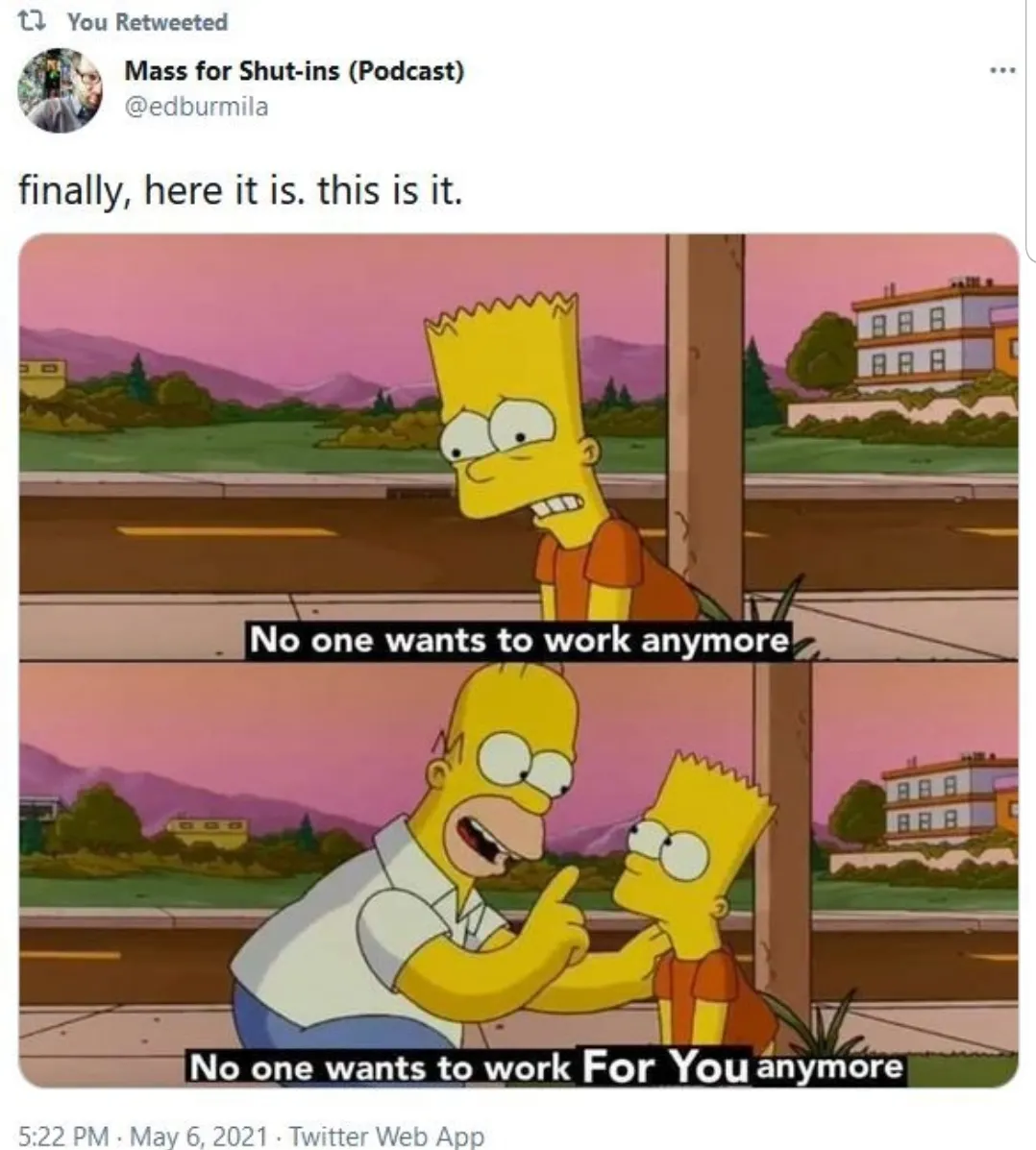
When nobody wants to work for you, that should be a strong indication that you are the problem.
And thinking that employees are "enacting vengence? in the form of vandalism from day 1."... You must be terrible indeed.
Comment by metalman 2 hours ago
Comment by mystraline 1 hour ago
The world is not out to get you, no matter how much you think it is.
Comment by billy99k 3 hours ago
Someone will feel slighted no matter how well you treat them. I blame all of the 'micro-aggression' nonsense we've seen in the last couple of years and subreddits like /r/antiwork. This sounds like just the kind of thing that's encouraged there.
"The study found that when managers at a national retail chain failed to deliver birthday greetings on time, it resulted in a 50% increase in absenteeism and a reduction of more than two working hours per month. "
Most people I know don't care about their birthday (or being recognized) to this extent. Years ago, I worked at a place that decided to celebrate everyone's birthday that week with a cake and a 10/15 minute meeting (usually multiple birthdays were celebrated at the same time). As the company grew, we were having these meetings 3-times per week.
My 6 year old would care if their birthday didn't get recognized and similarly pout all day and seek this type of 'revenge'.
I wouldn't want to work with anyone that did this.
Comment by nchmy 6 hours ago
Comment by turtlesdown11 6 hours ago
Comment by njhnjhnjh 6 hours ago
Comment by docstryder 6 hours ago
Comment by Leynos 6 hours ago
Comment by Leynos 6 hours ago
Tables from the study available here: https://www.pnas.org/action/downloadSupplement?doi=10.1073%2...