All the Way Down
Posted by surprisetalk 11 days ago
Comments
Comment by sd9 5 days ago
They’re great and cool for things you already know to be true, but they can be tricky.
Comment by bastawhiz 5 days ago
- Folding the corners of a rectangle an infinite number of times doesn't make it a circle, it just means it has an infinite number of corners.
- The folded corners always make right triangles, no matter how small they are. If you put the the non-hypotenuse legs of a right triangle against a circle, no matter how infinitely small the legs are, the corner of the legs will never touch the edge of the circle: an infinitely small triangle can't have all three points be the same point (or it's not a triangle). Which means the area of the folded rectangle will always exceed the area of the circle it's mimicking, even with infinite folds.
- As the folds become smaller and smaller, the arc of the circle (relative to the size of the triangles against it) becomes straighter and straighter. Which means each successive fold scrunches up more perimeter while becoming less and less circle-like.
Comment by derbOac 5 days ago
I.e., the perimeter doesn't approach the circumference in value because it doesn't change.
It's an interesting thing to think through though, and maybe a good point about how arguments can seem intuitive at first but be wrong. On the other hand, I'm not sure that's any more true of visual proofs than other proofs.
Comment by chemotaxis 5 days ago
There's no convergence after a finite number of steps. But at infinity, the canonical limit of this construction method is a circle. And because it is a circle, the circumference at infinity "jumps" to 2*pi. This is quite counterintuitive but perfectly legit in mathematical analysis. It's just one of many wacky properties of infinity.
Comment by JKCalhoun 5 days ago
I kind of ran into this when I was in high school and was introduced to limits.
For me the quandary was a "stair step" shape dividing a square with length of side "s" ("stairs" connecting two opposite diagonal corners). You could increase the number of steps—they get smaller—but the total rise + run of the stairs remains the same (2s). At infinity I reasoned you had a straight, diagonal line that should have been s√2 but was also still 2s in length.
At the very least you can say that the volume enclosed approached that of a right triangle (at infinity) but the perimeter stays stubbornly the same and not that of a right triangle at all.
Comment by arjie 5 days ago
Comment by sd9 5 days ago
But imagine this was a domain you weren't familiar with, you didn't know that pi != 4, you didn't know that the proof was false going into it. Could you have come up with a list of problems so quickly?
For what it's worth, I'm not sure that problems 1 and 2 are actually genuine problems with the proof. You can approximate the length of a curve with straight lines by making them successively smaller. This is the first version of calculus that students learn. Problem 3 is the crux.
Comment by bastawhiz 5 days ago
No, but if I didn't know anything about the domain, literally any proof (correct or incorrect) would seem fine. But then it's not really "proving" anything. Knowing enough for the proof to make sense but still unconditionally accepting assertions like "if you fold the corners an infinite number of times, it makes a circle" strikes me as odd.
> I'm not sure that problems 1 and 2 are actually genuine problems with the proof. You can approximate the length of a curve with straight lines by making them successively smaller.
But that's not what's happening here: the lines are straight, but you'd approximate the length of the curve with the hypotenuses, not the legs of the folds. Surely as you repeat this process you wouldn't think "wow, the circumference of this circle is actually equal to the perimeter of the original square." You'd have to disbelieve your own eyes and intuition and knowledge of circles to accept that this is true and hopefully you'd think "maybe I'm doing this wrong."
That's not to say 1 and 2 alone prove the visual proof incorrect, but they demonstrate that it is doing something wrong. Proofs that are correct don't have inconsistencies.
Comment by sd9 5 days ago
Comment by bombcar 5 days ago
Comment by bastawhiz 5 days ago
Comment by bombcar 5 days ago
Comment by ta2112 5 days ago
Comment by SoftTalker 5 days ago
Comment by evanb 5 days ago
1/3 = 1/4 + 1/16 + 1/64 + ...
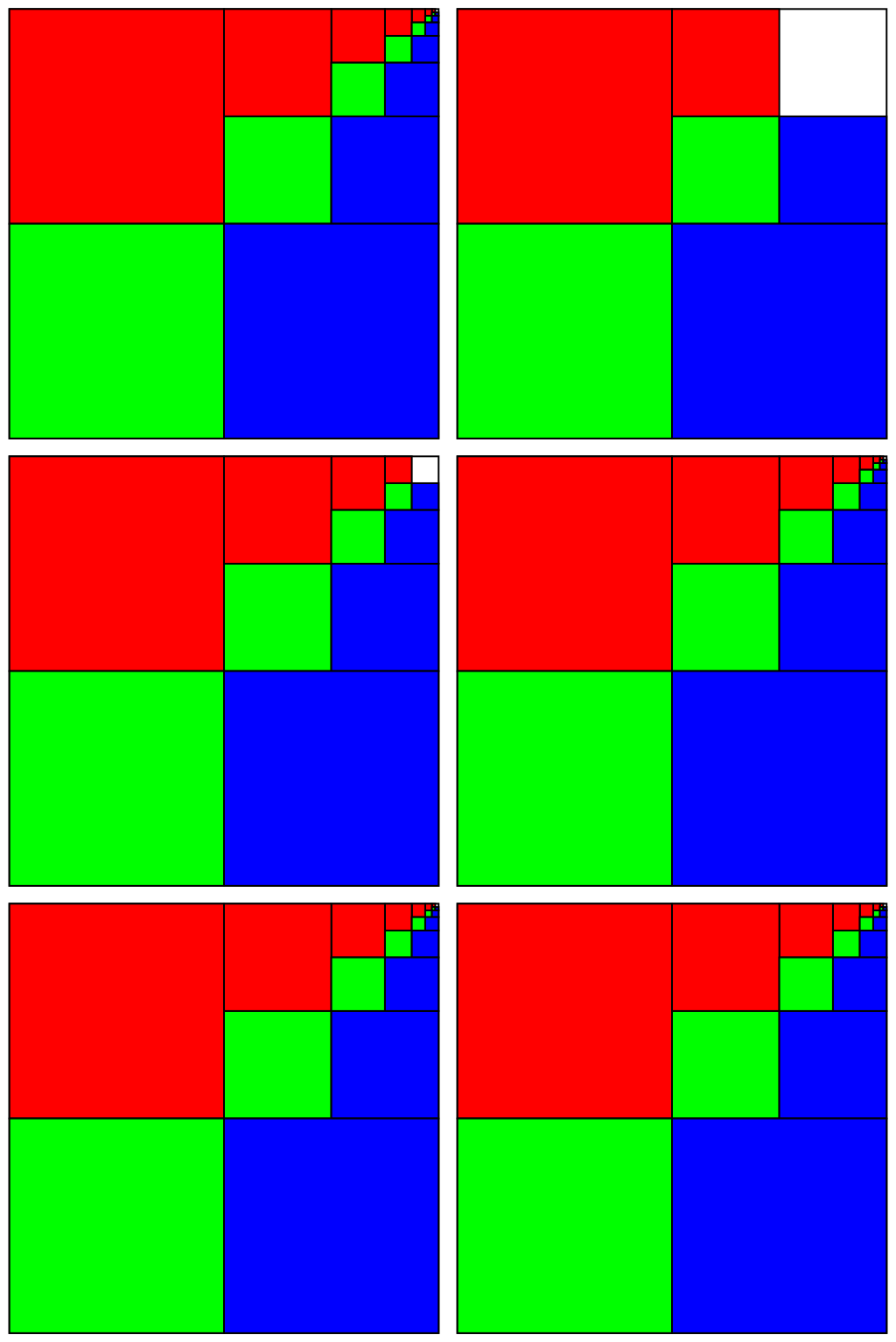
https://evanberkowitz.com/images/2014-03-15-quarters/Triangl...
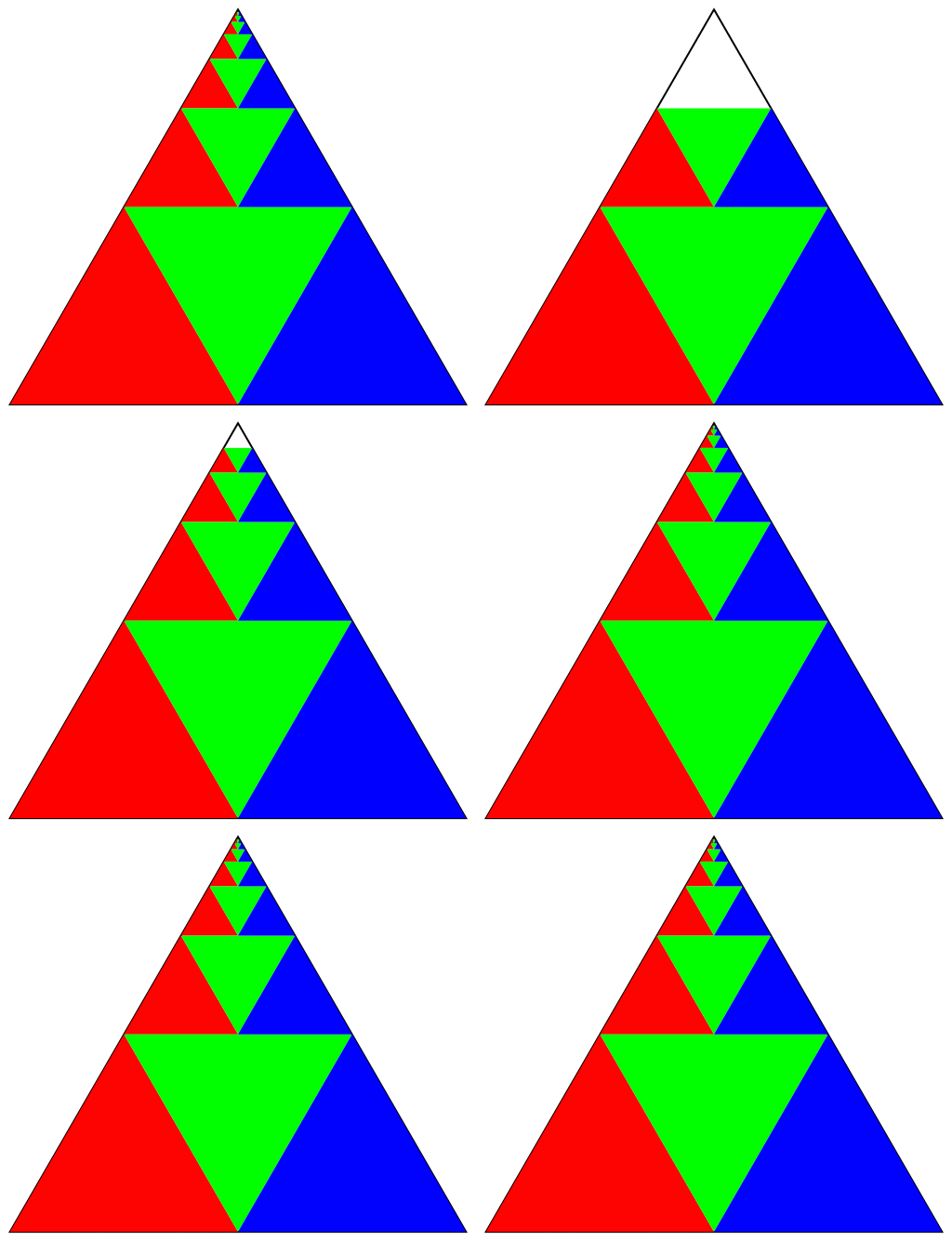
1/7 = 1/8 + 1/64 + 1/512 + ...
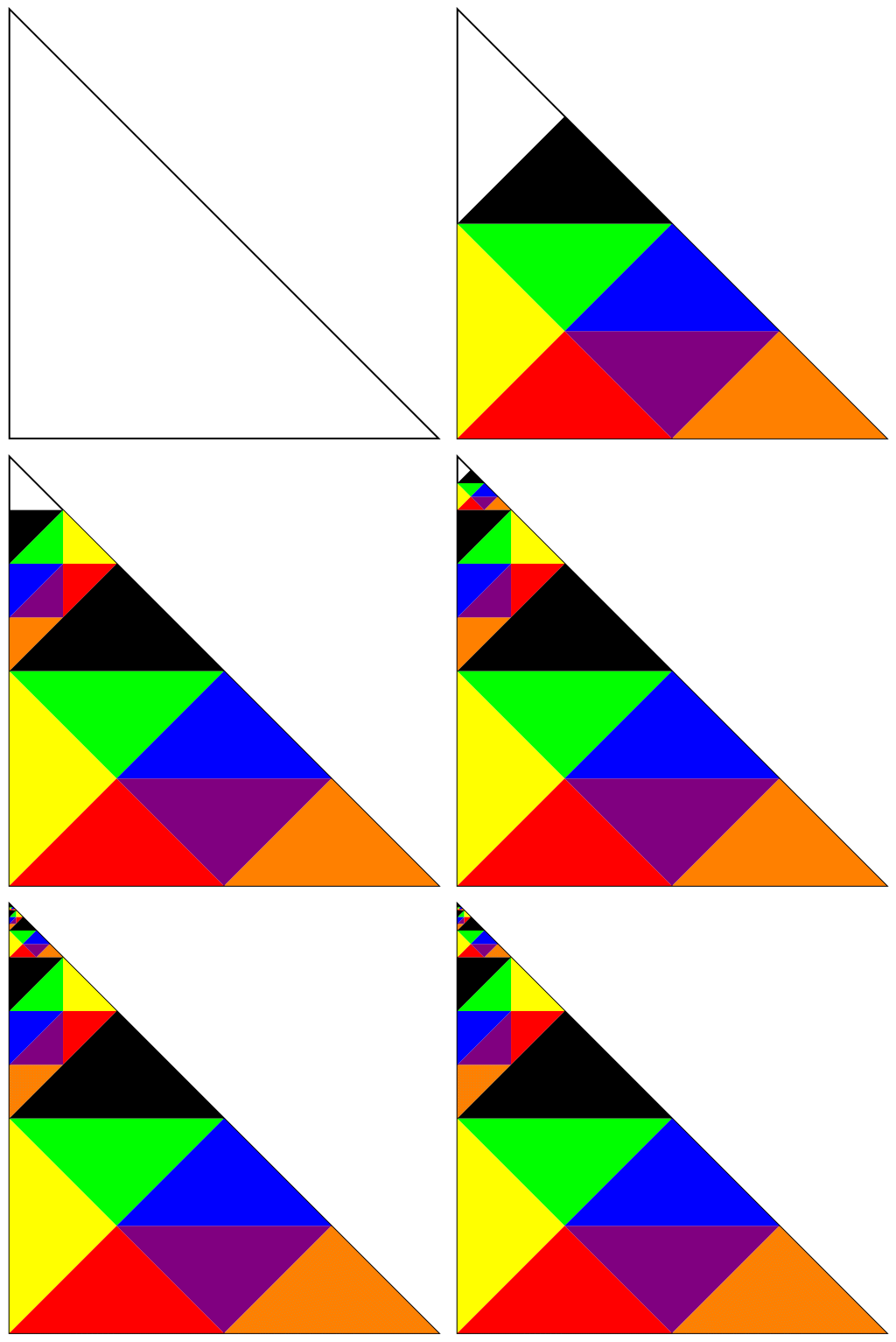
1/8 = 1/9 + 1/81 + 1/729 + ...
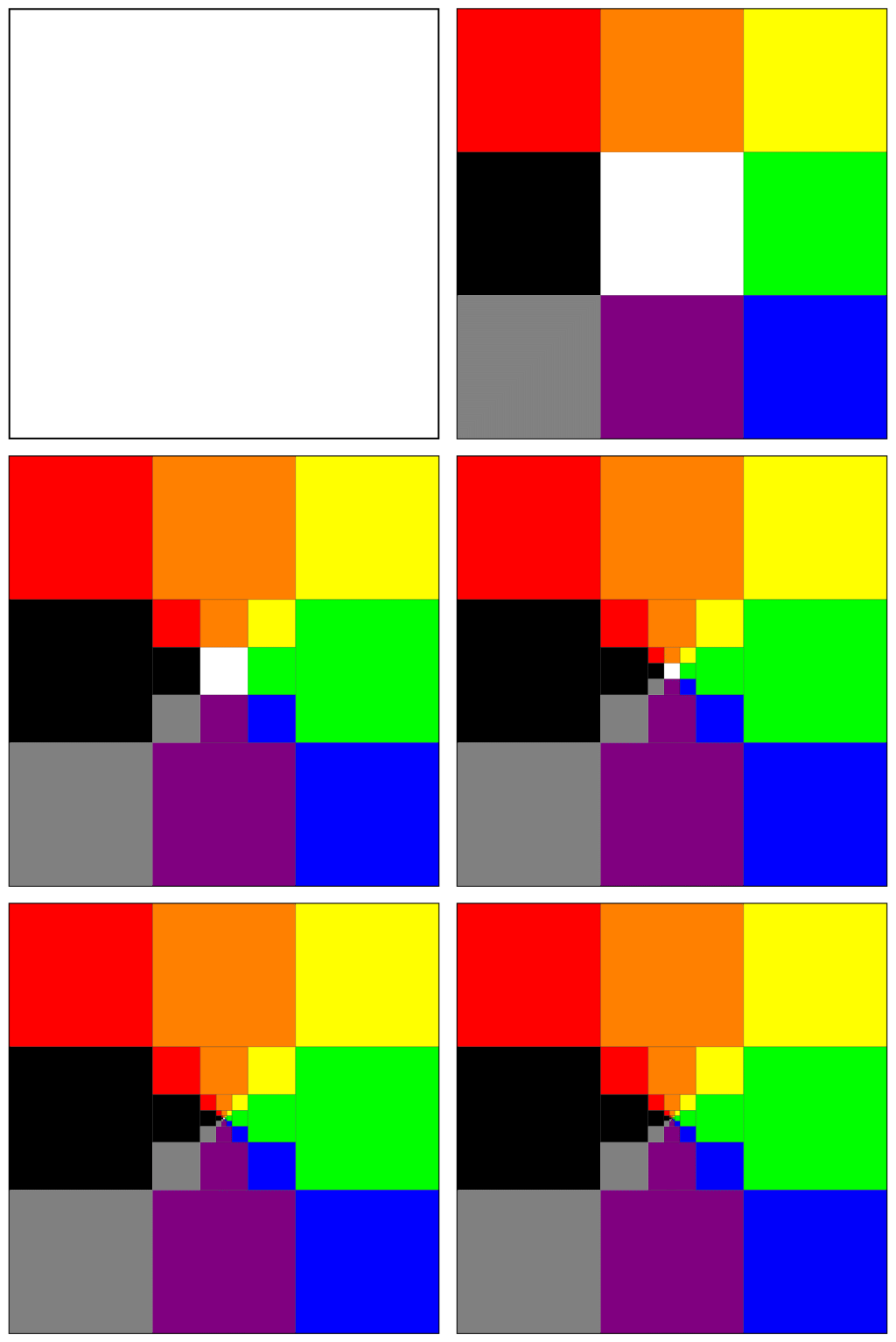
Comment by ta2112 5 days ago
Comment by zkmon 6 days ago
Comment by euroderf 6 days ago
Comment by edgineer 5 days ago
He argues/explains how evolutionary forces become dominant, with much more focus on the why. Why it has come to be that living things grow, multiply, and over time changed in ways that out-succeeded the prior ones, down to the level of DNA--and that these driving forces are manifested by individual genes.
Comment by __MatrixMan__ 6 days ago
And then I learned the theory that many cancers are caused by undiscovered DNA-based viruses which tamper with the cell cycle to activate the replicative machinery that they need to make copies of their genome (HPV does this, and several others too). So then it was a switch: not an immutable feature of the universe, but caused by an agent.
But it's starting to look like viruses emerged independently more times than expected, so maybe it is more like "the universe just does that," and viruses are just cancers with a space program. Back to where I started.
I suppose some would see these loops as unproductive. "First principles" people. Descartes, etc. But I think that unresolvable why's like this are what understanding is made of.
Comment by CGMthrowaway 5 days ago
Certainly the deeper into the why chain one can get personally, the greater understanding one has.
Comment by Sharlin 6 days ago
Comment by tenthirtyam 5 days ago
*How (or why) this step occurred is another intriguing topic.
Comment by IsTom 6 days ago
There's no force and there's no goal. These things happen because every moment is a direct consequence of the previous one.
Comment by lo_zamoyski 6 days ago
Try talking about biological operations without invoking “function”. Claiming it’s “convenient” to do so doesn’t cut it: convenient for what?
Why do acorns become oak trees? They must be causally ordered toward that end. That’s telos.
Even efficient causality presupposes telos. Why does striking a match against a matchbox consistently produce fire? Because the match has a causal ordering toward that end. Otherwise, you could not explain why fire consistently results as opposed to random things like a flock of seagulls or a BMW 7 Series…or nothing at all.
Telos is not necessarily a matter of some external purpose or Paley-style watchmaker. That’s mechanistic metaphysics appealing to a watchmaker to explain a purpose things would - under that metaphysics - inherently lack. It is a matter of causal order and directedness.
Comment by IsTom 5 days ago
If you had a strong vendetta against mistaking map for territory, you could very well talk in terms of past survival and statistics. It's just not necessary for regular biological talk. It becomes relevant only when you start going to the boundaries.
> Why does striking a match against a matchbox consistently produce fire?
Because you wouldn't call these objects a "match" and a "matchbox" otherwise.
Comment by ryandamm 5 days ago
Comment by yetihehe 6 days ago
Comment by bncndn0956 5 days ago
My grandpa explained it in layman terms which even I could understand. He said, "If nothing should exist because it is simpler state to be in for everything, a sort of Primordial Law. Then what is the mechanism by which this law is enforced. Who or what is ensuring that Law is implemented everywhere for eternity. If we assume that such a mechanism must exist, then we have just proved that something must exist."
Comment by Gormo 5 days ago
But I think a more reasonable understanding of natural laws is that they're our attempt to describe the cause-and-effect patterns observable within reality itself. They're not being enforced, they're simply manifest.
Construing "nothing can exist" as a rule that has to be enforced, and not just the absence of any patterns of causality that would produce something that exists, seems to be an error. It actually seems to be a more sophisticated version of reifying the concept of "nothing" such that "nothing exists" would be interpreted as describing the positive existence of an entity called "nothing" rather than merely describing the absence of any such entities within the context.
Comment by bncndn0956 5 days ago
A Bubble of Absolute Nothing - Sixty Symbols
Comment by epiccoleman 5 days ago
https://alwaysasking.com/why-does-anything-exist/
> In a reality containing nothing, there are no things as such — at least no material things. But in such a nothing, there is an abstract thing: zero.
> Zero reflects the number of material things to count. But how many abstract things are there to count? There is at least one. The one number that exists to define the number of material things is zero.
> But if we have one number and it is one thing to count, now another number exists: one. We then have zero and one together as the only numbers. But now we have two numbers. Now two exists…
Your grandfather's explanation seems to echo this in terms appropriate for a 10-year-old - there is something inherently unstable about nothingness.
Comment by bncndn0956 5 days ago
But your way of putting it is like these successor function could be considered as edges of graphs or references or signposts
Imagine a number system with 3 distinct types of Null Sets and they meet at number P after applying successor function for 10, 42, 135 times respectively.
Comment by bncndn0956 5 days ago
Graham Priest - "Everything and Nothing" (Robert Curtius Lecture of Excellence)
Comment by Tyrannosaur 5 days ago
Comment by rtgfhyuj 5 days ago
Comment by bncndn0956 5 days ago
Comment by dcminter 5 days ago
Comment by zkmon 5 days ago
Comment by Nevermark 5 days ago
Just because things interact doesn't mean there was a goal end state.
But, life is different. Life that survives better, out competes life that doesn't survive as well. So biology becomes incredibly fine tuned for one goal: survival.
Not survival of the individual, although that is part of it. But survival of the thing that makes the choices of how to survive. I.e. our genes. They evolve to enhance their own survival.
Which is why we care about our family more than others. Genes for caring about family have an advantage over genes that don't. Because many of our genes will also be in our other family members.
So from that perspective, each of our cells cares about doing its part to help ensure our genes survive. So it cares about itself surviving, but it also cares enough (when working properly) to sacrifice itself when it is too damaged. Because the cell doesn't last forever no matter what, but the individual it is in can pass on its genes if it sacrifices for that individual.
Comment by dcminter 4 days ago
Again, this is a category error. It works well as a metaphor, but evolution has no goal. Evolution is a description of a simple fact of the universe: things that are good at making copies of themselves become more prevalent. Hence things that become better at making copies of themselves prevail more than ones that don't.
Comment by Nevermark 3 days ago
The fact that this is a tautological drive, makes this effective goal even stronger than if it was by design. It doesn't drift. You can't change it. Even if you direct adaptations (i.e. replace natural selection with artificial selection), it still operates unswervingly. Only stopping if there is an extinction event, by happenstance or design.
Not only is survival relentlessly selected for directly, but anything that improves adaptability, repeatedly enabling more efficient downstream survival changes, is also selected for. I.e. meta-means to achieve this effective goal compound at multiple levels.
The highest meta-level, of course, being brains that know they want to survive. But that isn't some goal brains made up. It is an effective goal brains were invented for, and pre-imprinted with, as a means of better achieving it.
Anything goal-like in a living system can be explained at a low enough level by simple physics with "no goal". But if "goal" has any emergent meaning, which is to say, any meaning at all, evolution has a goal.
A tautologically emergent goal.
It isn't an overstatement to say that all other goals are either an expression of, or side effect of, that goal. I.e. curiosity, the need to avoid pain (even though statistically that sometimes motivates suicide), play (social and artifact behavioral exploration), and other seemingly flexible idiosyncratic goal generators only exist because of their statistical survival benefits.
So, THE tautologically emergent origin of, and unwavering statistical master over, all other goals.
Comment by dcminter 2 days ago
You can't have the goal without the personality trying to achieve it.
This notion that evolution has an opinion is exactly why there are a lot of companion misconceptions about it - not least of which is the notion that humans are somehow at the top of the landscape it has produced.
Comment by Nevermark 2 days ago
Actively and adaptively. With every part and behavior continuously tuned, within and across generations, to support that one outcome. Carried out by inventive means and intricate strategies. With hierarchies of structure, function and interaction. And statistically successful over all kinds of environmental challenges and variation.
"Consistently, actively and adaptively, X outcome aligned", over all other potential outcomes, is as good a phrase for "goal of X" as any.
Yes, you can narrow the definition of "goal" in any way you want, for yourself. But my use of the term is consistent with normal use of the term, and its definition. It is not a technically defined term.
If you want to argue that there is a difference between "effective goals" for things that relentlessly and adaptively pursue some outcome, but without cognitive support, vs "reflective goals", created and/or carried out cognitively, often idiosyncratically to particular individuals, I would agree.
There is also a clear distinction between artifacts without structure and function aligned for some outcome, and those that "consistently, actively and adaptively" maximize the reliability of some very specific class of outcome. And calling the latter a "goal" is reasonable.
Comment by dcminter 2 days ago
Comment by dcminter 4 days ago
Comment by MDCore 6 days ago